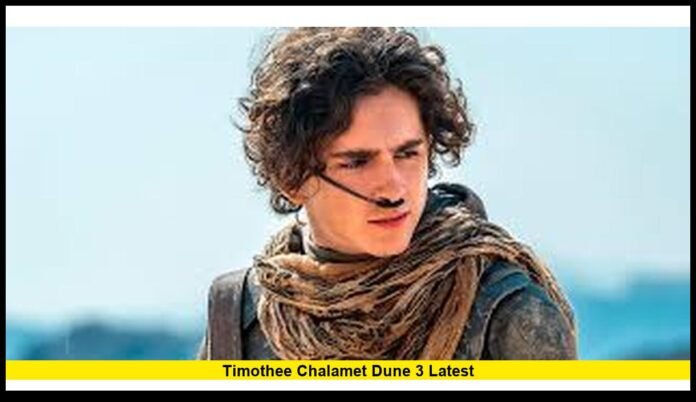

Timothee Chalamet Dune 3 has become one of the most talked-about topics in Hollywood after the worldwide success of Dune: Part Two. Director Denis Villeneuve has confirmed that he is developing a third film based on Frank Herbert’s novel Dune Messiah, continuing the story of Paul Atreides after his rise to power on Arrakis. The upcoming installment is planned as the final film in Villeneuve’s Dune trilogy.
The modern Dune franchise has redefined large-scale science fiction cinema. Stunning visuals, deep storytelling, and powerful performances turned the films into global events. Now audiences are eager to see how Paul Atreides’ rule changes the fate of the galaxy and what consequences follow the dramatic ending of the second film.
Here is a detailed look at everything currently known about the next chapter of the Dune saga.
How the Modern Dune Films Became a Global Phenomenon
The journey began in 2021 when Denis Villeneuve released Dune. The film adapted the first half of Frank Herbert’s groundbreaking 1965 novel. It introduced audiences to the harsh desert planet Arrakis and the powerful noble families fighting for control of its valuable spice.
The movie featured an ensemble cast led by Timothée Chalamet as Paul Atreides. Other major performers included Rebecca Ferguson, Oscar Isaac, Josh Brolin, Zendaya, Jason Momoa, and Javier Bardem.
Despite releasing during a challenging period for movie theaters, the film achieved major success. It earned strong global box office numbers and widespread praise for its visuals and sound design. The production later won six Academy Awards, including honors for cinematography, editing, production design, sound, visual effects, and original score.
The story continued with Dune: Part Two, which premiered in U.S. theaters on March 1, 2024. This sequel completed the narrative of Herbert’s first novel and significantly expanded the scale of the story.
The second film introduced new characters such as Princess Irulan and Feyd-Rautha Harkonnen while showing Paul’s growing influence among the Fremen people.
Key achievements of Dune: Part Two include:
- Global box office exceeding $700 million
- Strong audience demand across international markets
- High praise for performances and visual storytelling
- Expanded attention on the future of the franchise
The movie’s ending dramatically reshaped the power structure of the Dune universe, creating a clear path for the next installment.
Denis Villeneuve’s Vision for the Third Film
Director Denis Villeneuve has spent years developing a clear creative plan for the Dune series. Instead of attempting to adapt every novel written by Frank Herbert, he designed a focused cinematic trilogy.
The first two films covered the events of the original Dune novel. The third film will adapt Dune Messiah, Herbert’s second book, which was published in 1969.
Villeneuve has described this story as the natural conclusion of Paul Atreides’ journey.
Unlike the earlier films, the next chapter focuses less on large battles and more on the consequences of power. The narrative explores the political and religious impact of Paul’s rise to emperor.
Development work on the screenplay is underway, with Villeneuve continuing to shape the story before production begins.
The director has made it clear that the upcoming film represents the closing chapter of the arc he began in 2021.
Paul Atreides After the Rise to Power
Timothée Chalamet’s character undergoes one of the most dramatic transformations in modern science fiction storytelling.
At the beginning of the first film, Paul is the young heir to House Atreides. He arrives on Arrakis as part of a political assignment that quickly turns into a deadly trap.
By the end of Dune: Part Two, Paul has fully embraced his role among the Fremen and defeated his enemies. He forces the emperor to surrender control of the empire.
The next chapter examines what happens after victory.
In the story that inspires the third film, Paul rules the galaxy while facing enormous political pressure. His followers view him as a prophetic figure, and that devotion begins to reshape the entire empire.
Several themes dominate the narrative:
- The burden of absolute power
- The dangers of political and religious fanaticism
- Internal conflicts within the ruling empire
- The personal cost of fulfilling prophecy
These ideas make the upcoming story more introspective than the earlier films.
Returning Characters From the Previous Films
The Dune movies feature one of the most impressive ensemble casts in modern cinema. Many characters who survived the events of the second film remain central to the ongoing story.
Major characters connected to the continuing narrative include:
| Actor | Character |
|---|---|
| Timothée Chalamet | Paul Atreides |
| Zendaya | Chani |
| Rebecca Ferguson | Lady Jessica |
| Javier Bardem | Stilgar |
| Florence Pugh | Princess Irulan |
| Josh Brolin | Gurney Halleck |
Each of these figures represents a different political or cultural force within the Dune universe.
Chani’s relationship with Paul becomes increasingly complicated as his role changes. Stilgar remains one of the most loyal Fremen leaders. Lady Jessica continues to influence events through her connection to the Bene Gesserit order.
Princess Irulan, introduced in the second film, also plays an important role in the power structure surrounding Paul’s rule.
Why the Story of Dune Messiah Is So Important
Frank Herbert’s Dune Messiah shifts the tone of the series in surprising ways.
While the original novel focuses on revolution and survival, the sequel examines the aftermath of victory. Paul’s control of the empire creates a new set of political challenges.
Powerful groups within the galaxy begin to question his authority. At the same time, a religious movement forms around his image as a messianic leader.
These developments create a tense political environment filled with conspiracies and shifting alliances.
Instead of another large military conflict, the story centers on strategy, influence, and the dangers of unchecked power.
For filmmakers, adapting this material requires a careful balance between dramatic storytelling and philosophical depth.
Villeneuve’s previous films demonstrate his ability to handle complex ideas while maintaining cinematic intensity.
The Impact of Timothée Chalamet’s Performance
Timothée Chalamet plays one of the most complex protagonists in modern blockbuster cinema.
The actor first gained widespread attention through acclaimed dramas before taking on the massive scale of the Dune franchise. His performance helped anchor the story emotionally while the film explored vast interstellar politics.
Chalamet’s portrayal highlights the internal conflict within Paul Atreides.
Throughout the films, Paul experiences visions of possible futures. These glimpses of destiny force him to confront difficult choices about leadership and sacrifice.
The character’s evolution across the trilogy includes several distinct stages:
- Noble heir learning about responsibility
- Survivor navigating the dangerous world of Arrakis
- Warrior accepted by the Fremen culture
- Revolutionary leader challenging imperial rule
- Emperor facing the consequences of prophecy
This transformation allows the actor to explore a wide emotional range.
The next film will continue that journey by examining the pressure of ruling an empire shaped by myth and belief.
The Visual Style That Defined the Franchise
One reason the Dune films gained such strong recognition is their striking visual design.
Villeneuve worked with a creative team that focused on realism and scale. Massive desert landscapes and enormous spacecraft helped establish the sense of a vast universe.
The films rely heavily on practical sets and location filming. This approach creates a grounded look that distinguishes the series from many modern digital-heavy productions.
Several visual elements became iconic within the franchise:
- Giant sandworms emerging from the desert
- The towering architecture of imperial cities
- Ornithopter aircraft flying over Arrakis
- Vast Fremen settlements hidden among the dunes
Cinematography, sound design, and music all contribute to the immersive atmosphere.
Because the third film continues the same storyline, it is expected to maintain this distinctive style.
Why the Franchise Matters to Modern Sci-Fi
The success of the Dune series has influenced how studios approach science fiction storytelling.
For years, many studios believed that complex sci-fi narratives were difficult to translate into blockbuster entertainment. Villeneuve’s films proved that audiences will embrace thoughtful stories when filmmakers present them with ambition and visual creativity.
Several factors explain the franchise’s cultural impact:
Deep World-Building
The universe of Dune includes detailed political systems, religions, and social structures. This complexity gives the story lasting depth.
Philosophical Themes
The films explore ideas about power, leadership, destiny, and belief. These themes resonate with modern audiences.
Strong Character Arcs
Rather than focusing only on spectacle, the story follows characters as they evolve through difficult decisions.
High Production Quality
Large sets, intricate costumes, and innovative visual effects elevate the cinematic experience.
The Road Ahead for the Dune Trilogy
The success of the previous films ensured strong interest in the future of the franchise. Denis Villeneuve has stated that completing the trilogy remains a major creative goal.
The story planned for the third film provides a natural conclusion to Paul Atreides’ arc. It explores the emotional and political consequences of the revolution that reshaped the galaxy.
Fans continue to follow every update related to development, casting discussions, and production plans.
Excitement around Timothee Chalamet Dune 3 reflects the massive impact the franchise has already achieved.
The first two films demonstrated that epic science fiction can combine spectacle with meaningful storytelling. That balance created one of the most respected modern franchises in Hollywood.
As anticipation grows, audiences around the world are eager to see how Paul Atreides’ reign ultimately changes the destiny of the Dune universe.
What are your expectations for the final chapter of Paul Atreides’ journey? Share your thoughts and stay tuned for more updates as the next era of the Dune saga continues.