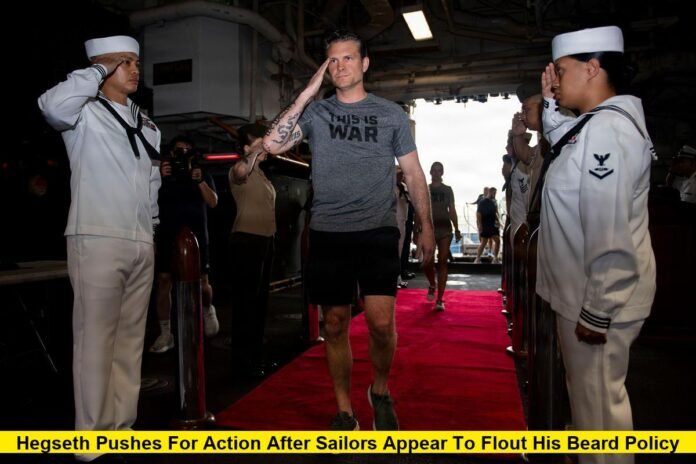

Defense Secretary Pete Hegseth is once again pressing the Pentagon to enforce his strict grooming rules, and this time the issue is personal. According to a defense official and internal emails, Hegseth pushes for action after sailors appear to flout his beard policy during a recent shipboard visit, where he reportedly noticed multiple sailors wearing beards despite his own directive restricting facial hair across the armed forces. The episode has reignited a long-running debate inside the Department of Defense over grooming standards, medical exemptions, and how aggressively commanders should discipline troops who fall out of compliance.
The incident underscores just how central the beard issue has become to Hegseth’s broader agenda of reshaping military culture. What might once have been treated as a minor uniform violation is now drawing direct attention from the secretary’s office, with Pentagon officials reportedly holding follow-up meetings to make clear that Hegseth is watching closely.
Background on Hegseth’s Beard Policy
Since taking over the Pentagon, Hegseth has made grooming and appearance standards one of the signature issues of his tenure. In September, he issued a memo tightening restrictions on beards and scaling back medical-based exemptions that allow certain troops to keep facial hair. That policy built on an earlier directive from August 2025 requiring service members to be clean shaven unless they were actively undergoing medical treatment for a condition that prevents shaving.
For years, the military had gradually become more accommodating of beards, granting thousands of medical and religious exemptions. Hegseth’s memo reversed that trend, arguing that facial hair poses a national security risk because it can interfere with the proper seal of gas masks and other protective equipment during chemical or biological threats. Critics note that the Army has previously studied this issue extensively and still approved exemptions, and that a 2018 study published in the Journal of Occupational and Environmental Hygiene found that beards of about an eighth of an inch passed the vast majority of respirator fit tests.
The rule change has been especially controversial because of its impact on service members with pseudofolliculitis barbae, commonly known as razor bumps. The condition, which occurs when shaved hair curls back into the skin, disproportionately affects Black men, with estimates suggesting roughly 60 percent may experience it at some point. Under the new policy, commanders now have the authority to separate personnel from service if they require a shaving waiver for longer than one year, even when the underlying cause is medical rather than a matter of personal preference.
The Sailors Who Sparked the Latest Crackdown
The most recent controversy stems from a shipboard visit in which Hegseth reportedly spotted several sailors with beards that appeared to violate his tightened standards. CNN could not determine precisely which visit triggered the response, though Hegseth traveled to the USS Carl Vinson in San Diego in June and the USS Boxer in Singapore in May. Whichever stop prompted his reaction, the outcome was the same: Hegseth left visibly frustrated, questioning whether the rank and file across the Pentagon and the fleet were actually paying attention to his grooming reforms and other workplace policy changes.
Shortly afterward, Pentagon officials convened a series of internal meetings to relay a clear message to subordinates — that the defense secretary was closely monitoring progress on the beard policy, along with related workplace directives, and that political appointees were pushing for faster compliance. One Pentagon official focused on civilian personnel policy wrote to colleagues that the secretary was “paying close attention” to how quickly agencies were moving on the reforms.
Pentagon spokesman Sean Parnell addressed the situation in a statement, saying Hegseth “maintains the highest expectations for our service members to uphold the professional standards of appearance, fitness, and discipline that define our warfighting force.” Parnell added that the secretary continues to emphasize consistent enforcement of hair, weight, and grooming standards across every rank, signaling that further action against noncompliant sailors is likely.
How the Navy Is Responding
The Navy has already begun tightening its own procedures to align with Hegseth’s directive. A recent Navy Administrative Message, or NAVADMIN, confirmed that the service will no longer issue permanent shaving waivers to sailors with skin conditions caused by shaving, including pseudofolliculitis barbae. Under the updated guidance, sailors experiencing skin irritation must report the issue to their supervisors and seek a medical evaluation. If treatment is recommended, a commanding officer may issue a temporary waiver allowing a beard of up to a quarter inch, but only for periods of up to 90 days at a time, and only up to four times before separation proceedings must be considered.
Recruits and those reentering the service will not be granted temporary medical shaving waivers at all under the new rules. The Navy has also directed commanders to treat willful non-compliance with uniform regulations as a matter for military justice, a notable escalation from how such violations were handled in the past. Administrative separations tied to unmanageable medical conditions are not expected to begin until July 2027, giving commands roughly a year to update local policies and train personnel on the new procedures.
Religious accommodations for facial hair are being reevaluated as well. Earlier this year, the Navy required sailors to resubmit religious accommodation requests under standardized procedures, affecting roughly a thousand existing exemptions. Under the revised rules, service members seeking a religious exemption must now submit a sworn statement affirming their beliefs, along with supporting documentation explaining how the grooming standard conflicts with their faith. Groups such as the Sikh Coalition have pushed back, arguing that accommodations already granted under previous administrations should not be subject to renewed bureaucratic scrutiny.
Broader Context Within Hegseth’s Pentagon Agenda
The beard crackdown fits into a wider pattern of change Hegseth has pursued since arriving at the Pentagon, including revisions to Equal Employment Opportunity procedures for civilian personnel. Those reforms require workplace complaints to be resolved more quickly and establish a presumption of innocence for those accused of misconduct unless evidence indicates otherwise. Katherine Kuzminski, a scholar at the Center for a New American Security, has said the EEO changes could address long-standing delays in the complaint process, though she noted that both complainants and the accused face real consequences when cases drag on.
Hegseth has also brought Christian prayer services into the Pentagon and has threatened to sever ties with Scouting America over policies he has criticized as overly progressive. Taken together, these moves reflect an effort by the 46-year-old Iraq War veteran to reassert what he considers traditional standards of discipline, appearance, and conduct across the Department of Defense. Facial hair, more than perhaps any other single issue, has become the most visible symbol of that broader push.
Public Reaction and Ongoing Debate
The renewed attention to beards has drawn criticism from advocacy groups and some medical professionals who argue that the policy fails to adequately account for legitimate health conditions. Critics have specifically pointed to the disproportionate impact on Black service members who suffer from pseudofolliculitis barbae, warning that the rules could create an environment where affected troops face greater scrutiny or harassment from senior enlisted personnel. Some dermatologists with military experience have also disputed the underlying justification tied to gas mask safety, calling those claims unsubstantiated given more recent research on respirator fit.
At the same time, supporters of the policy argue that uniform grooming standards are essential to unit discipline, safety, and operational readiness, particularly for sailors who may need to don protective breathing equipment in hazardous environments. The debate is likely to continue as more commands begin enforcing the tightened rules and as affected service members navigate the new waiver and separation timelines.
Final Thoughts
The fact that Hegseth pushes for action after sailors appear to flout his beard policy shows just how seriously the defense secretary views compliance with his grooming directives, even amid larger questions about troop readiness, morale, and legal challenges tied to religious and medical exemptions. With the Navy’s new shaving waiver rules now in effect and administrative separations on the horizon for 2027, the coming months are likely to bring further scrutiny, and potentially more friction, as the military works to align its ranks with the secretary’s vision of discipline and appearance.
Stay tuned for more updates on this developing story, and share your thoughts in the comments below.