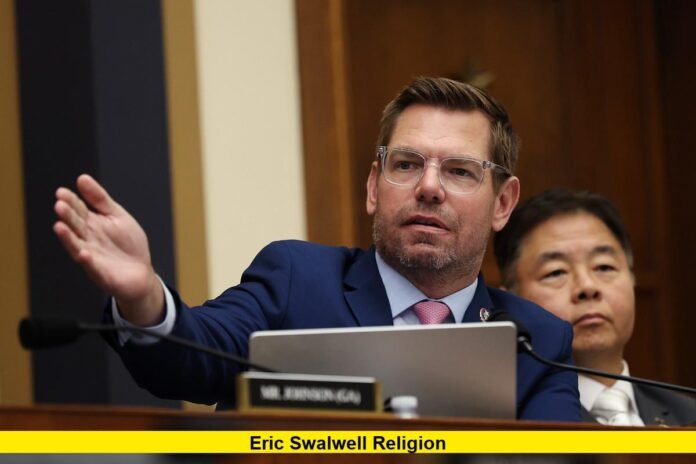

A sitting U.S. Congressman is sparking fresh conversations online — not because of a floor speech or a political controversy, but because of something far more personal: his faith. Questions surrounding Eric Swalwell’s religion have been trending across search engines and social platforms, prompting many Americans to take a closer look at the Christian beliefs of one of Congress’s most vocal Democrats.
The story cuts to the heart of a broader debate playing out in American politics right now — can a Democrat be openly religious, and what does faith actually mean to someone on the progressive side of the aisle?
Keep reading — the answer is more nuanced and revealing than most people expect.
Why People Are Searching This Now
The renewed curiosity about Swalwell’s faith comes on the heels of a candid podcast interview the California congressman gave in spring 2025, where he opened up about his religious upbringing, his church, and the complicated relationship between being a Democrat and being a person of faith. In a political climate where religion is often treated as the exclusive territory of conservatives, Swalwell’s willingness to discuss his beliefs caught the attention of listeners and sparked wider interest online.
Who Is Eric Swalwell?
For those less familiar, Eric Swalwell is a Democratic congressman from California who has represented his Bay Area district since 2013. Born in Sac City, Iowa, and raised in a Midwestern household, he built a career that took him from Dublin City Council all the way to a brief 2020 presidential run. He currently sits on the House Committee on Homeland Security and has long been one of the more recognizable faces of the Democratic Party — known for his sharp media presence and outspoken stance on issues like gun control.
But the personal side of his story — including his religion — has largely stayed out of the spotlight.
A Lutheran Upbringing, a Christian College, and an Evolving Faith
Swalwell grew up attending Sunday school and going to church with his family. In his own words, he was raised Lutheran. That foundation carried him into adulthood and shaped his path in ways that surprised many listeners when he first spoke about it publicly.
He attended Campbell University, a small Christian school in North Carolina, where he arrived on a soccer scholarship as a goalkeeper. A sports injury changed everything — it redirected his energy toward student government, mock trial, and eventually a calling toward public service.
His faith didn’t stop evolving there. Today, Swalwell’s local church is Cornerstone in Livermore, California. The church’s founding pastor, Steve Matson, even officiated Swalwell’s 2016 wedding to his wife Brittany. That kind of personal connection to a faith community is something many Americans can relate to — and it tells a deeper story than a simple label ever could.
Officially, Swalwell is listed as Protestant in congressional records, a designation that reflects the broad Christian tradition he has remained a part of throughout his life.
What Viewers and Listeners Noticed
When the podcast interview surfaced more widely, people tuned in expecting typical political talking points. What they got instead was a congressman talking openly about Sunday school, soccer injuries, and the pastor who married him.
The moment that particularly struck listeners was when Swalwell described the tension many Democrats feel around faith in public life. He observed that members of his party often keep their religious beliefs private because they’ve watched religion get used as a political weapon rather than a genuine guide to service. He expressed a desire to see faith become a bridge between communities rather than a dividing line.
That message — coming from a high-profile Democrat — felt fresh to many people who have come to expect faith-based conversations almost exclusively from the political right.
How the Internet Reacted
The reaction online was a mix of genuine surprise, appreciation, and debate. Some users expressed they had no idea Swalwell had any religious background at all. Others said it reframed how they thought about Democratic politicians and religion more broadly.
Conservative commentators pushed back, questioning whether his policy positions align with his stated faith. Progressive voices, meanwhile, welcomed the conversation as an example of Democrats being willing to speak authentically about values without using faith as a campaign prop.
The discussion quickly spread beyond political circles, drawing in people who were simply curious about the intersection of personal belief and public service.
What Swalwell Has Said
Swalwell has been clear and consistent on one point: he does not want religion weaponized. His vision is one of cooperative, cross-faith dialogue — people working together because of shared human values rather than competing to claim religious authority.
He has also connected his faith to his policy commitments, particularly around protecting public services and fighting for what he describes as fairness and justice for all Americans. In conversations with faith-focused interviewers, he has framed his political work not as separate from his beliefs, but as an expression of them.
Why the Story Keeps Trending
Part of what makes Eric Swalwell’s religion a topic of ongoing interest is the larger cultural question it represents. In a country where faith and politics have become deeply entangled, the idea of a leading Democrat speaking openly — and thoughtfully — about Christian belief challenges the narrative that the two parties occupy completely different spiritual universes.
That challenge to assumption is exactly the kind of thing that keeps a story alive online.
What to Watch For
As Swalwell continues to be a prominent voice in the Democratic Party and potentially eyes future political ambitions, his willingness to engage on faith publicly may become a larger part of his public identity. Whether that shifts how voters — or fellow lawmakers — perceive him remains to be seen.
What do you think — should more politicians speak openly about their faith? Drop your thoughts in the comments and share this story with someone who’d find it interesting.