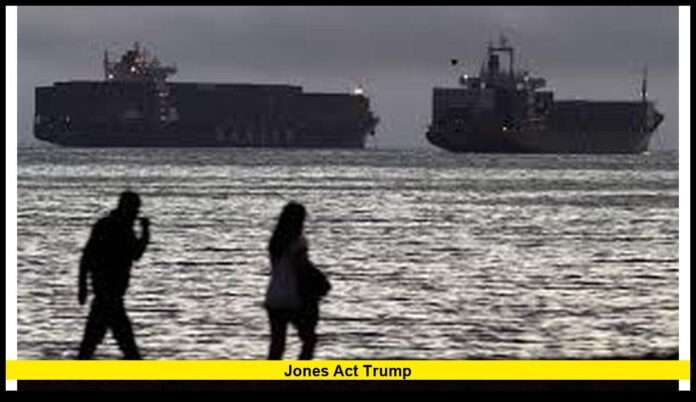

Jones Act Trump discussions continue to appear in U.S. policy conversations as lawmakers, economists, and maritime leaders examine the role of the century-old shipping law in modern transportation and national security. During Donald Trump’s presidency from 2017 to 2021, the Jones Act became part of national debate when the administration issued temporary waivers after major hurricanes and addressed questions about domestic maritime policy. Those decisions brought renewed attention to a law that has shaped American shipping for more than 100 years.
Today the Jones Act still governs cargo transported between U.S. ports. Because of its economic and strategic importance, the connection between the law and Trump-era policy decisions remains a significant topic in discussions about maritime regulation and emergency response.
Understanding the Jones Act
The Jones Act is part of the Merchant Marine Act of 1920, a major piece of legislation that regulates maritime commerce in the United States.
Congress passed the law shortly after World War I. Lawmakers wanted to ensure the United States maintained a strong commercial shipping industry capable of supporting national defense.
The Jones Act specifically governs the movement of goods between U.S. ports.
Under the law, ships transporting cargo between American ports must meet several requirements.
Core Requirements of the Jones Act
Ships involved in domestic maritime transport must be:
- Built in the United States
- Owned by American companies
- Registered under the U.S. flag
- Operated primarily by U.S. citizens or permanent residents
These rules apply to shipping routes between states, territories, and coastal regions within the country.
Examples of domestic shipping routes covered by the law include:
- Texas to Florida
- California to Hawaii
- Washington state to Alaska
- U.S. mainland ports to Puerto Rico
Because of these regulations, only vessels that meet these requirements can participate in domestic maritime trade.
Historical Purpose of the Law
The Jones Act emerged from national security concerns after World War I.
During the war, the United States recognized the importance of having a reliable merchant fleet capable of supporting military operations.
Congress designed the law to achieve several strategic goals.
Objectives of the Merchant Marine Act
The legislation aimed to:
- Maintain a strong American shipbuilding industry
- Ensure the country had a dependable merchant marine fleet
- Provide trained American sailors for wartime logistics
- Protect U.S. maritime employment
These goals shaped maritime policy throughout the twentieth century and continue influencing U.S. shipping regulations today.
Jones Act Trump Policy Actions During the Presidency
The topic of Jones Act Trump gained national attention during several emergency situations between 2017 and 2020.
Federal law allows the government to temporarily waive the Jones Act when national defense or emergency circumstances require additional shipping capacity.
During the Trump administration, the government issued waivers after major hurricanes affected parts of the United States and its territories.
These waivers allowed foreign-flagged ships to transport goods between U.S. ports for a limited time.
Major Jones Act Waivers Issued
Several disasters led to temporary waivers.
| Year | Event | Reason for Waiver |
|---|---|---|
| 2017 | Hurricane Harvey | Ensure fuel supply along the Gulf Coast |
| 2017 | Hurricane Irma | Assist fuel delivery to affected states |
| 2017 | Hurricane Maria | Support emergency relief shipments to Puerto Rico |
These actions drew national attention because the Jones Act rarely receives widespread public focus outside the maritime industry.
Hurricane Maria and the Puerto Rico Waiver
The most widely discussed Jones Act decision during the Trump administration occurred after Hurricane Maria struck Puerto Rico in September 2017.
The storm caused catastrophic damage across the island.
Infrastructure including power systems, roads, and ports experienced severe disruptions.
In response to the humanitarian crisis, federal officials issued a 10-day waiver of the Jones Act.
This waiver allowed foreign-flagged ships to transport goods between U.S. ports and Puerto Rico temporarily.
The purpose was to speed up the delivery of emergency supplies such as:
- Fuel
- Food
- Medical equipment
- Construction materials
The decision became part of a larger national debate about disaster response and shipping regulations.
Economic Impact of the Jones Act
The Jones Act influences the American economy in several ways.
Because it restricts domestic shipping to U.S.-built and U.S.-crewed vessels, the law shapes both shipping costs and maritime employment.
Supporters say the law protects American jobs and ensures reliable domestic shipping.
Critics argue it can increase transportation costs in certain regions.
Industries Affected by the Law
The Jones Act plays a role in several economic sectors.
Industries connected to domestic maritime transport include:
- Oil and energy distribution
- Construction material shipping
- Agriculture and grain transport
- Manufacturing supply chains
Many businesses rely on ships to move large quantities of cargo between coastal regions.
The law regulates those shipping operations.
Impact on U.S. Territories and Island Regions
The Jones Act has a particularly strong impact on island territories and remote regions.
Locations that depend heavily on ocean shipping often experience the most noticeable effects of maritime regulations.
These areas include:
- Puerto Rico
- Hawaii
- Alaska
- Guam
Because goods must travel on Jones Act–compliant vessels, shipping availability and vessel supply can influence transportation costs.
Supporters argue the law guarantees reliable service to these areas.
Others believe increased competition could lower shipping costs.
The debate remains ongoing among policymakers and industry leaders.
Support From the Maritime Industry
The American maritime industry strongly supports maintaining the Jones Act.
Organizations representing shipbuilders, sailors, and maritime workers argue that the law protects critical national infrastructure.
Key benefits highlighted by supporters include:
- Stable maritime employment
- Growth of domestic shipbuilding companies
- Reliable shipping during national emergencies
- Maintenance of maritime training programs
Shipyards in states such as Virginia, Mississippi, Louisiana, and Texas build vessels used in domestic maritime trade.
These shipyards employ thousands of workers.
National Security Considerations
National defense remains one of the most frequently cited reasons for maintaining the Jones Act.
During military operations, the United States relies on commercial ships to transport supplies, vehicles, and equipment.
A strong domestic merchant fleet ensures the country can move materials during wartime without depending entirely on foreign shipping companies.
The Department of Defense has historically supported maintaining a domestic shipping industry for this reason.
Trained American merchant mariners also provide important logistical support during military deployments.
Emergency Waivers and Federal Authority
Temporary waivers provide flexibility when the government needs additional shipping capacity during emergencies.
The Department of Homeland Security can authorize these waivers under specific conditions.
Waivers typically occur when:
- Natural disasters disrupt supply chains
- Fuel shortages affect transportation networks
- Domestic vessels cannot meet urgent shipping demand
These waivers remain limited in duration.
Once emergency conditions pass, the standard Jones Act rules return.
Modern Policy Discussions About the Jones Act
More than a century after its passage, the Jones Act remains a topic of debate in Washington.
Lawmakers, economists, and maritime organizations frequently discuss possible reforms.
Some policymakers support maintaining the law without changes.
Others propose modifications designed to balance national security with economic flexibility.
Topics often discussed include:
- Shipbuilding capacity in the United States
- Transportation costs for island regions
- Maritime workforce development
- Disaster response logistics
The debate continues as policymakers evaluate how the law affects modern supply chains.
Importance of Domestic Maritime Transportation
Domestic shipping plays a vital role in the American transportation network.
Ships carry large quantities of cargo between ports more efficiently than many land transportation methods.
Important materials transported through domestic shipping include:
- Petroleum products
- Natural gas liquids
- Coal and minerals
- Industrial equipment
- Agricultural goods
The Jones Act regulates these shipments to ensure they occur within the framework of American maritime law.
How the Jones Act Shapes U.S. Maritime Policy
The relationship between Jones Act Trump decisions and ongoing policy discussions illustrates how maritime law interacts with emergency response and economic planning.
Temporary waivers issued during major disasters highlighted the role the law plays in national logistics.
At the same time, the underlying legislation continues guiding domestic maritime commerce every day.
Because of its influence on national security, transportation, and industry, the Jones Act remains one of the most significant maritime laws in the United States.
The continuing discussion surrounding Jones Act Trump policies reflects the broader importance of maritime regulation in shaping American shipping, disaster response, and economic policy.
What do you think about the role of the Jones Act in modern U.S. shipping? Share your thoughts and join the discussion about maritime policy and national transportation.