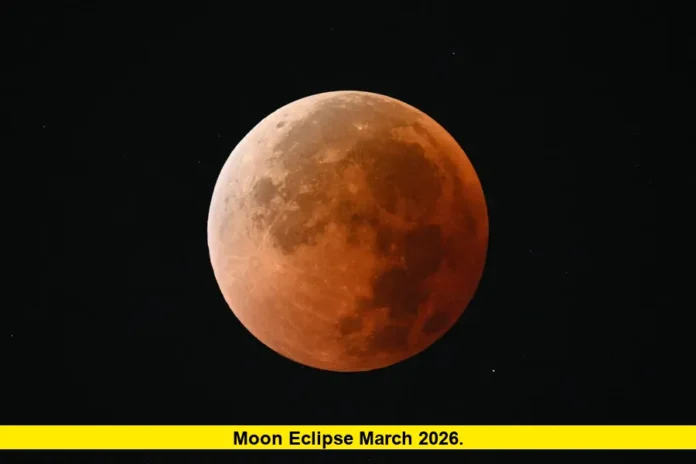

On March 3, 2026, skywatchers across the United States and other parts of the world will witness a stunning moon eclipse March 2026 event, where our natural satellite passes into Earth’s shadow and briefly shines with an eerie red glow. This rare total lunar eclipse — often called a “Blood Moon” — marks the first full lunar eclipse of the year and will offer a dramatic early-morning celestial show visible across much of North America. According to astronomical data, the total eclipse will occur just before sunrise in many U.S. time zones. Viewers from coast to coast are already preparing for this unforgettable sight. The early morning timing and vibrant color change make this a must-see astronomical phenomenon for skywatchers and casual observers alike.
If you’ve never seen a total lunar eclipse before, this one promises to be especially striking. As the Moon enters Earth’s deepest shadow, it will take on hues of deep red and orange — a visual effect caused by sunlight bending through Earth’s atmosphere. Many astronomy clubs and planetariums across the U.S. are planning viewing events, and photographers are gearing up to capture the phenomenon in images that could become iconic moments of the 2026 sky calendar. Explore local viewing tips below and prepare your camera for one of the year’s most anticipated events.
Get your camera ready and find a dark sky spot for the eclipse!
What Is a Total Lunar Eclipse and Why It Happens
A lunar eclipse occurs when Earth aligns directly between the sun and the full moon, casting its shadow across the lunar surface. In a total lunar eclipse, the Moon passes completely into Earth’s umbra — the darkest part of our planet’s shadow. When this happens, direct sunlight is blocked and only refracted light from Earth’s atmosphere reaches the Moon. That filtered light often appears red or coppery, giving rise to the “Blood Moon” nickname.
The entire eclipse lasts several hours — starting with the penumbral phase, moving into the partial and then total phases, and finally ending back in penumbral shadow. But the most dramatic part, totality, when the Moon is fully within Earth’s shadow and glowing red, lasts just under an hour. For the March 2026 event, totality is expected to last about 58 minutes. Across the United States, the earliest stages begin in the pre-dawn hours, with totality happening roughly between 4:00 and 7:00 a.m. local times depending on your time zone. Morning observers should check local eclipse timing guides to know when to look.
If you’re planning to watch the eclipse, head outside before the total phase begins for the full experience!
Where and When You Can See the Eclipse in the U.S.
The moon eclipse March 2026 event is visible across all of the contiguous United States, as well as Alaska and Hawaii. However, viewing conditions differ slightly depending on where you are:
- Western U.S. regions — From states like California, Oregon, Washington, and into the Mountain West, the Moon will be high enough in the sky to see the full event, including totality. In California, the penumbral phase begins shortly after midnight local time with totality around 3:00–4:00 a.m. PST. This makes the eclipse especially scenic against dark western horizons.
- Central time zones — Central states see similar timing adjusted to local time, with totality beginning around 5:00 a.m. CST.
- Eastern states — Farther east, like in New York and along the Atlantic seaboard, the Moon sets as totality approaches or is underway. Observers may catch the early stages and some of the red hue if they have a clear horizon view before moonset.
- Alaska and Hawaii — Observers in Alaska will see earlier local times due to time zone differences, while Hawaiian viewers will enjoy a complete view in the early Hawaiian morning hours.
The Moon will take about five hours from beginning to end to complete all eclipse stages, though the truly eye-catching red phase is around one hour long. Since this spectacle unfolds before sunrise on March 3, weather conditions such as clear skies and minimal light pollution will boost your viewing experience.
How to Watch and Photograph the Eclipse
Good news for viewers: no special eye protection is needed to watch a lunar eclipse. Unlike solar eclipses, lunar eclipses are completely safe to view with the naked eye. Here’s how to make the most of it:
- Choose a clear, open view of the sky, ideally away from bright city lights.
- Bring binoculars or a telescope if you want a closer look at the Moon’s surface as it darkens and reddens.
- For photographs, use a camera with manual settings if possible. A tripod and a shutter speed of several seconds will help capture the red hue and details.
- Arrive early so you don’t miss the onset of the eclipse — the Moon will gradually darken before totality begins.
Even if you’re not a photography buff, simply watching this celestial dance with friends or family can be an unforgettable early-morning adventure under the stars.
What Makes This Eclipse Special
The March 2026 total lunar eclipse is significant for a few reasons. It is the only total lunar eclipse visible in the United States this year. It also marks the last total lunar eclipse until late 2028, making it a rare opportunity for skywatchers across North America and beyond. The early-morning timing and subtle transition from full moon to deep red color create a dramatic contrast against the twilight sky as sunrise approaches.
For astronomy enthusiasts and casual observers alike, the event serves as a reminder of the dynamic, interconnected motions of celestial bodies — Earth, moon, and sun — and the visual wonders their alignments can produce.
Whether you’re a seasoned stargazer or a curious first-time viewer, watching the moon eclipse March 2026 is an experience worth planning for. Dress warmly and check local timing guides to catch every phase.
Share your eclipse photos and experiences in the comments, or check back for more sky-watching highlights!