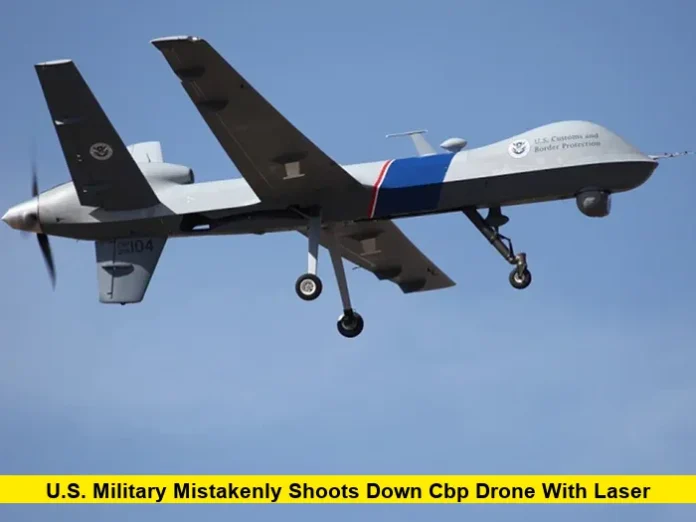

In a striking and unusual event near the U.S.–Mexico border in Fort Hancock, Texas, the U.S. military deployed a high-energy laser weapon to shoot down a drone — only to later learn it belonged to its own government.
The aircraft was perceived as a potential threat in restricted military airspace, and military forces used a counter-unmanned aerial system (C-UAS) laser to disable it. It was only after the drone was downed that officials recognized it belonged to Customs and Border Protection (CBP) — a fellow agency also operating along the southern border.
✈️ Airspace Closure and Safety Measures
Following the laser engagement, the Federal Aviation Administration (FAA) issued a temporary airspace closure around Fort Hancock for “special security reasons.” Commercial flights were not disrupted, but the restricted airspace will remain in effect through June 24 to ensure safety and prevent potential hazards from laser and drone operations.
This incident comes just two weeks after another drone-related airspace disruption: earlier in February, CBP itself deployed a laser weapon near El Paso that mistakenly struck what turned out to be a party balloon, prompting a temporary halt in air traffic in that area.
🧨 Political Fallout and Interagency Coordination Concerns
The mishap has sparked sharp criticism from lawmakers — especially Democratic members of Congress — who say it underscores deep flaws in how federal agencies coordinate drone operations and safety protocols.
Leaders such as Rep. Rick Larsen, Sen. Tammy Duckworth, and others have blasted the current administration over what they describe as “incompetence” and poor communication among the Department of Defense (DoD), the Department of Homeland Security (which oversees CBP), and the FAA.
Concerns include:
- A lack of formal notification procedures between agencies when counter-drone weapons are used.
- Failure to implement bipartisan legislation aimed at improving training and interagency coordination for drone surveillance and countermeasures.
- Calls for a joint investigation to assess how such mistakes can be prevented.
Defenders of the action (including DoD and CBP) argue that the laser deployment was part of ongoing efforts to counter real drone threats from Mexican cartels or other hostile actors operating along the border.
🔍 What This Means for the Future
This episode highlights a key challenge the United States faces as it deploys advanced technologies like laser-based counter-drone systems domestically:
Technology Outpacing Regulation
High-energy lasers and other counter-UAS tools are cutting-edge technologies — but rules for their use in U.S. airspace are still evolving, especially when multiple agencies operate similar systems.
Safety Protocols and Public Trust
Ensuring these systems are used safely — and that civilian airspace is protected — is crucial to maintaining public confidence and aviation safety. Misfires or misidentifications, even among government agencies, can have serious consequences.
Heightened Legislative Scrutiny
Congress may respond with new laws or oversight hearings to clarify authority, improve training, and standardize notification procedures for operations involving counter-drone technology.
🛩️ Broader Context: Drone Safety in U.S. Skies
This isn’t the first time unmanned aerial vehicles have caused confusion or controversy in American airspace. From accidental engagements — like this laser incident and the mistaken balloon shootdown — to internationally notable moments such as the 2023 Chinese balloon incident, the presence of drones continues to challenge existing airspace rules and safety norms.
As the skies become increasingly crowded with commercial, recreational, and government drones, incidents like this highlight how crucial strong communication and operational frameworks are for ensuring safety at all levels.