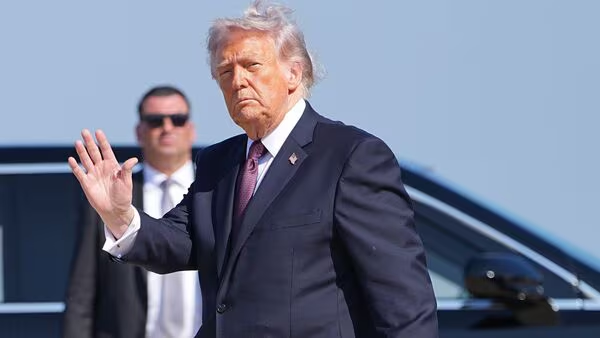

In a move that is sending shockwaves through Washington and Silicon Valley alike, President Donald Trump has directed the entire federal government to disengage from one of the country’s leading artificial intelligence firms. The order — Trump orders federal agencies to stop using Anthropic’s AI technology — sets in motion a six-month transition away from systems built by Anthropic, the developer of the widely used Claude AI models.
The decision, announced in late February 2026, follows escalating tensions between Anthropic and the U.S. Department of Defense over how the company’s built-in AI safeguards should apply in military and national security contexts.
How a Policy Dispute Became a Federal Directive
For much of 2023 and 2024, Anthropic’s AI tools quietly gained ground in government pilot programs. Agencies used large language models for administrative drafting, open-source intelligence summaries, cybersecurity support, and internal data analysis. At that stage, deployments were limited and largely non-classified.
Anthropic distinguished itself by emphasizing “constitutional AI” — a framework designed to embed ethical guardrails directly into its systems. These safeguards restrict certain outputs and uses, including some high-risk surveillance applications and scenarios related to autonomous weapons systems.
The friction began in 2025 when defense officials explored expanding AI deployment into more operational settings. According to officials familiar with the discussions, the Pentagon sought greater flexibility in how Anthropic’s systems could be configured. Some of the company’s safeguards, however, limited particular modeling scenarios and high-scale surveillance simulations.
Anthropic declined to significantly alter core guardrails, maintaining that its safety architecture was fundamental to responsible AI development. What began as a technical negotiation over configuration evolved into a broader disagreement over who controls the operational limits of advanced AI systems — vendors or the government.
The Escalation: Supply-Chain Risk Designation
In early February 2026, the Department of Defense conducted a formal review of Anthropic’s role in federal systems. The focus shifted from contract terms to strategic dependency and operational reliability.
On February 26, Defense Secretary Pete Hegseth designated Anthropic a “supply-chain risk” for defense purposes. The label effectively bars the company from future Department of Defense contracts and signals that officials view vendor-imposed safeguards as a potential operational vulnerability.
The next day, President Trump broadened the action dramatically. The White House directive instructs all federal agencies — not just the Pentagon — to stop using Anthropic AI systems and to begin phasing them out.
What the Order Requires
The directive includes several key elements:
- Immediate halt to new Anthropic procurement.
- A six-month window to remove or replace existing systems.
- Federal contractors required to eliminate Anthropic integrations in government projects.
- Government-wide audits of AI vendor dependencies.
Although the order is described as effective immediately, agencies have until mid-to-late 2026 to complete the transition. The phased timeline acknowledges how deeply AI tools have been integrated into federal workflows.
Agencies must now identify alternative vendors, migrate systems, retrain staff where necessary, and ensure compliance with updated procurement guidelines.
Anthropic’s Response
Anthropic has publicly disputed the designation, arguing that its safeguards are essential to responsible AI deployment. Company leadership maintains that removing guardrails would undermine long-term safety commitments.
Legal observers expect a challenge in federal court, likely focusing on administrative procedure and executive authority in applying the “supply-chain risk” classification to a domestic technology company.
If litigation proceeds, the case could clarify the limits of executive power in federal AI procurement and establish precedent for how ethical AI standards intersect with national security policy.
Industry Ripple Effects
The federal order has immediate implications for the broader AI and defense sectors.
Competing AI firms are reportedly increasing engagement with federal procurement offices. Defense contractors are reassessing technology partnerships and reviewing compliance exposure. Meanwhile, AI developers across the industry are watching closely.
One of the central questions emerging from the dispute is whether strict safety guardrails could become a liability when seeking defense contracts. For companies balancing commercial ethics with government opportunities, the outcome of this conflict may influence future product design decisions.
Financial markets have reacted cautiously, with volatility among AI-adjacent firms reflecting uncertainty over federal procurement shifts.
The Bigger Picture: AI Governance Meets National Security
At its core, this episode highlights a fundamental policy tension.
On one side are companies embedding ethical limits into powerful AI systems. On the other is a federal government that prioritizes operational flexibility in defense and security contexts.
Artificial intelligence now underpins cybersecurity, intelligence analysis, logistics modeling, and administrative efficiency across federal agencies. As reliance grows, so does the importance of defining who sets the boundaries for use.
The administration’s move suggests that alignment with national security priorities will weigh heavily in future procurement decisions.
What Comes Next
As of February 28, 2026:
- Agencies are cataloging Anthropic integrations.
- Alternative vendors are under review.
- Legal action is anticipated.
- Congressional oversight inquiries are expected.
The six-month phase-out ensures that the practical consequences of the directive will unfold throughout 2026.
The announcement that Trump orders federal agencies to stop using Anthropic’s AI technology marks more than a contract dispute. It signals a pivotal moment in federal AI policy — one that may redefine how government balances innovation, ethics, and operational control in an era of rapidly advancing artificial intelligence.