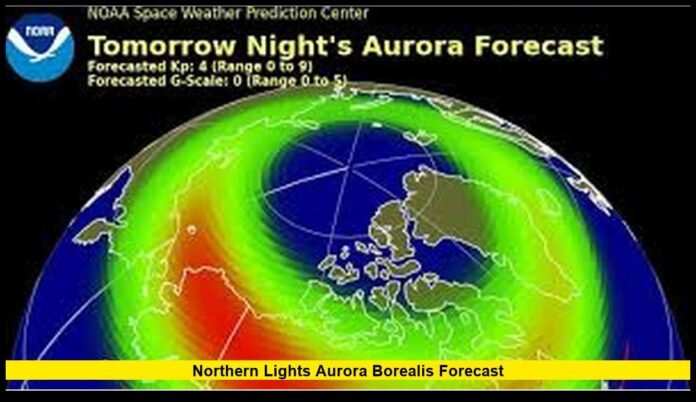

The latest northern lights aurora borealis forecast indicates that a powerful geomagnetic storm is driving auroral activity far south of its usual range, creating a rare opportunity for skywatchers across large portions of the United States. Enhanced solar wind conditions and sustained disturbances in Earth’s magnetic field are expanding the auroral oval, increasing the likelihood that the shimmering lights will be visible well beyond the northern border states.
This surge in activity is the result of an intense interaction between charged particles from the Sun and Earth’s magnetosphere. When these particles collide with atmospheric gases near the poles, they release energy in the form of light, producing the glowing arcs, curtains, and rays known as the aurora borealis. During periods of strong geomagnetic storms, this luminous zone widens, allowing the display to be seen from much lower latitudes.
What Is Powering the Current Aurora Activity
The Sun regularly emits streams of charged particles, but at times it releases far more energetic bursts in the form of solar flares and coronal mass ejections. When a fast-moving cloud of solar plasma reaches Earth, it compresses the planet’s magnetic field and injects large amounts of energy into the upper atmosphere.
This process triggers a geomagnetic storm. The strength of such storms is measured on a scale that ranges from minor to extreme. The current conditions fall into the severe category, meaning the magnetosphere is undergoing strong and sustained disturbances. These conditions are well known for producing bright and widespread auroral displays.
Key physical factors shaping the present forecast include:
- High-speed solar wind striking Earth’s magnetic shield
- A southward-oriented magnetic field within the solar wind, which allows energy to enter the magnetosphere more efficiently
- Elevated geomagnetic indices that signal strong global magnetic fluctuations
- An expanded auroral oval that now covers much of the northern half of the continental United States
Together, these elements create an environment highly favorable for aurora formation and visibility.
How Far South the Aurora May Be Seen
Under typical conditions, the aurora borealis is confined to high latitudes, most often visible in Alaska, northern Canada, and the far northern tier of the Lower 48. Severe geomagnetic storms, however, can push the lights hundreds of miles farther south.
Based on the current northern lights aurora borealis forecast, potential viewing areas include:
- The Upper Midwest, including Minnesota, Wisconsin, and Michigan
- The Northern Plains, such as North Dakota, South Dakota, and northern Nebraska
- The Pacific Northwest, covering Washington, Oregon, and parts of northern California
- The Northern Rockies, including Montana, Wyoming, and Colorado
- The Northeast, extending through New York, Vermont, New Hampshire, and Maine
During peak storm intensity, faint auroral glows may also be detectable in parts of the Mid-Atlantic and central United States. In these lower-latitude locations, the display is often seen low on the northern horizon and may appear as a pale green or whitish arc rather than bright overhead curtains.
Best Time Windows for Viewing
Auroras depend not only on geomagnetic activity but also on darkness and local sky conditions. For most U.S. locations, the most favorable viewing times begin after evening twilight and can extend through the late-night and early-morning hours.
Common high-probability periods include:
- The first few hours after full darkness
- Late evening, when geomagnetic energy input often intensifies
- Pre-dawn hours, when the magnetosphere can become especially active
Auroral activity is dynamic. It can brighten suddenly, fade, and then return in waves. Remaining outdoors for extended periods and scanning the northern sky regularly improves the chance of catching one of these luminous bursts.
Understanding the Science Behind the Forecast
Forecasting auroras involves monitoring several key parameters that describe conditions in near-Earth space.
Geomagnetic Indices
One of the most widely used measures is the planetary Kp index. It reflects the level of global magnetic disturbance on a scale from 0 to 9. Higher values correspond to stronger storms and a greater southward expansion of the auroral oval.
General guidelines are:
- Kp 5: Auroras possible near the U.S.–Canada border
- Kp 6–7: Visibility across the northern tier of states
- Kp 8–9: Potential for auroras deep into the central and eastern United States
Current readings associated with the ongoing storm are in the upper range, supporting the possibility of unusually widespread visibility.
Solar Wind Speed and Density
Fast solar wind streams deliver more energy to Earth’s magnetic environment. When combined with high particle density, they can significantly enhance auroral brightness and motion.
Magnetic Field Orientation
A southward-pointing interplanetary magnetic field allows for efficient magnetic reconnection with Earth’s field. This process opens a pathway for solar energy to flow directly into the magnetosphere, intensifying geomagnetic storms and, in turn, auroras.
What Viewers Might See
The appearance of the aurora varies with latitude and storm strength.
In northern regions, the sky may fill with:
- Bright green curtains that ripple and fold
- Vertical rays that stretch upward like glowing pillars
- Occasional pink or purple edges caused by high-altitude oxygen and nitrogen emissions
Farther south, the display is often more subtle and can include:
- A soft green or white glow near the horizon
- Faint arcs extending from east to west
- Brief surges of brightness that appear and fade within minutes
Even when the colors seem weak to the naked eye, cameras can reveal striking detail. Long exposures often capture reds and purples that are otherwise difficult to perceive.
Practical Tips for Successful Aurora Watching
To make the most of this rare opportunity, observers across the United States can improve their chances by following a few simple steps:
- Choose a location away from city lights to reduce skyglow
- Find an open area with a clear view toward the north
- Allow at least 15 minutes for your eyes to adjust to the dark
- Check cloud cover and aim for the clearest part of the night
- Use a tripod and night mode or long exposure settings when photographing
Warm clothing and patience are essential, especially during winter nights when temperatures can drop quickly.
Broader Impacts of Strong Geomagnetic Storms
While the aurora is the most visible effect of geomagnetic storms, such events also influence modern technology. Disturbances in Earth’s magnetic field can:
- Affect high-frequency radio communications
- Introduce minor errors in satellite navigation systems
- Alter conditions in the upper atmosphere, changing satellite drag
- Create electrical currents in long conductors, including power lines
Monitoring these storms allows operators to take precautions, while the public gains advance notice of potential aurora displays.
Why Events Like This Are Uncommon
The Sun follows an approximately 11-year activity cycle, moving between quieter periods and times of frequent and powerful eruptions. Severe geomagnetic storms tend to occur more often near the peak of this cycle, when large sunspots and energetic flares are more common.
Even during active phases, not every solar eruption is aimed at Earth. For a storm to develop, the ejected material must travel along a path that intersects our planet’s orbit and carry a magnetic configuration that strongly couples with Earth’s field. This precise alignment is what makes widespread auroral events relatively rare and highly anticipated.
What the Next Day Could Bring
As the stream of solar plasma continues to pass Earth, geomagnetic conditions may remain unsettled. Activity can rise and fall as different structures within the solar wind interact with the magnetosphere. This means that auroral intensity can fluctuate, with additional bright intervals possible before the system gradually returns to quieter conditions.
The northern lights aurora borealis forecast will continue to evolve in response to real-time measurements of solar wind speed, density, and magnetic orientation. These updates refine predictions of where the auroral oval is likely to be positioned and how intense the displays may become.
A Moment to Look North
For many in the United States, seeing the aurora borealis is a once-in-a-lifetime experience. The current geomagnetic storm offers a chance for millions of people, even far from the Arctic, to witness a phenomenon driven by solar activity nearly 93 million miles away.
Whether the lights appear as faint glows or vivid curtains, their presence is a reminder of the dynamic connection between the Sun and Earth. As darkness falls and the sky clears, turning your gaze northward may reveal a spectacle that links space weather, atmospheric science, and natural beauty in a single, unforgettable display.
If the sky lights up where you are, take a moment to look, capture the view if you can, and share what you see, because moments like this do not come often.