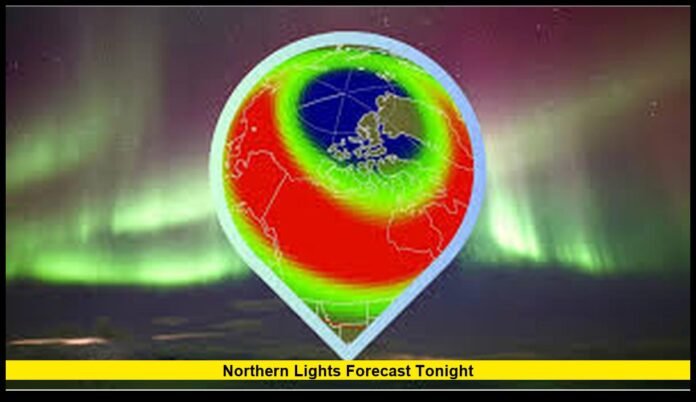

Tonight, skywatchers across the United States may witness one of the most impressive aurora displays in years. The northern lights forecast tonight points to unusually strong geomagnetic activity, creating the potential for visible auroras far beyond their usual Arctic zones. From Alaska to parts of the Midwest and Northeast, conditions are aligning for a rare and breathtaking natural light show in the night sky.
Solar activity over the past day has energized Earth’s upper atmosphere, sending charged particles toward the planet at high speed. When these particles collide with gases in the magnetosphere, they produce the glowing curtains of light known as the aurora borealis. Under typical conditions, this phenomenon stays close to the polar regions. Tonight, however, the strength of the solar storm could push the auroral oval much farther south than normal, making the display visible to millions more people across the continental United States.
Why the Northern Lights May Be Visible Tonight
The aurora appears when energy from the Sun interacts with Earth’s magnetic field. A strong burst of solar material has recently reached Earth, intensifying geomagnetic activity. This energy excites oxygen and nitrogen atoms high in the atmosphere, causing them to emit light in shades of green, red, purple, and blue.
The current space weather conditions indicate a strong to severe geomagnetic storm. When storms reach this level, the auroral oval expands, allowing the northern lights to be seen at lower latitudes. This expansion is what makes tonight’s forecast especially significant for viewers in states that rarely experience aurora activity.
States With the Best Viewing Potential
While Alaska remains the most reliable location for bright and frequent auroras, tonight’s conditions extend viewing possibilities much farther south. The following regions have a realistic chance of seeing the northern lights:
- Northern states near the Canadian border, including Washington, Montana, North Dakota, Minnesota, Wisconsin, Michigan, and Maine
- The northern portions of New York, Vermont, and New Hampshire
- Parts of the Midwest, including Iowa, Illinois, Indiana, and Ohio
- Selected areas of the Plains and Rockies, depending on cloud cover and local geomagnetic strength
In strong geomagnetic storms, faint auroral glows can sometimes be detected even farther south, appearing low on the northern horizon as pale green or reddish arcs.
Best Time to Watch the Sky
The prime viewing window is expected to fall between late evening and the early morning hours. The darkest skies and peak geomagnetic activity usually occur between 9 p.m. and 2 a.m. local time. During this period, auroras may brighten suddenly, forming rippling bands or slowly moving curtains across the sky.
Activity can fluctuate from minute to minute. A quiet sky can suddenly erupt into motion, so patience is essential. Staying outside for at least 30 to 60 minutes significantly increases the chance of catching a peak in activity.
How to Improve Your Chances of Seeing the Aurora
To make the most of tonight’s opportunity, a few simple steps can greatly improve visibility:
- Find a dark location. Light pollution from cities can wash out faint auroras. Rural areas, open fields, lakeshores, and hilltops provide much better viewing conditions.
- Look toward the north. In most of the U.S., the aurora will appear in the northern portion of the sky, sometimes stretching overhead during strong bursts.
- Check local weather. Clear skies are essential. Even thin cloud cover can block the aurora completely.
- Allow your eyes to adjust. Avoid bright screens and lights for at least 10 to 15 minutes so your night vision can fully develop.
What the Northern Lights May Look Like
Depending on the strength of the storm and your location, the aurora could appear in several forms:
- Soft green arcs glowing near the horizon
- Vertical rays rising like pillars of light
- Wide curtains that ripple and fold across the sky
- Occasional red or purple edges during intense activity
In southern locations, the aurora may initially look like faint, milky clouds with a green tint. Long-exposure photography often reveals colors and structures that the naked eye may only faintly detect.
Photography Tips for Capturing the Aurora
Even basic camera equipment can capture impressive aurora images if used correctly:
- Use a tripod to keep the camera steady
- Select a wide-angle lens
- Set a high ISO and a long exposure time
- Focus manually on distant stars or a far horizon
- Use a remote shutter or timer to avoid camera shake
Many modern smartphones also offer night modes capable of recording auroral colors when skies are dark and activity is strong.
Possible Impacts Beyond the Sky Show
Strong geomagnetic storms can sometimes affect technology. Temporary disturbances to satellite navigation, radio communication, and power grid stability are possible during heightened solar activity. While these effects are usually limited and well-managed, they are part of the same space weather system that creates tonight’s aurora.
Air travelers, satellite operators, and power utilities monitor these conditions closely, ensuring that systems remain stable during periods of increased solar influence.
Why Events Like This Are Rare
Auroras at mid-latitudes require a precise alignment of solar and magnetic conditions. The Sun must release a large amount of energy in the direction of Earth, and Earth’s magnetic field must be oriented in a way that allows the charged particles to penetrate deep into the atmosphere.
Most solar storms are either too weak or miss Earth entirely. When a strong, well-directed event occurs, it creates the kind of widespread auroral visibility forecast for tonight. These opportunities are infrequent, making each one especially memorable for those who witness it.
What Makes Tonight’s Forecast Stand Out
The current auroral outlook suggests a level of geomagnetic activity capable of producing visible northern lights across a large portion of the northern United States. Such widespread coverage places tonight among the more notable aurora events of the season.
For many people, this could be their first chance to see the aurora without traveling far north. For experienced skywatchers, it offers the possibility of particularly vivid colors and dynamic motion.
Planning a Safe and Comfortable Viewing Session
If you plan to head outdoors, especially in winter conditions, dress warmly and bring extra layers. Choose safe, accessible locations away from traffic and hazardous terrain. Let someone know where you are going if you plan to stay out late in remote areas.
A thermos of a warm drink, a folding chair, and a blanket can make the experience far more enjoyable during long periods of waiting under cold skies.
A Night Worth Watching
With strong solar activity energizing Earth’s upper atmosphere, tonight could deliver one of the most striking aurora displays visible from the United States in recent months. The northern horizon may soon glow with waves of color, turning an ordinary winter night into a remarkable natural spectacle.
If you step outside to look up tonight, share what you see and stay connected for the latest sky updates.