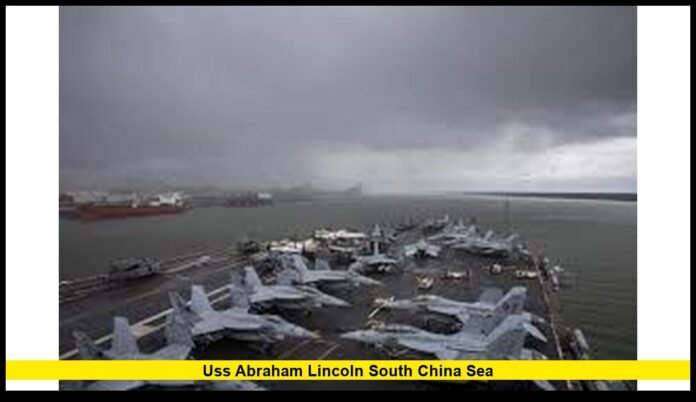

The USS Abraham Lincoln South China Sea deployment stands as one of the most closely followed U.S. naval operations of early 2026, highlighting America’s sustained military presence in one of the world’s most strategically sensitive maritime regions. The nuclear-powered aircraft carrier and its strike group continue operating in contested waters, carrying out flight operations, defensive drills, and maritime patrols that reflect a broader U.S. commitment to stability, deterrence, and freedom of navigation across the Indo-Pacific.
A Supercarrier at the Center of Indo-Pacific Strategy
USS Abraham Lincoln, a Nimitz-class aircraft carrier, represents the core of U.S. power projection at sea. With a displacement of more than 100,000 tons and a flight deck capable of supporting dozens of advanced aircraft, the carrier serves as both a mobile airbase and a command center. Its presence in the South China Sea places one of the most capable warships in the world directly within a region marked by overlapping territorial claims and intense strategic competition.
The carrier’s deployment forms part of a broader operational pattern in which the U.S. Navy maintains forward-deployed forces to reassure allies, deter potential adversaries, and preserve open sea lanes that are vital to global commerce.
Carrier Strike Group Operations
USS Abraham Lincoln is operating as the flagship of a full Carrier Strike Group. Alongside the carrier are guided-missile destroyers equipped with advanced radar, missile defense systems, and anti-submarine warfare capabilities. These escort vessels create a layered shield around the carrier, enabling it to operate in high-threat environments while maintaining freedom of movement.
Together, the strike group conducts coordinated maneuvers that integrate surface, air, and subsurface capabilities. This multi-domain approach allows the group to respond rapidly to a wide range of scenarios, from humanitarian assistance to high-intensity conflict.
Flight Operations in Contested Airspace
A central element of the deployment involves continuous flight operations from the carrier’s deck. Fighter jets, electronic warfare aircraft, early-warning planes, and helicopters conduct daily missions that include surveillance, air defense, and training sorties. These operations ensure pilots and air crews remain proficient while also maintaining situational awareness across vast stretches of ocean and airspace.
The ability to launch and recover aircraft around the clock gives the strike group a persistent presence that few other military platforms can match. In the South China Sea, this capability allows U.S. forces to monitor activity, respond quickly to emerging situations, and support allied operations if required.
Live-Fire Training and Defensive Readiness
During its time in the region, the carrier and its escorts have carried out live-fire training designed to test and refine defensive systems. These drills include the use of close-in weapon systems, missile defense radars, and coordinated responses to simulated aerial and surface threats.
Such exercises serve multiple purposes. They sharpen crew skills, validate the performance of complex weapons systems, and demonstrate the strike group’s ability to defend itself in a contested environment. Conducting this type of training in the South China Sea underscores the seriousness with which the U.S. Navy views operational readiness in a region where military activity from several nations continues to increase.
Strategic Importance of the South China Sea
The South China Sea is a vital artery for international trade, with trillions of dollars in goods passing through its waters each year. It also contains critical energy routes and undersea infrastructure. Control or disruption of these sea lanes would have far-reaching economic and security implications.
For the United States, ensuring that these waters remain open and governed by international law is a core strategic objective. The presence of a supercarrier like USS Abraham Lincoln reinforces the principle that no single nation should be able to restrict lawful access to international waters.
Regional Tensions and Military Posture
The deployment takes place amid heightened regional tensions driven by territorial disputes and expanding military capabilities. Several nations have increased their naval and air activity in the South China Sea, building new facilities and conducting frequent exercises.
In this environment, the U.S. Navy’s forward presence serves as a stabilizing factor. The carrier strike group operates with transparency and predictability, emphasizing adherence to established maritime norms while maintaining the capacity to respond decisively if challenged.
Cooperation With Allies and Partners
Although much of the carrier’s activity focuses on independent operations, its presence also supports cooperation with allied and partner nations. Shared training, coordinated patrols, and professional exchanges enhance interoperability and build trust among regional navies.
For countries that rely heavily on secure sea lanes, the visible presence of a U.S. carrier provides reassurance. It signals that the United States remains committed to collective security and to upholding a rules-based order in the Indo-Pacific.
Life Aboard the Carrier
Behind the strategic messaging and complex operations are thousands of sailors who keep the carrier functioning. Daily life aboard USS Abraham Lincoln involves a demanding routine of watch standing, maintenance, training, and mission planning. Crews work around the clock to ensure that aircraft are ready to fly, sensors remain operational, and the ship can respond immediately to any contingency.
Morale and resilience are critical during extended deployments. Command leadership places strong emphasis on safety, communication, and the well-being of the crew, recognizing that operational effectiveness depends on both advanced technology and the people who operate it.
Sustaining Operations Far From Home
Operating a carrier strike group thousands of miles from U.S. shores requires a sophisticated logistics network. Replenishment ships deliver fuel, food, and spare parts while underway, allowing the group to remain on station for long periods without returning to port.
This logistical reach is a key enabler of U.S. global presence. It allows carriers like USS Abraham Lincoln to operate continuously in regions such as the South China Sea, maintaining readiness while supporting a wide range of missions.
Broader Implications for U.S. Security
The ongoing deployment reflects long-term U.S. strategic priorities in the Indo-Pacific. By maintaining a powerful naval presence, the United States seeks to deter conflict, reassure allies, and ensure that maritime commons remain open to all.
The carrier’s operations also contribute to a broader pattern of global engagement, demonstrating that the U.S. Navy can project power, sustain operations, and adapt to evolving security challenges across multiple theaters.
Looking Forward
As USS Abraham Lincoln continues its mission, its activities will remain a focal point for observers across the region and in the United States. The carrier’s presence in the South China Sea is more than a routine deployment; it is a visible expression of strategic intent, operational capability, and enduring commitment to maritime security.
From flight operations and defensive drills to patrols that uphold international norms, the carrier and its strike group embody the role of sea power in shaping the balance of stability and deterrence in the Indo-Pacific.
The unfolding mission of USS Abraham Lincoln in the South China Sea will continue to influence regional security and global maritime dynamics, making it a story worth watching as events develop.