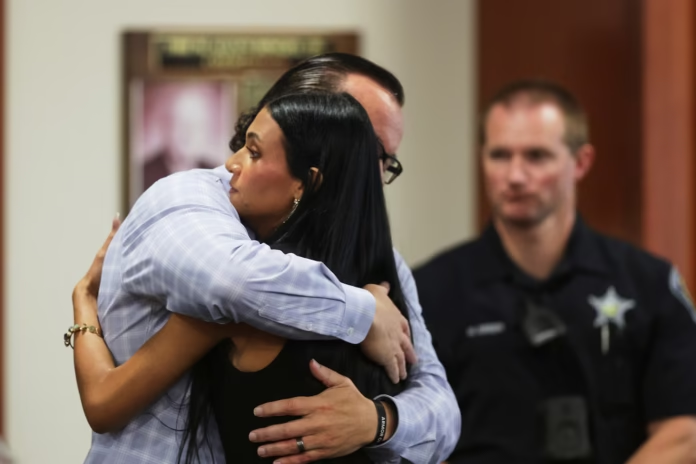

In the aftermath of one of the most shocking criminal cases in modern U.S. history, bryan kohberger sister has emerged as an unexpected voice, offering insight into the emotional reality faced by families of convicted killers. Her public remarks provide a rare, human perspective on how a single crime can permanently alter not only victims’ lives, but also the lives of relatives who had no role in the violence yet remain tied to it forever.
This account focuses on confirmed developments and documented statements, outlining how the Kohberger family learned of the crimes, how public attention reshaped their lives, and how one sister is navigating the long shadow cast by her brother’s actions.
A Family Confronts an Unthinkable Reality
When Bryan Kohberger was arrested and later convicted for the murders of four University of Idaho students, the news reverberated far beyond the courtroom. For his family, the revelation arrived suddenly and without warning.
According to his sister’s account, the initial notification of his arrest was so unexpected that it did not feel real. The idea that a sibling could be responsible for such violence clashed entirely with the person she believed she knew. Like many families in similar circumstances, the Kohbergers were forced to absorb devastating information while the rest of the country watched closely.
She has stated plainly that no one in the family had prior knowledge of the crimes or any indication that Bryan was capable of committing them. This point has been central to her comments, as speculation and online theories have often suggested otherwise.
Bryan Kohberger Before the Case
Before his name became synonymous with a national tragedy, Bryan Kohberger was known within his family as a reserved and academically driven individual. He was pursuing advanced studies in criminology and had relocated for his education, a move the family viewed as a sign of ambition and progress.
His sister has acknowledged that he faced challenges earlier in life, including bullying and struggles with substance use. However, she has consistently said those issues appeared to be behind him. From her perspective, he had rebuilt stability through education, structure, and discipline.
Nothing in his daily behavior or family interactions, she explained, suggested a capacity for extreme violence. This disconnect between who he appeared to be and what he ultimately did remains one of the most painful aspects for the family to process.
The Warning That Still Haunts Her
One of the most unsettling moments described by Bryan’s sister occurred before his arrest, when the murders were still unsolved. With news spreading about a dangerous killer in the area, she recalled reaching out to her brother with a simple message of concern.
She warned him to be careful, particularly when spending time outside alone. At the time, it felt like a normal exchange between siblings during a frightening local situation. Only later did she understand the chilling irony of that conversation.
This moment has since taken on deep emotional weight, symbolizing how close ordinary family life existed alongside hidden violence.
Immediate Consequences Beyond the Courtroom
The arrest triggered consequences that extended far beyond public attention. Bryan Kohberger’s sister revealed that she was preparing to enter a professional role in the mental health field when the case became national news.
As her family name became widely recognized, she faced intense scrutiny that affected her ability to move forward with that position. Ultimately, she chose to step away, prioritizing safety, privacy, and emotional well-being.
This professional disruption reflects a broader reality faced by relatives of high-profile defendants, who often experience career setbacks despite having no involvement in the crimes themselves.
The Weight of Public Curiosity
As the case gained traction online, Bryan’s sister found herself drawn into a world of speculation, commentary, and misrepresentation. She has spoken about strangers analyzing her life, misusing her identity, and attempting to associate themselves with the case for attention or profit.
She described this experience as deeply unsettling, noting that it created a sense of being targeted without having done anything wrong. The constant attention, she said, stripped away a sense of normalcy and personal control.
This aspect of the case highlights how digital culture can amplify harm, especially for people connected by family ties rather than actions.
Navigating True Crime Culture
In her public remarks, Bryan Kohberger’s sister has also addressed the broader phenomenon of true crime fascination. While acknowledging that people seek understanding and accountability, she has expressed concern about how quickly empathy disappears for anyone connected to the accused.
She emphasized that families of perpetrators often experience grief, shock, and shame simultaneously. They lose the person they thought they knew while also confronting the reality of what that person did to others.
Her comments have added to an ongoing national conversation about the ethical boundaries of crime coverage and the responsibilities of audiences consuming it.
Misunderstood Moments and Public Interpretation
During Bryan Kohberger’s sentencing, observers fixated on a drawing seen in his possession. Online discussions quickly assigned dark meanings to the image, fueling further speculation.
His sister later clarified that the drawing was a personal item she had given him, intended as a simple expression of family connection rather than a symbolic message. The incident became another example of how easily personal details can be misinterpreted once placed under public scrutiny.
For the family, such moments reinforced the feeling that nothing connected to the case could exist without being dissected.
Balancing Accountability and Humanity
Throughout her statements, Bryan’s sister has maintained a careful balance between acknowledging the harm caused and asserting her own humanity. She has expressed profound sympathy for the victims’ families, recognizing that their loss is permanent and irreplaceable.
At the same time, she has spoken about the emotional complexity of loving a family member while rejecting their actions. This dual reality, she said, is something she will carry for the rest of her life.
Her background in mental health has shaped how she processes this experience, focusing on accountability without dehumanization.
Remembering the Victims Privately
While much of the public conversation centers on the perpetrator, Bryan Kohberger’s sister has said she makes private efforts to remember the victims. She has described keeping important dates in mind and reflecting daily on the lives that were lost.
These actions are not public gestures, but personal ones. She has emphasized that remembrance should not be performative, but sincere and respectful.
This approach reflects her belief that empathy must extend beyond words and into daily awareness.
Where the Case Stands Now
Bryan Kohberger is serving four life sentences without the possibility of parole following his guilty plea for the November 2022 murders of four University of Idaho students. The legal proceedings have concluded, bringing formal closure to the case.
However, for families on both sides, closure is not a simple concept. The emotional impact continues long after sentencing, reshaping identities, relationships, and futures.
Within this reality, bryan kohberger sister remains a reminder that violent crime leaves lasting damage far beyond those directly targeted, affecting families who must live with consequences they never chose.
A Story That Continues to Resonate
As public interest persists, her decision to speak has added depth to an otherwise one-dimensional narrative. By sharing her experience, she has highlighted the unseen aftermath of crime — the quiet losses, the disrupted careers, and the emotional rebuilding that occurs away from headlines.
Her voice does not excuse the crimes, nor does it seek attention. Instead, it offers context, urging a more thoughtful understanding of how tragedy radiates outward in unpredictable and lasting ways.
How should society balance accountability with compassion for families affected by violent crime? Share your thoughts and stay engaged as discussions around this case continue.