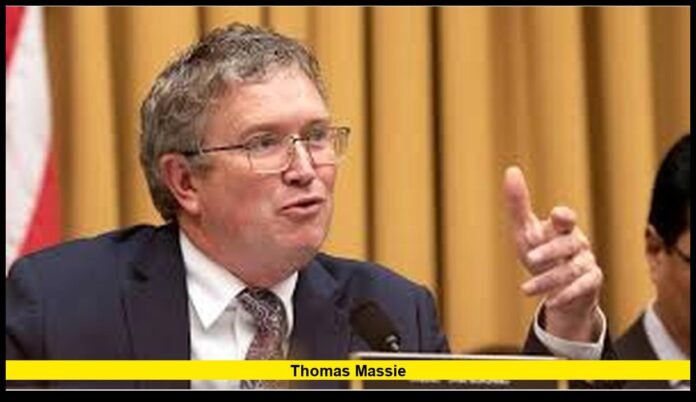

Thomas Massie has become one of the most closely watched figures in American politics as the 2026 election cycle accelerates and internal Republican divisions move into public view. Serving Kentucky’s 4th Congressional District, Massie stands apart from many of his colleagues through a record defined by constitutional limits, fiscal restraint, and resistance to centralized political power.
As of now, Massie remains an active member of the U.S. House of Representatives and is preparing for the most consequential campaign of his career. His re-election bid has drawn national attention not because of shifting ideology, but because of his consistency in an era of increasing party discipline.
A Lawmaker Shaped by Engineering and Structure
Born on January 13, 1971, Massie’s path into politics did not follow a traditional political trajectory. He earned both undergraduate and graduate engineering degrees from the Massachusetts Institute of Technology, a background that continues to influence his legislative approach.
Engineering training emphasizes systems, constraints, and consequences. In Congress, Massie often applies that same framework to government policy. He questions whether programs scale properly, whether authority is assigned correctly, and whether long-term costs are being ignored for short-term political gains.
Before entering Congress in 2012, Massie worked in technology and entrepreneurship. He built businesses, managed teams, and dealt directly with regulatory frameworks. Those experiences reinforced his belief that economic growth and innovation are strongest when government involvement is limited and predictable.
Early Congressional Years and a Defined Identity
From the start of his House tenure, Massie distinguished himself through his voting record. He quickly earned a reputation as a lawmaker unwilling to support legislation he believed violated constitutional boundaries or expanded federal spending without clear justification.
Rather than align himself closely with party leadership, Massie adopted a district-first and Constitution-first approach. He frequently voted against omnibus spending bills, emergency funding packages, and legislation passed under compressed timelines.
This approach did not make him universally popular within Republican leadership circles. However, it did establish him as a consistent voice for voters who prioritize limited government and legislative accountability.
Fiscal Discipline as a Core Principle
One of the most defining aspects of Massie’s record is his opposition to excessive federal spending. He has repeatedly warned that unchecked borrowing undermines national stability and shifts the financial burden to future generations.
Massie argues that large spending packages often obscure waste and limit meaningful debate. He has called for transparent budgeting, single-subject legislation, and recorded votes that clearly assign responsibility.
While critics say this approach slows the legislative process, Massie maintains that efficiency should never come at the expense of accountability.
Congressional Authority and Constitutional Limits
Another cornerstone of Massie’s work involves the balance of power between Congress and the executive branch. He consistently resists efforts that transfer authority away from lawmakers and toward administrative agencies or presidential discretion.
Massie has opposed emergency declarations that expand executive power beyond clearly defined limits. He argues that emergencies should not become permanent governance tools.
This position has placed him at odds with presidents from both parties, reinforcing his image as a lawmaker driven by structure rather than allegiance.
Foreign Policy and War Powers
Foreign policy has emerged as one of the most visible areas where Massie’s principles diverge from mainstream political practice. He has been especially vocal on the issue of war powers.
Massie insists that the Constitution grants Congress the authority to declare war and authorize military action. He has criticized executive-led military decisions that bypass legislative approval, warning that such actions weaken democratic oversight.
His comments regarding Iran and other global conflicts reflect this consistent framework. He has emphasized that threats of force should be deliberate, debated, and approved through constitutional processes.
Supporters view this stance as a safeguard against prolonged conflicts. Critics argue it limits executive flexibility. Regardless, the position has become central to his national profile.
The Epstein Files and Government Transparency
One of Massie’s most high-profile legislative efforts centers on government transparency related to the Jeffrey Epstein case. He co-authored the Epstein Files Transparency Act, legislation designed to compel the release of federal records connected to Epstein’s investigations and prosecution.
The measure advanced after sustained pressure and reflected growing public concern over secrecy surrounding the case. While document releases have occurred, Massie has expressed dissatisfaction with the extent of redactions and withheld material.
He continues to press for full compliance, arguing that partial disclosure undermines public trust. For Massie, the issue extends beyond a single case and speaks to a broader problem of institutional opacity.
Domestic Policy Beyond Headlines
While national debates often focus on foreign policy and transparency, Massie remains active across a wide range of domestic issues.
In 2025, he introduced legislation aimed at repealing the Smith-Mundt Modernization Act of 2013. Massie argues that changes made under that law weakened barriers preventing federal agencies from distributing government-produced information to domestic audiences.
He has stated that restoring earlier restrictions would protect Americans from government-funded messaging intended to influence public opinion.
Support for Military Families
Massie has also advanced proposals focused on tax relief for military families. His efforts address the financial strain caused by frequent relocation, deployment, and complex tax treatment tied to service obligations.
These proposals aim to simplify compliance and reduce penalties faced by service members and their households.
Agriculture and Rural Policy
Representing a largely rural district, Massie places strong emphasis on agricultural policy. He has repeatedly argued that federal regulations often place disproportionate burdens on small farmers.
Massie supports reducing compliance costs, preserving local food systems, and limiting the reach of agencies whose rules are written primarily for large-scale operations.
He frames these efforts as essential to preserving rural economies and local autonomy.
A Complex Relationship With Party Leadership
Massie’s independence has shaped a complicated relationship with Republican leadership. While some view his consistency as admirable, others see it as disruptive.
This tension reached a new level as President Donald Trump publicly opposed Massie and endorsed a primary challenger in Kentucky’s 4th District.
The endorsement transformed the race into a national proxy battle over party identity.
The 2026 Primary Takes Shape
The 2026 Republican primary has emerged as the most competitive and closely scrutinized contest of Thomas Massie’s political career. What was once considered a reliably safe seat has evolved into a nationally watched race, driven by internal party divisions and heightened involvement from outside political organizations.
In recent months, well-funded groups aligned with national Republican interests have poured significant resources into the district. These efforts include coordinated advertising campaigns, direct mail, and digital outreach aimed at questioning Massie’s conservative credentials and highlighting his frequent departures from party leadership positions. The scale and intensity of this activity underscore the strategic importance party leaders have placed on the outcome of the race.
Massie has responded by accelerating his own campaign operations. He has built a substantial fundraising apparatus centered largely on grassroots donors, with a notable emphasis on small-dollar contributions. His campaign has framed this support as evidence of broad voter engagement rather than reliance on large institutional donors or national party structures.
On the campaign trail, Massie’s messaging remains tightly focused on his record in Congress. He highlights his consistent votes against large federal spending packages, his opposition to emergency powers that expand executive authority, and his long-standing advocacy for congressional oversight. Rather than soften his positions, Massie has leaned into his reputation for independence, presenting it as a reflection of accountability to voters rather than party leadership.
As the primary continues to take shape, the contrast between Massie’s approach and that of his challengers has become increasingly clear. The race is no longer defined solely by policy differences, but by competing visions of what Republican representation should look like in a polarized political environment. With months remaining before voters cast their ballots, the contest is expected to remain intense, well-funded, and influential far beyond the borders of Kentucky’s 4th Congressional District.
A Test for Republican Voters
For many political observers, the Republican primary in Kentucky’s 4th Congressional District represents far more than a contest for a single seat in the U.S. House. It has emerged as a broader test of how Republican voters define leadership, accountability, and independence within their party at a time of heightened political polarization.
At the center of the race is a fundamental question facing the Republican electorate: should lawmakers prioritize alignment with party leadership and nationally influential figures, or should they place greater emphasis on adherence to constitutional boundaries and independent judgment? Thomas Massie’s candidacy has brought this question into sharp focus, forcing voters to weigh consistency in principle against strategic unity.
Supporters of Massie argue that independence is essential to effective representation, particularly when it involves resisting executive overreach or unchecked federal spending. They contend that lawmakers are elected to exercise judgment on behalf of their constituents, even when that judgment leads to disagreement with party leadership. For these voters, independence is viewed as a strength rather than a liability.
Others within the Republican base take a different view. They emphasize the importance of cohesion, arguing that legislative success depends on disciplined alignment and coordinated action. From this perspective, frequent dissent can weaken collective bargaining power and dilute the party’s ability to advance its priorities on the national stage.
The outcome of the Kentucky primary is expected to influence how future Republican candidates approach internal disagreement. A result favoring independence could encourage more lawmakers to assert constitutional authority and resist centralized party control. Conversely, a result favoring alignment may reinforce the expectation that loyalty to leadership is a defining factor in Republican primaries.
As similar debates unfold across the country, the implications of this race are likely to extend beyond Kentucky. The choices made by voters in this primary may help shape the tone, strategy, and internal dynamics of Republican contests nationwide in the years ahead.
Public Perception and Cross-Party Appeal
Thomas Massie’s public image is shaped by a combination of strong admiration and sustained criticism, reflecting the unconventional path he has taken within modern American politics. Supporters frequently point to his consistency as a defining trait, noting that his positions on spending, executive authority, and constitutional limits have remained largely unchanged over the course of his congressional career. For these voters, Massie represents a form of political reliability that has become increasingly rare.
Critics, however, argue that this same consistency comes at a cost. They contend that Massie’s willingness to break with party leadership complicates efforts to present a unified Republican agenda, particularly during high-stakes legislative negotiations or election cycles. Some within the party view his resistance to leadership-backed initiatives as strategically risky, even when they agree with the principles behind his votes.
Beyond Republican circles, Massie’s approach has occasionally resonated with voters who do not typically align with conservative candidates. His positions on civil liberties, government surveillance, and congressional war powers have drawn attention from independents and some Democrats who share concerns about executive overreach. While these areas of agreement do not translate into broad ideological alignment, they have contributed to a perception of Massie as a lawmaker guided more by constitutional interpretation than partisan loyalty.
This cross-party appeal remains limited but notable. It highlights how certain policy positions, particularly those tied to individual rights and checks on power, can transcend traditional political boundaries. At the same time, it reinforces the idea that Massie’s political identity does not fit neatly into standard partisan categories.
Taken together, these factors underscore the complexity of Massie’s standing in national politics. He is viewed simultaneously as a principled conservative, a party dissenter, and an institutional traditionalist. This multifaceted perception continues to shape how voters, colleagues, and political observers assess his role within the Republican Party and the broader landscape of American governance.
Looking Toward the Election
As the 2026 campaign unfolds, Thomas Massie remains a central figure in national discussions about governance, constitutional authority, and the role of independent lawmakers within the Republican Party. His campaign has quickly become one of the most closely watched contests in the midterm cycle, not just because of its impact on Kentucky’s 4th Congressional District, but due to its broader implications for the direction of Republican politics.
Massie’s stance throughout his career — emphasizing strict adherence to constitutional limits, fiscal restraint, and legislative oversight — continues to be a key focus for voters and commentators alike. In the current political climate, where partisan alignment often overshadows individual principle, Massie’s profile as a lawmaker willing to vote against party leadership on high-profile issues has drawn both praise and criticism from different corners of the electorate.
The Republican primary in Kentucky has taken on heightened significance this cycle following President Donald Trump’s endorsement of Ed Gallrein, a retired Navy SEAL and fifth-generation Kentucky farmer, as a challenger to Massie’s incumbency. Gallrein’s entry into the race, backed by the former president and party activists, has transformed what was once expected to be a routine re-election into a competitive and highly publicized contest. Gallrein has built momentum through robust fundraising, reporting a substantial haul in the final quarter of 2025 that underscores the seriousness of his campaign and the financial resources now in play.
Massie has responded to the challenge with a strong fundraising effort of his own, building a war chest aimed at countering the expected influx of outside spending from groups aligned with Gallrein and national party interests. The contrast between the two campaigns reflects a deeper ideological divide among Republican voters: one that centers on loyalty to party leadership versus the importance of independent judgment in legislative decision-making.
The debate over these competing visions of Republican leadership has drawn attention far beyond Kentucky. Some voters view Massie’s independence as a defining strength, appreciating his willingness to resist what he sees as overreach by the executive branch or legislation that conflicts with his interpretation of constitutional norms. Others argue Massie’s approach makes it difficult to advance a unified party agenda, especially in a political environment where cohesion is often emphasized as essential for legislative success.
With the primary set for May 2026, the race has become a barometer of grassroots voter sentiment about how the Republican Party should balance principle and party cohesion. A victory for Massie would send a clear message that independent conservative voices still resonate strongly with Republican voters, even when they diverge from national party leadership. Conversely, a win for Gallrein would signal that alignment with dominant party figures and agendas remains a decisive factor for many primary voters.
Regardless of the eventual outcome, Massie’s influence on national debates about constitutional authority, legislative independence, and the limits of executive power is likely to remain significant. His presence in Congress and his high-profile campaign continue to shape discussions about how lawmakers interpret their roles in a polarized political era. The ways in which Kentucky voters respond to these questions in the 2026 primary will provide insight into broader trends shaping the Republican Party and the future of legislative independence in American politics.
How should Republican lawmakers balance independence and party loyalty? Share your perspective and stay connected for ongoing updates.