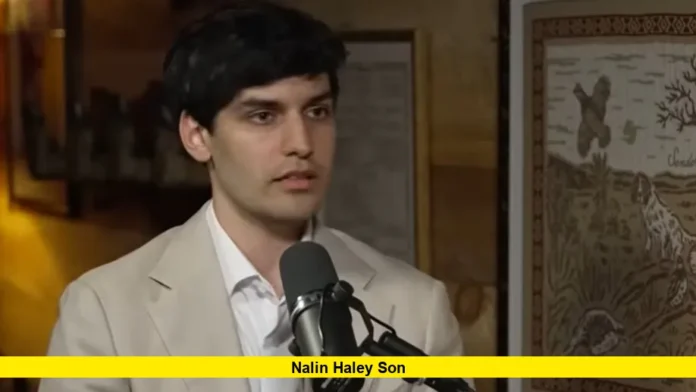

Nalin Haley has sparked nationwide debate after stating that naturalised citizens should not be eligible to hold public office in the United States. He also argued that foreign students in American universities should be limited, raising new questions about immigration, education, and national identity. Nalin Haley’s comments have ignited conversations across political, academic, and cultural spaces, especially because they come from the son of former U.S. Ambassador to the United Nations Nikki Haley.
Nalin Haley’s remarks and the attention they generated
Nalin Haley shared his perspective during a widely viewed interview, making a direct claim that naturalised citizens lack the lived experience needed to serve in public-office positions. His statement—delivered with striking conviction—instantly drew attention. Commentators, students, political observers, and immigrant communities reacted quickly, leading his comments to travel across social platforms within hours.
He argued that individuals who immigrated later in life do not have the same long-term cultural and social understanding of the United States as those born and raised here. This viewpoint placed him at the center of a sensitive national conversation about citizenship, identity, and belonging.
At the same time, he expressed strong concerns about the number of foreign students attending American universities. He suggested that the U.S. should impose restrictions on the international-student population, claiming that the country must protect its institutions and prioritize educational opportunities for American citizens.
These remarks, delivered by someone connected to a prominent political family, intensified interest even further.
Who is Nalin Haley?
Nalin Haley was born in 2001 and is the younger child of Nikki Haley and Michael Haley. Though he does not hold an official role in government or politics, his family name gives him a visible platform. Growing up in a politically active household, he has been exposed to public affairs from an early age.
He is known for expressing strong views on immigration, identity, and the role of citizens within American society. His recent statements reflect a strict, uncompromising approach to citizenship and national allegiance. Many people who follow U.S. political debates, especially younger audiences, have taken notice of the firm and sometimes controversial positions he articulates.
Naturalised citizens and public-office eligibility
The most widely discussed comment from Nalin Haley centers on his belief that naturalised citizens should not be allowed to hold public office. It is a bold stance, especially because it extends beyond current presidential requirements. Under existing rules, natural-born citizenship is required only for the presidency, while many federal, state, and local positions may be held by naturalised citizens.
Nalin Haley argued that the experience of “growing up here” forms an essential foundation for public service. In his view, long-term exposure to the country, its institutions, and its historical and cultural identity makes a meaningful difference when shaping policy or representing the nation.
His critics claim the viewpoint dismisses the loyalty and contributions of millions of naturalised Americans. Supporters, however, see his remarks as an attempt to protect political leadership from foreign influence. This divide mirrors larger national debates surrounding immigration, public trust, and the definition of American identity.
His views on dual citizenship
During the same set of remarks, Nalin Haley also shared his opposition to dual citizenship, calling it a dangerous and confusing status for anyone with ties to two nations. He suggested that dual allegiance introduces security risks and questions about loyalty.
He has stated that a citizen who serves in another country’s military should lose their U.S. status, signaling his belief that citizenship requires clear, single-nation commitment. For supporters of his views, this position fits within a broader framework of national responsibility. For critics, it ignores the complexity of global migration and dual identity among American families.
Limiting foreign students in American universities
Another central point in Nalin Haley’s commentary involves the number of international students studying in the United States. He called for reductions in enrollment, arguing that American students deserve priority and that foreign students bring risks related to national security and workforce competition.
His stance taps into several current national conversations:
- University admissions fairness
Some policymakers believe foreign students occupy seats that should belong to U.S. residents. - Workforce competition
Graduates in fields like technology and engineering often face competition from holders of student visas seeking U.S. employment afterward. - Campus security concerns
A small but growing group argues that foreign students from certain regions pose security risks.
Nalin Haley’s commentary adopts a stricter view than many mainstream political leaders, placing him in a more hard-line camp when discussing the balance between open academic exchange and national protection.
Public reactions and political implications
Public reaction to Nalin Haley’s statements has been intense and mixed. For some, his words resonate with concerns about border security, cultural preservation, and the future of American leadership. For others, his comments are alarming because they categorize naturalised citizens as less qualified or less loyal.
Many immigrant families, especially those who have worked hard to become citizens, expressed concern that such ideas could reverse decades of progress toward openness and equal treatment in the political system.
Political analysts note that his remarks echo certain nationalist positions that have grown among younger conservative voices. His prominence as the son of a national political figure adds additional weight to the discussion.
How Nalin Haley’s identity affects the conversation
Nalin Haley’s own background has added a layer of complexity to the public debate. His mother, Nikki Haley, is the daughter of Indian immigrants, and her family’s story has often been highlighted as an example of the “American dream.” Many people pointed to this contrast when reacting to his statements.
Some argue that his views reflect a generational shift within parts of the conservative movement, where a younger cohort prioritizes national security, cultural cohesion, and citizenship exclusivity more strongly.
Others believe his remarks show a disconnect between the immigrant experience and modern discussions of identity and loyalty. For these critics, his comments overlook the sacrifices and contributions of naturalised families across American history.
Why these remarks matter now
The statements from Nalin Haley entered the national conversation at a moment when debates about immigration, higher education, and citizenship are at the forefront of U.S. politics. With federal discussions underway about student visas, work visas, border policies, and foreign influence on campuses, his remarks aligned closely with ongoing legislative priorities.
His commentary also coincided with increased scrutiny of international academic partnerships, including concerns about unauthorized information sharing or intellectual-property risks.
Moreover, conversations about who can or should hold public office remain active in states where leaders are questioning election integrity, eligibility criteria, and the responsibilities of public servants.
Because of this, Nalin Haley’s opinions, though controversial, reflect issues that many voters are already discussing.
Broader themes raised by his statements
Nalin Haley’s commentary touches several key themes relevant to the U.S. electorate:
1. Citizenship and belonging
Americans continue to debate what it means to be a full member of the nation. His remarks raise questions about whether birthplace should determine eligibility for leadership.
2. National security and trust
Concerns about espionage, foreign influence, and dual allegiance have surged in certain political circles. His stance fits into this landscape.
3. Education and opportunity
With growing pressure on American students, rising tuition, and intense admissions competition, the role of foreign students is becoming a more prominent political issue.
4. Generational divide in political ideology
Younger conservatives like Nalin Haley often express harder lines on citizenship and immigration than older leaders. This suggests a shift within certain ideological groups.
Looking ahead
As Nalin Haley’s comments continue to circulate, they will likely remain part of the broader national discussion on immigration and public-office eligibility. Whether these ideas gain political momentum depends on how voters, policymakers, and advocacy groups respond.
For now, his statements have amplified debate about the rights of naturalised citizens, the structure of U.S. education systems, and the responsibilities associated with citizenship.
What do you think about Nalin Haley’s position on naturalised citizens and foreign students? Share your thoughts and keep the discussion going.