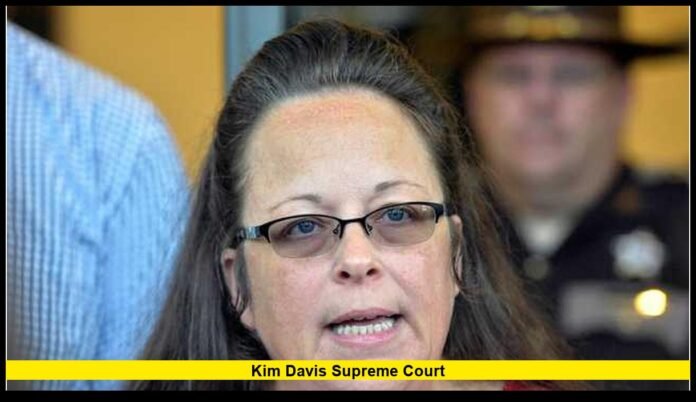

The Kim Davis Supreme Court case has reached a definitive conclusion. The U.S. Supreme Court has officially declined to review former Kentucky clerk Kim Davis’s appeal, leaving in place the rulings that held her liable for denying marriage licenses to same-sex couples. This decision, made public on November 10, 2025, effectively ends her legal fight and reaffirms the constitutional right to same-sex marriage established in the 2015 landmark Obergefell v. Hodges ruling.
Latest Update on the Petition
On November 10, 2025, the Supreme Court refused to hear Kim Davis’s petition that sought to revisit and potentially overturn the Obergefell decision. By denying certiorari, the justices decided that the lower-court judgments against her will remain in place. Davis had argued that her refusal to issue marriage licenses to same-sex couples was based on her sincere religious beliefs and that her actions should have been protected by the First Amendment’s free-exercise clause.
The Court’s rejection means that Davis remains liable for damages exceeding $360,000, including attorney’s fees. This decision not only upholds the financial judgment against her but also reinforces the legal principle that government officials cannot refuse to perform public duties based on personal religious convictions.
Background of the Case Involving Kim Davis
Kim Davis gained national attention in 2015 when she refused to issue marriage licenses to same-sex couples following the Supreme Court’s Obergefell v. Hodges decision. Serving as a county clerk in Rowan County, Kentucky, Davis maintained that issuing such licenses violated her Christian beliefs.
Her refusal led to multiple lawsuits filed by couples who had been denied marriage licenses. In subsequent rulings, federal courts found that Davis had violated the constitutional rights of those couples. She was briefly jailed for contempt after disobeying a court order directing her to issue the licenses.
In the years that followed, Davis became both a symbol of religious liberty for some and of discrimination for others. The case against her moved through various legal stages, culminating in a 2023 decision from the Sixth Circuit Court of Appeals affirming that Davis could not invoke the First Amendment as a defense against liability for actions performed in her official capacity.
What the Supreme Court’s Decision Means
By declining to hear the Kim Davis Supreme Court petition, the justices have allowed the existing lower-court decisions to stand. This action carries several key implications:
- The financial penalties remain in force. Davis must pay the damages awarded to the couples she denied marriage licenses.
- The Obergefell precedent is reaffirmed. The constitutional right to same-sex marriage remains settled law.
- Limits on religious exemptions are reinforced. Public officials cannot use personal beliefs to exempt themselves from performing legally required duties.
- Judicial restraint is evident. Even with a conservative majority, the Court chose not to reopen the debate on marriage equality.
This decision reflects the Supreme Court’s current approach to maintaining institutional stability on previously decided issues, particularly those with far-reaching social consequences.
Timeline of Events
| Year/Date | Event |
|---|---|
| 2015 | Obergefell v. Hodges legalizes same-sex marriage nationwide. |
| 2015 | Kim Davis refuses to issue licenses, citing her religious beliefs, and is later jailed for contempt. |
| 2018–2023 | Civil suits move forward; courts find Davis personally liable for violating constitutional rights. |
| March 2025 | The Sixth Circuit Court of Appeals upholds prior judgments against Davis. |
| November 10, 2025 | The Supreme Court denies Davis’s petition for review, finalizing the outcome. |
Key Legal Issues and Rationale
Kim Davis’s appeal centered on two core legal arguments:
- Free Exercise of Religion: Davis contended that her religious beliefs should exempt her from issuing marriage licenses to same-sex couples. Courts rejected this argument, holding that personal religious convictions cannot override constitutional obligations while acting as a public official.
- Challenge to Obergefell v. Hodges: Davis’s attorneys attempted to use her case as a vehicle to challenge the validity of the Obergefell decision itself. They argued that the ruling lacked constitutional grounding and infringed on states’ rights. However, the Supreme Court’s refusal to hear the case underscores its unwillingness to revisit that landmark precedent at this time.
The Sixth Circuit’s decision, left undisturbed by the Supreme Court, firmly establishes that public officials performing state duties cannot claim religious immunity from constitutional requirements.
Reactions and Broader Context
The Supreme Court’s decision was met with strong reactions from both sides of the issue. LGBTQ+ advocacy groups praised the ruling, emphasizing that it reaffirms equal treatment under the law for all citizens, regardless of sexual orientation. Supporters of Davis expressed disappointment, viewing the decision as a setback for religious liberty protections in the workplace.
The broader national context is noteworthy. Since the Supreme Court’s 2022 decision in Dobbs v. Jackson Women’s Health Organization, which overturned Roe v. Wade, some had speculated that other landmark rulings—such as Obergefell—might also be reconsidered. The Court’s action in the Davis case suggests that, at least for now, the justices are not inclined to reopen the marriage-equality debate.
Why This Decision Matters
The Kim Davis Supreme Court outcome is significant for several reasons:
- Legal Precedent: It reinforces the durability of Obergefell v. Hodges as settled constitutional law.
- Public Officials: It sends a clear signal that government employees cannot refuse service or duties based on personal beliefs.
- Religious Freedom Debate: It draws a distinct boundary between individual religious rights and public responsibilities.
- Judicial Strategy: It shows that attempts to relitigate major precedents through indirect cases will likely face steep challenges.
For same-sex couples, this decision provides continued legal certainty that their marriages and rights are protected nationwide. For those advocating for broader religious exemptions, it signals that the judiciary remains cautious about expanding such defenses in public-duty contexts.
What’s Next for Kim Davis
Following the Supreme Court’s refusal, Kim Davis’s legal options are now limited. She must comply with the existing judgment and satisfy the damages awarded to the plaintiffs. Although her attorneys may explore other state-level appeals or policy advocacy, the federal avenue for overturning her liability—or the Obergefell ruling itself—has effectively closed.
Her case will remain a touchstone in debates over religious liberty, LGBTQ+ rights, and the responsibilities of public officials.
Final Thoughts
The Supreme Court’s action in the Kim Davis Supreme Court case underscores a critical balance between personal faith and public duty. By leaving the lower-court rulings intact, the justices affirmed that constitutional rights, once established, cannot be denied based on individual religious objections. The decision not only concludes a decade-long legal battle but also reinforces the enduring strength of marriage equality in the United States.
If you found this article insightful, share your thoughts in the comments below and stay engaged for future legal updates.