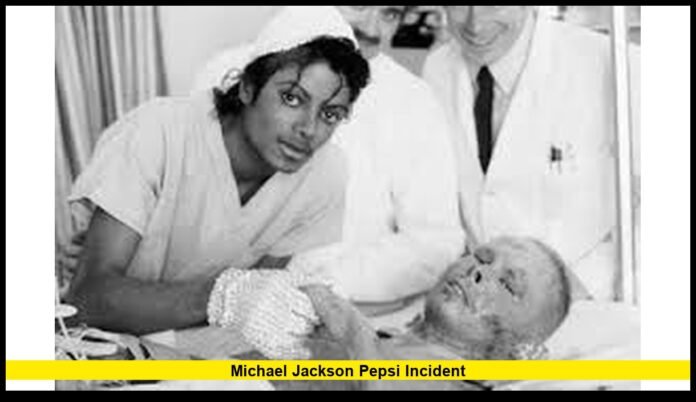

The Michael Jackson Pepsi incident remains one of the most dramatic turning points in pop music history, and its effects still ripple decades later. On January 27, 1984, during a high-profile commercial shoot for Pepsi at the Shrine Auditorium in Los Angeles, Michael Jackson suffered severe burns to his scalp when pyrotechnic effects malfunctioned. What began as a routine endorsement spot evolved into a career-and-life-altering event.
Accident at the Pepsi Shoot
Michael Jackson was filming a Pepsi commercial alongside his brothers and an audience of thousands, intended to launch a promotional campaign tied to his upcoming tour. During the sixth take, a set of magnesium-based flash bombs detonated too close to his head. The gel in his hair ignited, and sparks flew around his face and shoulders. He reportedly kept moving for a moment before realizing his scalp was on fire.
Emergency crews, production staff and fellow performers rushed to assist him. He was first taken to Cedars-Sinai Medical Center and later transferred to the Brotman Medical Center for burns to his scalp and face. He sustained second-degree burns, and some reports indicate damage may have touched third-degree levels in portions of the scalp. His characteristic hair loss and frequent use of wigs, hats and headgear in later years trace back to the damage sustained that night.
Immediate Medical and Personal Fallout
After the incident, Jackson faced both physical pain and psychological trauma. The burn area eventually required reconstructive procedures. He began using wigs and hair pieces more consistently to conceal scarring and hair loss. According to interviews and retrospective analyses, the accident also marked the beginning of chronic pain issues for him—particularly scalp pain and recurring migraines—which some observers link to his later heavy reliance on prescription medications.
Although Jackson did not publicly wage a high-profile lawsuit against Pepsi, the company provided a settlement and donation to the burn center where he was treated. In turn, Jackson donated the funds to establish a specialized treatment facility. The commercial was eventually completed and aired, but the incident permanently changed its legacy.
Long-Term Impact on Jackson’s Career and Identity
The Michael Jackson Pepsi incident signaled a turning point in how he presented himself publicly. Prior to the accident, Jackson was known for his flawless image and skyrocketing global success. Afterward several changes became visible:
- More frequent use of wigs, headgear and theatrical hairstyles—first as a concealment strategy then as a stylistic choice linked to his evolving persona.
- Greater caution (and perhaps anxiety) around stage effects and pyrotechnics; his performances, while still electrifying, incorporated more controlled visual elements.
- An often-overlooked influence on his health: the long-term pain and medical intervention seem to have shaped his experience behind the scenes—from sleep and medication use to his personal reflections on performance and vulnerability.
Though he released landmark albums afterward (such as Bad and Dangerous), the accident cast a shadow on his “invincible” image. Fans and commentators believe the physical and emotional scars never fully healed.
Safety in Entertainment: Lessons from the Pepsi Incident
While the spark-ignited hair of a global superstar makes for shocking visuals, the lessons behind the Michael Jackson Pepsi incident extend into broader entertainment industry practices:
- On-set pyrotechnic coordination demands precise timing, distance and fail-safe protocols—especially when performers are in motion in front of live audiences.
- Producer, director and safety teams must ensure adequate protective measures, including fire-resistant hair products, immediate medical access and audience safety boundaries.
- The incident underscored how celebrity status does not exempt production from rigorous safety checks. The aftermath of the Pepsi including fire-safety reviews and policy improvements in commercial and music-video sets.
Landmark Moments and Timeline
| Date | Event |
|---|---|
| Jan 27 1984 | Michael Jackson suffers head/face burns during Pepsi commercial shoot |
| Early 1984 | Immediate treatment: burn center, hospitalization, emergency surgeries |
| Mid 1980s | Jackson begins using wigs/headgear regularly; some reconstructive procedures |
| Post-1984 | Jackson’s global superstardom continues—but personal health struggles deepen |
Legacy and Reflection
Today, the Michael Jackson Pepsi incident is more than just a historical footnote. It is:
- A vivid reminder that even icons are vulnerable to the hidden costs of performance and fame.
- A key moment that reshaped Jackson’s public image, artistic choices and personal narrative.
- A cautionary tale for entertainment productions—demonstrating that the drive for spectacle must always be balanced with safety.
As Jackson himself once described the cause plainly: a miscalculation of proximity and timing, “stupidity, pure and simple.” The incident triggered no immediate career halt, yet its effects rippled for decades—in pain, in recovery, in reinvention.
Today, fans view Jackson’s later look—hats, wigs, dramatic hairstyles—not just as fashion, but as artifacts of recovery. His enduring status as the “King of Pop” remains intact; yet the Pepsi incident reminds us that even legends carry scars.
What do you think changed most for Michael Jackson after the Pepsi incident? Join the discussion below and share your perspective.