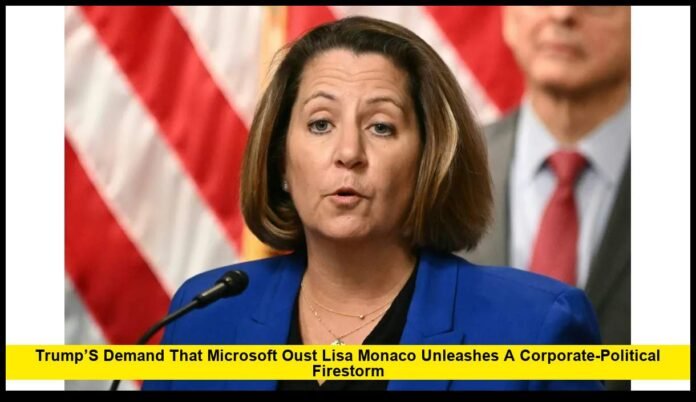

In a dramatic show of power, former President Donald Trump has urged Microsoft Corporation to immediately remove its President of Global Affairs, Lisa Monaco, declaring her a “menace to U.S. national security.” At the heart of this battle lies what can aptly be called a house of dynamite scenario — one spark could trigger wide-ranging consequences across business, politics and government.
Monaco, a veteran of the Obama and Biden administrations, was tapped by Microsoft in mid-2025 to oversee its global affairs and policy engagements. Trump’s public call to action, posted on Truth Social on September 26, 2025, accused Monaco of having her security clearances revoked and being barred from federal properties — assertions she has not publicly addressed. Microsoft chose not to comment when asked about the demand.
Background: Why This Matters
Monaco’s appointment at Microsoft came at a time when the firm holds expansive federal government contracts and increasingly global operations. With her deep experience in national security, counterterrorism and justice department leadership, Monaco was positioned to bridge corporate and governmental worlds.
However, Trump and his allies saw her presence as ominous. He argued that a person who once held responsibility for investigating elements of the U.S. justice system had no business sitting in a private-sector role that interfaces with government agencies and global policy shaping. That, he claimed, transforms a corporate appointment into a “house of dynamite” — a ticking entity poised for explosion.
Monaco’s Résumé: It’s Impressive — And Contentious
A quick overview of Lisa Monaco’s career:
- Served as Homeland Security Advisor and Counterterrorism Adviser in the Obama administration.
- Led the Justice Department’s National Security Division, and eventually became Deputy Attorney General during the Biden administration.
- Joined Microsoft around July 2025 as President of Global Affairs, tasked with managing the company’s government relations, global policy footprint and geopolitical risk strategy.
These credentials made her an ideal choice for the role — yet drew immediate criticism from those wary of her deep regulatory and investigative background.
Trump’s Accusations: Sharp, Public and Strategic
Trump’s statement read:
“It is my opinion that Microsoft should immediately terminate the employment of Lisa Monaco. She is a menace to U.S. national security, especially given the major contracts that Microsoft has with the United States Government.”
He referenced Monaco’s alleged clearing-house access and government clearance revocations, and pointed to Microsoft’s large federal footprint as justification. Lines like “menace to national security” and “major contracts” were meant not only to persuade Microsoft but to signal — to corporate America — that leadership decisions will be scrutinized under his lens.
His post triggered a wave of commentary, raising questions such as:
- Would Microsoft acquiesce to a former president’s demand?
- What would that mean for corporate independence?
- How would investors, regulators and employees react?
The stakes are high. Microsoft accounted for billions in government contracts, so the idea of its global affairs leader being targeted as a security threat is not everyday fodder.
Corporate Risk and Reputation Exposure
For Microsoft, this moment represents a precarious test:
- If the company fires Monaco, critics will argue it yielded to political pressure, potentially weakening the principle of board-level independence.
- If the company stands by her, it risks friction with one of the most publicly outspoken political figures in America.
- Either path may affect morale, stock perception, regulatory posture and future hiring of high-level executives with government backgrounds.
Executives and boards across the tech sector are likely watching closely. This case may become a template for how political leaders attempt to influence corporate governance, especially where government contracts or national security intersect.
The Political Strategy at Play
Why did Trump choose to go after Monaco now, and in this manner? Several considerations:
- Symbolic value – Targeting a high-profile tech company and its senior executive amplifies his message that corporate America is not immune from his influence.
- Policy leverage – Microsoft’s strong ties to federal contracts and technology infrastructure mean pressure here could carry operational or regulatory weight.
- Historic pattern – This is not the first time Trump has publicly demanded changes in corporate leadership. Past incidents included calls for executive resignations at other major firms.
- Media moment – The confrontation garners headlines across politics and business outlets, reinforcing Trump’s brand of confrontation and oversight.
By dubbing the situation a “house of dynamite,” one might say the metaphor reflects not only potential explosive consequences for Microsoft or Monaco—but for the broader intersection of government and business.
What Happens Next?
Several key developments will determine the outcome:
- Microsoft’s public response: The company may issue a statement defending Monaco, affirming internal processes, or remain silent while it deliberates.
- Board and executive deliberation: Internal governance discussions will evaluate whether the board and senior leadership view the request as legitimate, reputationally risky or an overreach of political influence.
- Employee and investor reaction: Leadership could face internal unrest or external investor pressure based on how they respond. Some may see firing as weakness; others may view standing firm as risk.
- Regulatory and contract risk: With federal contracts and national security implications in play, the company may well monitor for ripple effects on its government relationships.
- Precedents being set: Other companies with executives possessing strong government or security backgrounds may reassess their governance and public exposure.
In many ways, Microsoft—and Monaco—sit at the center of this “house of dynamite.” One false move, mis-statement or decision could trigger significant backlash.
Implications Beyond One Executive
While the headline focuses on Lisa Monaco and Microsoft, the underlying themes extend much further:
- Corporate governance: The pressure to act based on political demands rather than purely internal evaluation may erode long-established practices of board autonomy.
- Tech and national security: Many major tech firms now serve as critical infrastructure partners to the government. The case highlights how corporate roles can carry national implications.
- Executive hiring trends: Companies may rethink hiring former high-level government officials who face public political exposure. The risk of becoming a lightning rod may increase.
- Political influence in private sector: The episode raises the question: Can or should political figures publicly demand corporate firings? And what precedents will that set?
- Public trust and perception: How the public views corporate independence, national security, and tech firms’ relationships with government will likely shift depending on how this unfolds.
What Readers Should Watch
| Indicator | Why It Matters |
|---|---|
| Microsoft’s response time & tone | Indicates how seriously the company views the threat of reputational/political exposure. |
| Board & leadership statements | Reveal internal cohesion and governance stance under pressure. |
| Stock market reaction | A visible sign of investor concern over governance/strategic risk. |
| Press coverage & analyst commentary | Shapes public narrative about corporate-political boundaries. |
| Future corporate hires of former government officials | Will show how companies adapt their risk calculus. |
Reflecting on the “House of Dynamite” Metaphor
Why is this aptly called a house of dynamite?
- Dynamite implies something volatile, explosive and prone to sudden cascading changes.
- A “house” suggests it is built from multiple interconnected elements — politics, contracts, technology, leadership, government oversight.
- Combine them: a corporate entity (Microsoft) with deep government ties, a political figure (Trump) wielding public pressure, and a leader (Monaco) representing the juncture. One detonator—one public post—could spark widespread impact.
It underscores that in today’s U.S. landscape, corporate decisions are no longer isolated from political dynamics. The walls are thinner; the wiring more sensitive.
Wrapping Up
The demand by Trump that Microsoft fire Monaco places both the company and public corporate governance at a turning point. Whether Microsoft relents, resists, or carefully navigates a middle path, the outcome will reflect how technology companies respond to political pressure in a nation where private and public interests are increasingly intertwined.
What’s your take? Will Microsoft stand by its new executive or yield under the pressure? How do you see this affecting corporate–government boundaries going forward? Share your thoughts below and stay tuned as this story develops.