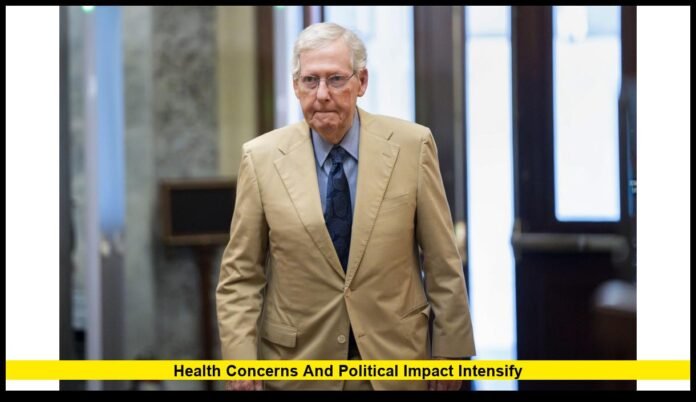

Senator Mitch McConnell falls in the Capitol hallway, once again drawing national attention to his health and sparking conversations about leadership, longevity, and transparency in American politics. The incident, which occurred as the 83-year-old senator was heading toward the Senate chamber to cast a vote, has added urgency to an already growing debate about age, fitness, and the future of senior lawmakers in Washington.
McConnell, a towering figure in U.S. politics for decades, appeared to recover quickly and proceeded with his schedule, but the moment was witnessed by reporters and staffers who immediately recognized its significance. For many Americans, this was more than a stumble — it was a symbolic reminder of the fragility of age at the highest levels of government.
The Fall That Captured Washington’s Attention
The incident unfolded in a busy Capitol hallway as McConnell walked toward the chamber accompanied by aides and Capitol Police. Witnesses say he stumbled, briefly lost his balance, and fell to the ground. Staff members quickly moved to assist him, and within moments, he was back on his feet.
He signaled to those around him that he was fine, brushed off his jacket, and continued toward the chamber to cast his vote. The fall was brief but highly visible, immediately sparking a flurry of discussions inside the Capitol and on political talk shows across the country.
McConnell’s office later downplayed the incident, stating he suffered no injury and would continue his work as planned. However, the moment resonated widely because it wasn’t the first time the senator has experienced such an event.
A History of Public Health Incidents
For years, Mitch McConnell’s health has been a subject of public attention. His recent fall is part of a larger pattern of medical events and physical missteps that have been documented over the last several years:
- Multiple falls in recent years — McConnell has experienced previous tumbles in Senate hallways, outside the chamber, and after luncheons.
- Concussion and fractured rib in 2023 — A serious fall two years ago led to an extended recovery period.
- Freezing moments — On several occasions during press conferences, McConnell has appeared to freeze mid-sentence before resuming, raising speculation about neurological issues.
- Mobility challenges — Residual effects from childhood polio have long influenced his gait, making stumbles more likely.
Each of these incidents individually might not raise alarm. But together, they create a pattern that has increasingly shaped public perception of his health and his ability to continue performing the demanding duties of a U.S. senator.
McConnell’s Political Standing Amid Health Scrutiny
Mitch McConnell is not just any senator. He is one of the most influential political figures in modern American history. Serving for decades, he has shaped the federal judiciary, led his party through polarized eras, and played a key role in major legislative battles.
Although he stepped down as Senate Republican leader in early 2024, McConnell still holds his Senate seat and remains an influential presence. Earlier this year, he announced that he would not run for re-election in 2026 but intends to serve out his current term, which ends in January 2027.
This decision set the stage for political maneuvering in Kentucky and Washington, but the senator has continued to participate in floor votes, closed-door meetings, and policy discussions. Every public appearance is closely watched — and each health-related episode, including this latest fall, intensifies speculation about how long he can remain active in such a demanding environment.
The Broader Age and Leadership Debate
McConnell’s fall is not occurring in isolation. In recent years, concerns over aging leaders have become a dominant theme in American political discourse. Several key political figures from both parties are well into their 80s, and voters are increasingly vocal about wanting transparency and accountability regarding the health of their elected officials.
The debate centers around several key themes:
- Public confidence: Voters expect their representatives to be physically and mentally capable of carrying out their responsibilities.
- Transparency: There is growing pressure for regular, detailed health disclosures from senior lawmakers.
- Institutional stability: Health crises among key leaders can disrupt legislative schedules, negotiations, and leadership plans.
- Succession planning: Parties and states must be prepared for transitions should health issues worsen unexpectedly.
McConnell’s fall, while brief and apparently without injury, feeds directly into this national conversation. It serves as a visible reminder of the physical toll that decades in public office can take and the responsibilities that come with such positions.
Inside the Capitol: Reactions from Lawmakers
The immediate response within the Capitol was one of concern but also familiarity. Lawmakers and staffers have grown accustomed to heightened attention whenever McConnell has a health episode. Some colleagues privately expressed worry about the frequency of these incidents, while others publicly praised his resilience and commitment to continuing his duties.
Behind closed doors, discussions have intensified around how leadership transitions might unfold if McConnell’s health were to deteriorate further. Although he no longer leads the Republican conference, his influence in policy negotiations, particularly on judicial appointments and budgetary issues, remains significant.
Several senators have also used recent health incidents among senior lawmakers as a catalyst to propose discussions on standardizing health disclosures. While such proposals have not gained official traction, they reflect growing unease in both parties about the lack of formal mechanisms to address health and capacity concerns for aging members.
Public Reaction Across the Country
The fall generated swift reactions nationwide. On social media, some Americans expressed concern and offered well-wishes. Others pointed to the incident as evidence of the need for term limits or mandatory retirement ages for members of Congress.
In Kentucky, where McConnell has been a political fixture for decades, reactions were mixed. Many long-time supporters voiced continued respect for his decades of service, while others questioned whether it might be time to begin a more formal transition process.
Political analysts noted that incidents like this can have subtle but real effects on public perception. Even if McConnell remains active and engaged, repeated health scares can shape narratives around leadership strength and institutional continuity.
Potential Political and Institutional Consequences
The repercussions of McConnell’s fall extend beyond personal health concerns. In Washington, leadership stability matters deeply for legislative strategy and political maneuvering.
Here are some potential consequences if incidents continue:
- Increased internal pressure within the Republican Party to accelerate succession discussions.
- Heightened scrutiny from Democrats, who may view any instability as an opportunity to press strategic advantages.
- Media focus on age and leadership, which could shape voter sentiment ahead of the 2026 election cycle.
- Possible adjustments to McConnell’s public schedule, reducing press conferences or floor appearances to minimize visible incidents.
While McConnell remains determined to fulfill his duties, the political ecosystem around him is already adapting to the reality of his age and health patterns.
A Career Defined by Power and Endurance
Senator Mitch McConnell’s career is unparalleled in modern Senate history. He has led his party through ideological battles, navigated government shutdowns, confirmed Supreme Court justices, and shaped the judiciary for a generation.
This latest fall does not erase that legacy, but it does add a poignant layer to his final years in office. For a man known for strategic calculation and political toughness, each health incident is not just personal — it’s part of the evolving story of his leadership and legacy.
What Comes Next
For now, McConnell continues to work. His office has indicated that no changes to his schedule are planned, and he remains committed to serving through the end of his term. However, Washington will continue to watch closely.
Future incidents could force more public conversations about health disclosures, leadership planning, and even possible early retirement scenarios. Political figures, constituents, and media outlets will all be paying attention to how McConnell navigates the remainder of his time in the Senate.
Closing Thoughts
Senator Mitch McConnell falls again, and though he rose quickly this time, the moment echoed far beyond the hallway where it happened. It crystallized national debates about leadership, aging, and accountability. It reminded the public that even the most powerful political figures are not immune to time.
As McConnell continues his work in Washington, the country watches not only his votes but his steps — each one carrying both political weight and symbolic meaning.