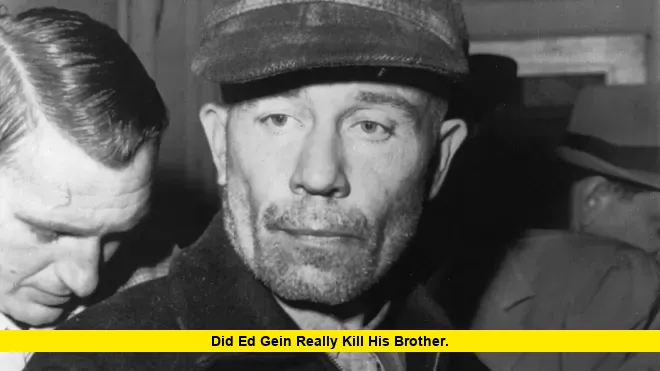

The question did Ed Gein really kill his brother has lingered in American criminal history for decades, and recent discussions have reignited public interest in one of Wisconsin’s most infamous cases. As of today, the mystery surrounding Henry Gein’s death continues to fascinate crime historians and true-crime followers, with fresh examinations of evidence, police reports, and psychological analyses shedding light on what may have happened on that remote farm in Plainfield.
The Night That Changed Everything
In the spring of 1944, Ed Gein and his older brother Henry set out to burn off marsh vegetation on their rural property near Plainfield, Wisconsin. It was a common agricultural practice intended to clear land for planting. But the controlled fire quickly spread, prompting local authorities to intervene and help contain the blaze.
By nightfall, Henry was dead. Ed reported his brother missing to authorities, leading to a search party. Strangely, Ed led the group directly to Henry’s body, lying face down on the ground, bruised but not burned. This unusual behavior immediately raised eyebrows. If Ed truly didn’t know where Henry was, how could he have located him so effortlessly in the dark woods?
At the time, the sheriff’s office listed the cause of death as heart failure, aggravated by smoke inhalation. But the presence of unexplained injuries on Henry’s head and the suspicious circumstances surrounding the discovery of his body created doubts that persist to this day.
A Deeper Look at Henry Gein’s Death
Henry’s death was never formally investigated as a homicide. The authorities closed the case quickly, stating that no foul play was suspected. However, after Ed Gein’s arrest in 1957 for the murders of Bernice Worden and Mary Hogan, investigators began reexamining his past—including his relationship with Henry.
Key details that make Henry’s death suspicious:
- Unusual injuries: Henry reportedly had bruises on his head, inconsistent with smoke inhalation alone.
- Ed’s behavior: He led police directly to the body, contradicting the idea that Henry was missing.
- Lack of autopsy: The absence of a detailed autopsy left critical questions unanswered.
- Family tensions: Henry had begun criticizing their domineering mother, Augusta, something Ed deeply resented.
While there is no physical evidence proving murder, these factors have kept speculation alive for more than 80 years.
Ed and Henry’s Relationship: Brothers or Rivals?
Ed Gein and Henry Gein were raised in a strict, isolated household under their mother Augusta’s authoritarian rule. She preached that the outside world was sinful and evil, particularly women. Ed was deeply attached to her, viewing her as a near-religious figure. Henry, however, grew increasingly disillusioned with her strict moral codes as he got older.
Henry began spending more time away from home, dating a local woman, and questioning Augusta’s influence over Ed. Witnesses at the time described Henry as protective of his younger brother but frustrated by Ed’s unwavering devotion to their mother.
Many criminologists believe that Henry’s criticism of Augusta may have triggered Ed’s resentment. In some interpretations, Henry represented a threat to Ed’s psychological world—one where Augusta’s word was law.
Renewed Public Interest in 2025
In recent months, documentaries, podcasts, and crime historians have brought Henry’s death back into the spotlight. Several modern analysts have reexamined old police files, autopsy records, and psychological evaluations of Ed Gein. Some even used forensic pathology techniques to reassess the likely causes of Henry’s death.
These renewed examinations highlight one thing: the original investigation was remarkably limited by today’s standards. With no autopsy, no crime scene photographs, and minimal evidence preservation, the case was effectively closed before any real inquiry took place.
Modern experts note that if Henry’s death happened today, it would have triggered a full-scale homicide investigation, including autopsy, forensic testing, and interviews with neighbors and family members. Many believe that if this had happened in 1944, the truth might have been uncovered long before Ed’s later crimes came to light.
How Henry’s Death Shaped Ed’s Later Crimes
The unresolved nature of Henry’s death raises another critical question: if Ed did kill his brother, was this his first violent act? Some analysts consider Henry’s death a possible precursor to Ed’s later murders and grave robbing activities.
After Henry died, Ed lived alone with his mother until her death in 1945. This isolation further deepened his psychological decline. Following her passing, Ed began collecting human body parts from graves, fashioning them into household items, and later committing two confirmed murders.
If Henry’s death was indeed the result of fratricide, it may have marked the beginning of Ed’s descent into the macabre acts that later horrified the nation and inspired countless books and films.
The Official Status of the Case Today
As of 2025, Henry Gein’s death remains officially classified as accidental. There have been no efforts to reopen the case, largely because of the lack of surviving evidence and witnesses. Local Wisconsin authorities acknowledge the historical interest in the case but maintain that the available information does not justify a formal investigation after so many decades.
Forensic experts note that exhuming Henry’s body might not yield conclusive results after more than 80 years, especially given the natural decomposition of soft tissue that could reveal head injuries.
However, the *question—did Ed Gein really kill his brother—*remains at the center of historical crime debates, illustrating how gaps in early 20th-century investigations can leave enduring mysteries.
Why This Question Still Matters
The intrigue around Henry Gein’s death goes beyond simple curiosity. It represents a critical chapter in understanding one of America’s most notorious criminals. It also serves as a case study for how limited investigative tools of the past can shape public perception and historical narratives.
True-crime enthusiasts, historians, and forensic experts continue to analyze this case not only to solve a mystery but also to better understand how early warning signs in criminal behavior can be missed. Henry’s unexplained death, if reclassified as murder, would rewrite the timeline of Ed Gein’s violent history.
The Lingering Mystery
The debate over Ed Gein’s involvement in his brother’s death is unlikely to be settled definitively. With no surviving physical evidence and few living witnesses, the mystery has become part of American crime folklore—a story that blends historical fact with psychological intrigue.
What remains clear is that Henry’s death marked a turning point in Ed Gein’s life, whether by fate or by his own hand. As public interest resurges, this decades-old mystery continues to challenge our understanding of truth and justice in historical criminal cases.
What do you think? Should Henry’s case be reopened, or will the truth remain buried forever? Share your thoughts and keep the conversation going.