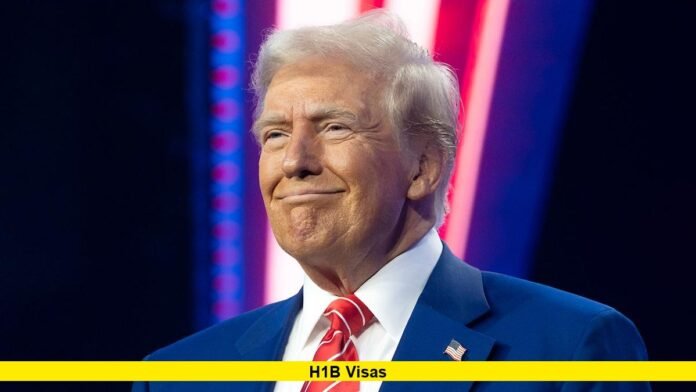

The debate over immigration and work permits has taken a sharp turn as President Donald Trump unveils a sweeping new rule regarding H1B visas. On September 19, 2025, Trump signed a presidential proclamation that introduces a $100,000 annual application fee for every H1B visa petition. This decision has sent shockwaves across the business world, academia, healthcare, and immigrant communities, making it one of the most consequential changes to the high-skilled worker program in decades.
The H1B visa program has long been a gateway for highly skilled foreign professionals—particularly in technology, science, and medicine—to work in the United States. Companies from Silicon Valley to Wall Street have relied on it to fill critical skill gaps and remain competitive in a fast-moving global economy. With this new rule, however, the cost of hiring foreign talent rises to unprecedented levels, effectively reshaping how employers approach workforce planning.
Trump and his administration argue that the move is necessary to protect American workers, ensuring that U.S. citizens are not undercut by cheaper foreign labor. By tying H1B access to such a high price tag, the policy intends to reduce dependence on international hires and push businesses to focus more on domestic recruitment. Critics, however, see the fee as a barrier that will drive talent away from the U.S. to more welcoming countries, jeopardizing innovation and economic growth.
As the announcement reverberates, industries that have traditionally relied on H1B visas—such as technology firms, research institutions, and hospitals—are now grappling with tough questions about the future. Will the U.S. continue to attract the world’s best and brightest, or has this new rule made that goal nearly impossible?
What Has Changed with H1B Visas
For decades, H1B visas have served as a cornerstone of U.S. immigration policy, providing a pathway for highly skilled foreign workers to contribute to the American economy. The program has been especially vital for technology firms, healthcare institutions, universities, and finance companies that depend on specialized global talent. Traditionally, employers sponsoring H1B visas paid government filing and legal fees amounting to just a few thousand dollars. Trump’s latest proclamation, however, has completely transformed that framework, introducing sweeping changes that will impact both employers and workers.
Here’s a breakdown of the new rules:
- New Fee Requirement
Employers must now pay $100,000 annually for each H1B petition. This is a massive jump from the earlier system, where typical filing fees ranged between $5,000 and $10,000 depending on the company’s size. The new cost structure means that hiring even a handful of foreign workers could cost a business millions of dollars every year. - Entry Restriction
Under the proclamation, an H1B worker cannot legally enter the United States unless the sponsoring employer has paid the required fee in advance. This condition ensures that no worker bypasses the payment system, effectively tying the visa’s validity to the employer’s financial capacity. - Prevailing Wage Increase
The Department of Labor has been instructed to revise prevailing wage levels, which serve as benchmarks for what employers must pay H1B workers. The goal is to prevent companies from hiring foreign talent at artificially low wages that could disadvantage U.S. workers. Employers will now be required to offer salaries more in line with—or in some cases higher than—market standards for American workers in the same roles. - New Immigration Paths for Wealthy Applicants
In addition to reforming the H1B system, Trump introduced “Gold Card” and “Platinum Card” immigration categories. These programs allow wealthy individuals or corporations to contribute large sums—ranging from one million dollars upward—in exchange for expedited residency and a potential pathway to citizenship. While distinct from H1B visas, these options reflect a broader shift toward wealth-based immigration.
Together, these changes mark a dramatic reconfiguration of America’s approach to high-skilled immigration. The H1B program, once accessible to a wide range of employers, is now poised to become an option primarily for the richest corporations.
Why the Trump Administration Made This Move
The Trump administration has consistently positioned itself as a defender of American workers, and the sweeping changes to the H1B visa system are being framed within that philosophy. According to Trump and his advisors, the H1B program—though designed to bring in top global talent—has often been misused by employers. In their view, companies have relied on foreign labor not only to fill skill gaps but also to reduce labor costs by paying international workers less than their U.S. counterparts. This, they argue, has had the unintended consequence of pushing down wages in some of the country’s most competitive and fast-growing industries.
By imposing a $100,000 annual fee for every H1B petition, the administration hopes to fundamentally alter how companies make hiring decisions. The reasoning is straightforward: if the financial burden of hiring foreign workers becomes significant, businesses will be forced to rethink whether it is truly necessary. For Trump’s team, this creates a powerful incentive to prioritize American citizens and permanent residents first when filling critical roles.
The administration also points to a broader economic purpose. The revenue generated from these steep fees could, in theory, be redirected toward workforce development programs, such as job training, apprenticeships, and education initiatives aimed at equipping Americans with skills in technology, healthcare, and other high-demand sectors. Supporters argue that this could help reduce the country’s reliance on foreign workers over the long term.
To summarize, the new fee structure is intended to:
- Discourage Over-Reliance on Foreign Hires: Companies will now think carefully before bringing in international workers under the H1B program.
- Encourage U.S. Employment First: The high cost nudges firms to recruit more aggressively from the domestic labor market.
- Raise Federal Revenue for Workforce Development: Funds from the program could be invested in training Americans for the jobs that companies say are hard to fill.
However, critics warn that these justifications mask a deeper problem. By setting the price so high, the government has effectively turned the H1B program into an immigration pathway that only wealthy corporations can afford. This not only shuts out small businesses and startups but also risks making the U.S. less attractive to highly skilled professionals, who may simply choose other countries with more accessible immigration systems.
Impact on the Tech Industry
Of all the sectors that rely on H1B visas, the technology industry will likely feel the greatest shockwaves from Trump’s new rule. For years, Silicon Valley giants such as Google, Microsoft, Amazon, Apple, and Meta have been among the top sponsors of H1B workers, bringing in thousands of engineers, data scientists, cybersecurity specialists, and software developers each year. These companies argue that the U.S. does not produce enough qualified workers to meet the explosive demand for tech skills, and foreign professionals help fill the gap.
With the new $100,000 annual fee per visa, the financial stakes are enormous. If a company hires 5,000 H1B workers—a number that’s not unusual for global tech leaders—the cost of maintaining that workforce could surge into the hundreds of millions or even billions of dollars annually. While mega-corporations might have the resources to absorb such costs, it could significantly impact their profitability and hiring strategies.
The effect on smaller businesses is even more severe. Many start-ups and mid-sized firms have traditionally relied on H1B visas to bring in niche expertise, especially in areas like artificial intelligence, robotics, or biotech, where specialized knowledge is scarce. Previously, a start-up might budget $10,000 in filing and legal fees to bring on a talented engineer from abroad. Under the new rules, that cost balloons by an additional $100,000 every single year—an expense that is simply unsustainable for most small firms.
The ripple effects could be profound:
- Slowing Down Innovation: With fewer skilled professionals entering the U.S., projects in fields like AI, cloud computing, and medical technology may be delayed or abandoned altogether.
- Accelerating Outsourcing: To avoid the new costs, companies may expand operations in countries such as India, Canada, or Eastern Europe, moving jobs out of the U.S. instead of creating them domestically.
- Reducing Diversity of Talent: The U.S. has long been a magnet for some of the brightest minds in the world. Restricting H1B visas to only the wealthiest companies risks narrowing the range of skills, ideas, and cultural perspectives that fuel American innovation.
- Widening the Gap Between Big Tech and Startups: Large firms may manage the expense and continue to dominate, while smaller competitors are effectively pushed out of the global talent race.
In the long term, this policy could reshape the entire technology ecosystem. Instead of America being the automatic destination for top global talent, engineers and innovators may increasingly look to Canada, the U.K., or Europe, where immigration pathways are less costly and more accessible. For a nation that has built much of its success on pioneering technologies and entrepreneurial dynamism, the risk of slowing innovation could prove to be one of the most consequential outcomes of the new H1B fee.
Reactions from Employers and Advocacy Groups
The announcement of a $100,000 annual fee on H1B visas has triggered immediate and wide-ranging reactions from across the country. From boardrooms in Silicon Valley to labor union halls in the Midwest, the policy is being dissected for its economic, social, and political implications. The response has been mixed, highlighting a sharp divide between those who see the change as a necessary corrective and those who view it as a dangerous step backward.
Corporate America
Large U.S. employers, particularly in technology, finance, and consulting, are grappling with the financial impact of the new rule. Multinational companies that sponsor thousands of H1B visas each year suddenly face billions in additional costs. Some firms are already conducting internal reviews to determine whether they can sustain these expenses or whether they should shift portions of their workforce overseas.
- Scaling Back U.S. Operations: Several companies are openly discussing the possibility of moving more jobs to countries like Canada or India, where they can hire the same skilled workers without exorbitant fees.
- Talent Shortages: Executives warn that limiting access to H1B workers could exacerbate existing skill shortages, particularly in artificial intelligence, biotechnology, and cybersecurity.
- Competitive Concerns: U.S. companies worry they will lose ground to international rivals who can access global talent without such restrictions.
Immigration Advocates
Organizations that support skilled immigrants see the new rule as deeply damaging to America’s long-standing identity as the “land of opportunity.” They argue that raising barriers to entry discourages the very professionals—engineers, scientists, researchers, and doctors—who have historically fueled U.S. innovation and progress.
- Global Talent Flight: Advocates warn that bright minds may increasingly choose to build their futures in Canada, the U.K., Australia, or European nations, which offer more affordable and predictable immigration systems.
- Equity Concerns: By turning H1B visas into an option primarily for wealthy corporations, the U.S. risks shutting out smaller employers and undercutting diversity in the workforce.
- Economic Growth Risks: They argue that restricting talent inflow could slow U.S. growth in key industries and weaken its global competitiveness.
Labor Unions and Worker Advocates
On the other side of the debate, some domestic labor groups and worker advocates welcome the change. They have long argued that companies use H1B visas to undercut wages and displace American workers in fields like software engineering and IT support.
- More Opportunities for Americans: By making foreign hires prohibitively expensive, unions believe employers will finally turn to domestic talent pools.
- Higher Wage Potential: With fewer foreign workers competing for jobs, some expect wages in fields such as data science and programming to rise.
- Rebalancing the Labor Market: Worker advocates see the policy as a long-overdue correction that places U.S. workers back at the center of hiring decisions.
Legal and Political Challenges Ahead
Legal experts note that the dramatic increase in fees is likely to be challenged in court. Visa fees are traditionally set through congressional legislation, not just executive order. Critics argue Trump may have exceeded his authority by imposing such a steep requirement without congressional approval.
Politically, the move aligns with Trump’s broader “America First” immigration platform, which seeks to reduce both legal and illegal immigration. However, it also risks alienating the technology industry, which has historically been one of the country’s strongest engines of economic growth.
What It Means for Current H1B Holders
For now, those who already hold an H1B visa are not directly affected. The $100,000 annual fee applies to new applications and new entries into the United States. Renewals and extensions remain a gray area until further guidance is issued by U.S. Citizenship and Immigration Services (USCIS).
Still, existing visa holders may face indirect consequences:
- Employers may decide not to renew sponsorships due to high costs.
- Workers may experience heightened uncertainty about long-term prospects in the U.S.
- Those seeking to transition from an H1B to permanent residency could encounter slower or more expensive pathways.
Broader Immigration Context
This move fits into a broader pattern of Trump’s second administration:
- Tighter controls on most immigration categories.
- A push toward wealth-based immigration programs like the “Gold Card” and “Platinum Card.”
- Continued emphasis on prioritizing U.S. workers for jobs across industries.
By introducing high-fee visa options for corporations and wealthy individuals while restricting traditional employment-based visas, the administration is effectively reshaping America’s immigration model.
The Future of Skilled Immigration in the U.S.
The long-term consequences are still unfolding. If courts uphold the proclamation, H1B visas may shift from a pathway for skilled workers across industries to an exclusive program dominated by only the wealthiest employers.
For the global workforce, this could mean:
- Talented professionals bypassing the U.S. for more accessible countries.
- American companies facing a talent shortage in high-tech industries.
- A widening gap between wealthy corporations that can afford the fee and smaller firms that cannot.
Closing Thoughts
The Trump administration’s decision to impose a $100,000 annual fee on H1B visas is a landmark moment in U.S. immigration policy. Whether it strengthens American jobs or stifles innovation remains to be seen, but its impact will be felt for years to come.
FAQ: H1B Visas and Trump’s New Fee
Q1: Who pays the $100,000 fee for H1B visas?
The employer sponsoring the H1B worker must pay the fee, not the employee. The cost cannot legally be passed on to the worker.
Q2: Does the fee apply to existing H1B visa holders?
At present, the fee applies to new applications and new entries. However, there is uncertainty about whether it will apply to renewals or extensions.
Q3: How does this affect students on OPT hoping for H1B sponsorship?
Many employers may be reluctant to sponsor new graduates under the H1B program due to the high cost, limiting opportunities for foreign students in the U.S.
Q4: What happens if an employer refuses to pay the fee?
The H1B visa petition will be denied, and the worker cannot enter the U.S.
Q5: Will small businesses be able to use the H1B program anymore?
For most small companies and start-ups, the $100,000 annual fee is prohibitively expensive, effectively excluding them from the program.
Q6: Could this fee be overturned in court?
Yes, legal experts expect challenges, arguing that such fees must be set by Congress and that the president may not have the authority to impose them unilaterally.
Q7: How does this compare with other countries?
Countries like Canada and the U.K. charge far lower visa fees and are actively courting skilled workers. The U.S. now risks losing talent to those countries.
Q8: Does the proclamation include any exceptions?
So far, no exceptions have been announced. All H1B visa petitions are subject to the $100,000 annual fee.
How do you feel about this new H1B visa fee—does it protect U.S. workers or limit America’s growth potential? Share your thoughts in the comments below.