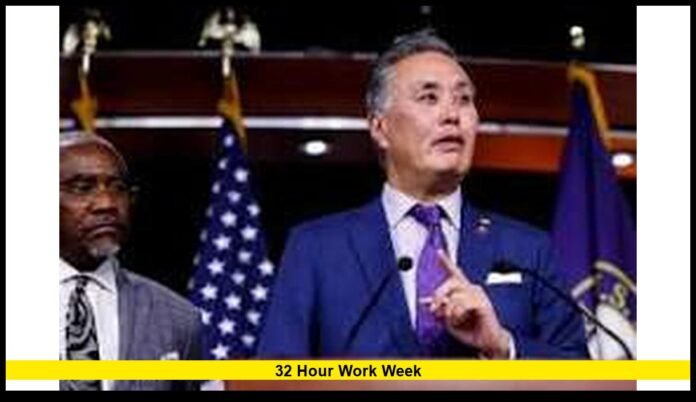

The 32 hour work week debate is back before Congress after Rep. Mark Takano and Sen. Bernie Sanders renewed their push for a shorter federal standard on September 8, 2026. Takano introduced H.R. 10323, the Thirty-Two Hour Workweek Act, in the House. The measure would change federal overtime rules so covered nonexempt employees would generally receive overtime after working more than 32 hours in a week. The bill is currently before the House Committee on Education and Workforce and has not become law.
The proposal arrives at a time when artificial intelligence, automation and productivity are reshaping discussions about working time. Its supporters argue that workers should share more directly in productivity gains. The legislation would eventually lower the federal overtime threshold from 40 hours to 32 hours through a three-year phase-in after enactment.
For American workers, however, the immediate situation has not changed. Federal law still generally requires overtime for covered nonexempt employees after 40 hours in a workweek. The new proposal would have to advance through Congress before that standard could change.
What Is Happening With the 32-Hour Workweek Proposal?
H.R. 10323 was introduced in the House on September 8, 2026, by Rep. Mark Takano, a California Democrat and senior member of the House Education and Workforce Committee.
The legislation has six original House cosponsors:
- Rep. Pramila Jayapal of Washington
- Rep. Eleanor Holmes Norton of the District of Columbia
- Rep. Rashida Tlaib of Michigan
- Rep. Ilhan Omar of Minnesota
- Rep. J. Luis Correa of California
- Rep. Delia C. Ramirez of Illinois
The bill was referred to the House Committee on Education and Workforce after its introduction.
Sanders also announced the renewed effort in the Senate. His office said he and Takano were reintroducing legislation intended to establish a 32-hour standard without reducing pay or benefits.
The current House measure is therefore a proposal, not a new federal workplace requirement.
No nationwide implementation date exists. Employers across the country are not currently required to move employees from 40 hours to 32 hours.
How the Proposed Workweek Would Change Federal Overtime Rules
The central part of H.R. 10323 is its proposed amendment to the Fair Labor Standards Act.
Current federal overtime rules generally require covered nonexempt employees to receive at least one-and-a-half times their regular rate for hours worked beyond 40 in a workweek.
The proposed legislation would gradually lower that threshold.
The schedule written into H.R. 10323 is:
| Period after enactment | Overtime threshold |
|---|---|
| Current federal rule | 40 hours |
| First year of phase-in | 38 hours |
| Second year | 36 hours |
| Third year | 34 hours |
| After the phase-in | 32 hours |
The legislation provides for the first phase to begin after a waiting period following enactment. The threshold would then decline by two hours each year until reaching 32 hours.
That gradual structure is important. If Congress eventually enacted the bill, employers would not immediately move from a 40-hour overtime threshold to 32 hours overnight.
The proposal also includes daily overtime provisions.
Employees covered by the proposed changes would generally receive time-and-a-half for work beyond eight hours in a day. Work exceeding 12 hours would generally receive double-time compensation under the bill.
The measure would therefore change both weekly and daily overtime calculations.
The Proposal Would Not Simply Mandate a Four-Day Weekend
The phrase 32-hour workweek is often associated with a four-day schedule.
H.R. 10323, however, does not simply order every employer to close its workplace for one additional day each week.
The legislation changes the point at which overtime compensation applies. Employers could still organize schedules in different ways, provided they comply with the applicable wage-and-hour requirements.
A company could potentially schedule four eight-hour days. Another employer could distribute 32 regular hours differently across the week.
The bill’s legal focus is the number of hours that trigger overtime rather than a single nationwide scheduling template.
That distinction matters for businesses, employees and policymakers.
A shorter legal workweek does not automatically mean every office, factory, store or service provider would operate only four days.
What Would Happen to Employees Working More Than 32 Hours?
Under the proposed final standard, covered nonexempt employees would generally become eligible for overtime after 32 hours in a workweek.
Consider an employee who works 36 hours.
Under today’s general federal rule, those 36 hours fall below the 40-hour overtime threshold.
Under the final proposed standard, four of those hours would generally qualify for overtime compensation.
An employee working 40 hours could eventually receive eight hours at the overtime rate.
Someone working 45 hours could have 13 hours subject to overtime, assuming the employee is covered and no other applicable rule or exemption changes the calculation.
The bill also contains daily overtime rules. That means the calculation would not always depend only on the weekly total.
For example, a worker could potentially trigger daily overtime by working more than eight hours in one day even if the total weekly schedule remains relatively short.
This approach would make scheduling more important for employers operating around the new threshold.
Pay Protection Is a Major Part of the Proposal
Supporters of the legislation have emphasized that the goal is not simply to turn full-time jobs into lower-paid part-time positions.
H.R. 10323 contains language preventing an employer from reducing an employee’s total workweek compensation rate or another employee benefit because the employee becomes covered by the revised overtime provisions.
That provision is central to the legislation’s design.
The proposal seeks to reduce the number of regular hours before overtime begins while protecting compensation for employees brought under the new rules.
This would distinguish the measure from an employer voluntarily reducing someone’s schedule from 40 hours to 32 hours and cutting pay proportionally.
The proposed federal change would instead alter the wage-and-hour framework itself.
Whether that protection would produce the intended economic results would depend on how the legislation moved through Congress and how employers implemented the final law.
The 32-Hour Workweek Is Not Federal Law
Workers should be careful about headlines suggesting that the United States has already adopted a nationwide 32-hour schedule.
That has not happened.
As of September 12, 2026, H.R. 10323 remains an introduced House bill. It has not passed the House or Senate, and it has not been signed into law.
The existing federal overtime framework therefore remains in effect.
Covered nonexempt employees generally qualify for overtime after more than 40 hours in a workweek. The Fair Labor Standards Act does not establish a universal federal definition of full-time employment based on 32 hours.
Employers can voluntarily offer shorter schedules, but that is different from a nationwide statutory requirement.
Workers should also consider state and local employment laws because those rules can provide protections that go beyond federal standards.
Why Bernie Sanders and Mark Takano Are Renewing the Push
The lawmakers supporting the measure are connecting shorter working hours with changes in workplace productivity.
Takano’s September 2026 announcement pointed to a large increase in American worker productivity since 1979 compared with a smaller increase in wages. Sanders has also argued that advances in artificial intelligence, automation and robotics should benefit working families rather than only companies and high-income individuals.
That argument is now becoming part of the broader national discussion about technology and employment.
Artificial intelligence is changing how companies approach administrative work, software development, customer service, manufacturing and other areas. Supporters of the bill argue that productivity gains should create an opportunity for employees to work fewer hours without losing compensation.
The legislation therefore combines a traditional labor-policy issue with a newer debate over artificial intelligence and automation.
What the Proposal Could Mean for Employers
Businesses would face significant changes if the bill became law in its proposed form.
Payroll systems would need to account for a lower overtime threshold. Human resources departments would need to review employee classifications and schedules. Managers would need to monitor both daily and weekly hours.
Industries that regularly schedule employees close to or above 40 hours could face particularly significant changes.
Manufacturing, construction, transportation, healthcare and other sectors often rely on schedules that vary by position and operating needs.
A lower overtime threshold could encourage some employers to redesign schedules. Companies might hire additional workers, redistribute hours or reduce overtime.
Other businesses could decide that paying overtime is preferable to adding staff.
The actual effect would vary considerably by industry and employer.
The legislation does not provide a single scheduling model that would apply identically to every workplace.
Different Industries Already Have Very Different Work Schedules
The U.S. workforce does not operate on one uniform schedule today.
Some industries regularly involve long shifts. Others rely heavily on part-time employment or schedules well below 40 hours.
This difference matters when considering a national change.
A worker in a manufacturing plant may have a very different experience from an employee in retail or hospitality. A professional employee may also have a different schedule from someone working in transportation or construction.
A federal overtime threshold would affect those groups differently.
Employers with many employees already working fewer than 32 hours could see a smaller direct effect.
Companies that frequently schedule employees between 33 and 40 hours could face a larger change because those additional hours could eventually become overtime hours.
Employers that rely heavily on overtime could face the greatest financial pressure.
The Proposal Includes a Long Phase-In Period
The gradual approach is one of the most important features of H.R. 10323.
Instead of changing the threshold immediately, the bill would reduce it in stages.
The sequence would move from 40 hours under current law to 38, then 36, then 34, and finally 32 hours.
Each stage would provide employers additional time to adjust.
A business could use that period to review staffing levels, scheduling systems and labor costs.
Employees would also have time to understand how the new overtime rules affect their schedules.
The phase-in could become especially important for employers whose operations depend on long shifts or substantial amounts of overtime.
What a 32-Hour Standard Could Mean for Workers
For workers, the proposed change could affect both time and compensation.
An employee who currently works 40 regular hours could eventually see eight hours treated as overtime under the proposed threshold if the employee remains covered and works the same schedule.
An employer could instead redesign the schedule to limit regular working hours.
That creates two possible outcomes for many workplaces: employees could work fewer hours, or employers could pay more overtime for the same workload.
The legislation’s supporters want the change to provide workers with more time without reducing compensation.
That objective is at the heart of the proposal.
The actual workplace experience would depend on the final legislation, employee classification and how individual employers organize their operations.
The Four-Day Workweek and a 32-Hour Standard Are Not Identical
A four-day workweek and a 32-hour workweek are often treated as the same concept, but they can be different.
A four-day schedule could involve four 10-hour shifts, creating a 40-hour week.
A 32-hour schedule could involve four eight-hour shifts.
The first arrangement would remain a 40-hour workweek. The second would total 32 hours.
This difference becomes particularly important under H.R. 10323 because the bill specifically changes the overtime threshold.
A four-day schedule alone would not necessarily satisfy the proposed final standard without overtime.
The legislation therefore focuses on working hours, not simply the number of days an employee reports to work.
Why the New Proposal Is Drawing Attention in 2026
The renewed federal push comes during a period of intense discussion about workplace productivity.
Artificial intelligence has become a major factor in conversations about how much work employees can complete in a given period.
Supporters of shorter schedules argue that higher productivity creates room for workers to gain more personal time.
Opponents and business groups have raised concerns about increased labor costs and the practical challenges of reducing hours while maintaining production and services.
Those competing views are likely to remain part of the congressional debate if the bill advances.
The legislation therefore represents more than a change to an overtime number. It raises questions about productivity, compensation, scheduling and the future structure of employment in the United States.
What Happens Next for H.R. 10323?
The immediate next step is consideration by the House Committee on Education and Workforce.
The bill must clear the congressional process before it could become federal law.
That process can involve committee consideration, amendments, House action, Senate action and presidential approval.
As of September 12, 2026, none of those later stages has resulted in enactment of a nationwide 32-hour standard.
The House bill remains at the introduced stage.
Sanders has also publicly backed the renewed effort in the Senate, but the important point for workers is that the federal legal standard has not yet changed.
Until Congress enacts a new law, covered nonexempt employees remain subject to the existing federal overtime framework.
What U.S. Workers Should Watch
Workers following the proposal should pay attention to several developments.
First, committee action could indicate whether H.R. 10323 is gaining momentum.
Second, any amendments could change the bill’s overtime thresholds, implementation schedule or protections.
Third, Senate action would be necessary for the proposal to continue through the federal legislative process.
Finally, any final legislation could differ from the current House version.
That means headlines about the proposal should not be treated as announcements of an immediate nationwide schedule change.
The current bill provides a clear starting point, but its final form would depend on the legislative process.
The 2026 Proposal Puts Shorter Hours Back at the Center of the Debate
The renewed congressional effort has placed shorter working hours back into the national labor discussion.
H.R. 10323 would gradually lower the federal overtime threshold and eventually establish 32 hours as the point at which covered nonexempt employees would generally begin receiving overtime.
It would also introduce daily overtime rules and protections against reductions in compensation and benefits tied to the new coverage.
But the proposal remains just that: a proposal.
American employers are not currently required to adopt a 32-hour schedule. The federal overtime threshold remains 40 hours for covered nonexempt workers.
The next major development will come from Congress as lawmakers decide whether the measure should move beyond committee consideration.
As the debate over working hours and workplace productivity continues, readers can follow the latest congressional developments and share their views on whether the U.S. should move toward a shorter standard workweek.