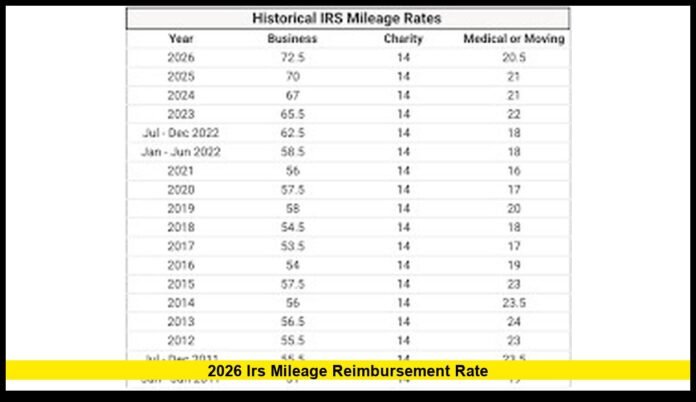

The 2026 IRS mileage reimbursement rate sets the standard per-mile deduction taxpayers and businesses can use to calculate vehicle expenses for business, medical, moving, or charitable driving in the U.S., helping determine how much of those costs can be reimbursed or written off on taxes.
The 2026 IRS mileage reimbursement rate is now in effect, bringing updated federal standards that directly impact how U.S. taxpayers calculate vehicle-related deductions and reimbursements. Effective January 1, 2026, the Internal Revenue Service finalized new mileage rates that apply for the entire calendar year, reflecting current vehicle operating costs across the United States. These rates are official, confirmed, and apply nationwide.
This article delivers a complete, in-depth overview of what the 2026 mileage rate means, who it affects, how it is used, and why it matters. The information below is factual, current, and written for U.S. readers seeking clarity on mileage reimbursement and tax compliance.
What the IRS Mileage Reimbursement Rate Means in 2026
The IRS mileage reimbursement rate is a standardized per-mile amount that allows taxpayers to calculate the cost of using a personal vehicle for approved purposes without tracking every individual expense. For 2026, the IRS has updated the rates to 72.5 cents per mile for business use, 20.5 cents per mile for medical and qualified moving purposes (including certain active-duty military personnel), and 14 cents per mile for charitable activities. Instead of itemizing costs like fuel, insurance, repairs, depreciation, and registration, eligible drivers can simply multiply their total qualified miles by the applicable rate to determine their deductible or reimbursable amount.
These rates are recalculated annually using nationwide data to reflect real-world driving costs, including fluctuations in fuel prices and vehicle ownership expenses. Notably, the standard mileage rate applies to gas, hybrid, and electric vehicles alike, meaning EV owners are not given a separate rate despite differences in operating costs. Taxpayers still have the option to use the actual expense method if it results in a larger deduction, but once chosen for a vehicle, switching methods may be limited.
For businesses and employers, the IRS mileage rate serves as a trusted federal benchmark. When companies reimburse employees at or below the standard rate under an accountable plan, those payments are generally not considered taxable income, making it a simple and tax-efficient way to cover work-related travel. Overall, the mileage rate remains one of the most widely used tools for simplifying vehicle expense reporting while keeping deductions aligned with current economic conditions.
2026 IRS Mileage Reimbursement Rate: Official Figures
For miles driven between January 1 and December 31, 2026, the IRS established the following standard mileage rates:
| Use Category | 2026 Rate |
|---|---|
| Business use | 72.5 cents per mile |
| Medical or moving | 20.5 cents per mile |
| Charitable activities | 14 cents per mile |
These figures apply to federal tax filings and mileage reimbursement planning throughout the year.
Business Mileage Rate for 2026
The business mileage rate for 2026 is 72.5 cents per mile, reflecting a continued adjustment based on nationwide driving costs such as fuel, maintenance, insurance, and vehicle depreciation. This rate remains the most commonly used mileage figure for both taxpayers and businesses, offering a simplified alternative to tracking actual vehicle expenses. It applies when a personal vehicle—whether gas, hybrid, or electric—is used for qualified business purposes, and it can be claimed by self-employed individuals or used by employers for tax-free reimbursements under accountable plans.
It’s important to note that taxpayers who choose the standard mileage method must generally do so in the first year the vehicle is used for business; switching to the actual expense method later may be restricted. Additionally, certain costs like parking fees and tolls can still be deducted separately, even when using the standard mileage rate.
Examples of Qualifying Business Travel
Business mileage typically includes:
- Travel between multiple job sites, offices, or work locations in the same day
- Trips to meet clients, customers, or vendors
- Attending work-related meetings, conferences, or networking events outside your regular workplace
- Driving to a temporary work location (generally defined as a place you expect to work for less than one year)
- Running business-related errands, such as banking, supply pickups, or deliveries
What Does NOT Qualify
- Daily commuting between your home and your primary workplace is not deductible, even if you perform minor work tasks during the trip
- Travel to a permanent work location does not qualify, regardless of distance
- Personal trips combined with business errands must be carefully separated, and only the business portion can be claimed
Overall, the 2026 rate continues to provide a practical, IRS-approved way to calculate vehicle-related business deductions while keeping recordkeeping relatively straightforward—especially when supported by a mileage log documenting dates, destinations, and purpose of each trip.
Medical and Moving Mileage Rate for 2026
The IRS mileage rate for medical and qualified moving purposes in 2026 is 20.5 cents per mile, reflecting modest adjustments in transportation-related costs while remaining separate from the higher business-use rate. This rate is specifically intended to help offset out-of-pocket driving expenses tied to essential medical care or certain qualified relocations.
Medical Mileage
Medical mileage may be deductible when a taxpayer uses a personal vehicle for necessary, unreimbursed medical care. Qualifying trips typically include travel to:
- Hospitals, clinics, and doctor’s offices
- Specialists, therapists, or mental health providers
- Diagnostic labs and testing facilities
- Pharmacies for prescription pickup
- Medical equipment suppliers
To claim this deduction, taxpayers must itemize deductions on Schedule A, and total medical expenses must exceed the applicable adjusted gross income (AGI) threshold (currently 7.5%). In addition to the per-mile rate, certain related costs—such as parking fees and tolls—can be included separately. However, trips that are primarily for general health improvement (like gym visits) or non-essential treatments do not qualify.
Moving Mileage
The moving mileage rate remains highly restricted under current tax law. As of 2026, it applies only to active-duty members of the U.S. Armed Forces who relocate due to a permanent change of station (PCS) order. Eligible travel generally includes:
- Transportation from the old residence to the new duty station
- Travel for the service member and household members
For most civilian taxpayers, moving expenses—including mileage—are no longer deductible under federal law unless Congress reinstates those provisions in the future.
Charitable Mileage Rate for 2026
The charitable mileage rate for 2026 remains 14 cents per mile, a figure set by statute that does not adjust annually with inflation, unlike the business and medical rates.
This rate applies to miles driven while performing unreimbursed volunteer services for qualified charitable organizations recognized by the IRS. To qualify, the travel must be directly connected to and solely in service of the charity’s activities.
What Qualifies as Charitable Mileage
Eligible mileage may include:
- Driving to and from a volunteer site or event location
- Transporting donated goods or supplies on behalf of a charity
- Providing transportation for individuals as part of charitable services (e.g., delivering meals or driving patients for a nonprofit program)
- Running errands or administrative tasks specifically for the organization
Important Rules and Limitations
- Only out-of-pocket, unreimbursed mileage qualifies for the deduction
- Personal travel or commuting related to volunteering does not count
- Taxpayers must itemize deductions to claim charitable mileage
- Additional expenses such as parking fees and tolls can be deducted separately
Because the rate is relatively low and fixed, accurate recordkeeping of dates, miles driven, and the charitable purpose is essential to substantiate the deduction.
Why the 2026 Mileage Rate Matters
The 2026 IRS mileage reimbursement rate plays a critical role in financial planning, tax reporting, and day-to-day expense management for both individuals and businesses, especially as rising vehicle and fuel costs continue to impact travel budgets.
Higher Deduction Potential
For eligible taxpayers—particularly self-employed individuals and small business owners—a higher mileage rate means greater deductions per mile driven. At 72.5 cents per mile for business use, even moderate travel can translate into meaningful tax savings, helping reduce overall taxable income when properly documented. This makes accurate mileage tracking more valuable than ever in 2026.
Employer Reimbursement Compliance
Employers widely use the IRS mileage rate as a safe-harbor benchmark for reimbursing employees who use personal vehicles for work. When reimbursements are made at or below the standard rate under an accountable plan, they are generally excluded from employees’ taxable income and not subject to payroll taxes. Using the correct 2026 rate helps businesses stay compliant with IRS rules while avoiding unnecessary tax complications.
Expense Forecasting and Budgeting
For businesses, the mileage rate serves as a practical tool for forecasting travel expenses. By applying a standardized per-mile cost, companies can:
- Estimate annual transportation expenses more accurately
- Set reimbursement policies and travel budgets
- Evaluate the cost efficiency of field operations, deliveries, or client visits
Simplified Recordkeeping and Consistency
Another key advantage is simplicity. Instead of tracking every vehicle-related expense, the standard mileage rate provides a consistent, IRS-approved method that reduces administrative burden. This is especially useful for freelancers, gig workers, and small teams managing high volumes of travel.
Overall, the 2026 mileage rate is more than just a number—it’s a financial planning tool that directly affects deductions, reimbursements, and operational decision-making across a wide range of industries.
Who Uses the 2026 IRS Mileage Reimbursement Rate
The 2026 IRS mileage reimbursement rate is used by a wide range of individuals and organizations to simplify how vehicle-related expenses are calculated, deducted, or reimbursed under federal tax rules.
Self-Employed Individuals
Independent contractors, freelancers, consultants, sole proprietors, and gig workers are among the primary users of the standard mileage rate. They rely on it to calculate deductible business travel expenses on their federal tax returns (typically on Schedule C). For many in the gig economy—such as rideshare drivers, delivery workers, and field service providers—the mileage rate is a key tool for reducing taxable income without complex expense tracking.
Employees
Although most employees can no longer deduct unreimbursed business mileage due to current tax law, employer-sponsored reimbursement programs remain widely used and fully valid. Companies often reimburse employees using the IRS standard rate to ensure payments are non-taxable and compliant with accountable plan rules. This is especially common in roles involving travel, sales, fieldwork, or client visits.
Charitable Volunteers
Individuals who volunteer for qualified nonprofit organizations can use the mileage rate to deduct eligible travel related to their service. While the charitable rate is lower and fixed, it still provides a way for volunteers to offset out-of-pocket costs, provided they itemize deductions and maintain proper records.
Taxpayers Claiming Medical Expenses
Taxpayers who itemize deductions and meet the 7.5% of adjusted gross income (AGI) threshold for medical expenses may deduct qualified medical mileage. This is particularly relevant for individuals with frequent healthcare-related travel, such as ongoing treatments, specialist visits, or long-distance care.
Businesses and Organizations
Beyond individuals, businesses and nonprofit organizations also depend on the IRS mileage rate to:
- Set standardized reimbursement policies
- Ensure tax compliance for employee travel payments
- Maintain consistency in expense reporting and budgeting
Overall, the mileage rate serves as a flexible, widely accepted standard that supports accurate and efficient vehicle expense handling across multiple taxpayer groups.
Mileage Tracking and Documentation Requirements
Accurate recordkeeping is essential when using the 2026 IRS mileage reimbursement rate, as deductions and reimbursements are only valid if they can be properly substantiated. The IRS expects contemporaneous records—meaning logs should be created at or near the time of each trip, not reconstructed later.
Proper documentation should include:
- Date of each trip
- Starting and ending locations (or total route description)
- Purpose of travel (clearly identifying the business, medical, or charitable reason)
- Total miles driven for each trip
Best Practices for Compliance
- Maintain a consistent mileage log throughout the year, whether in a notebook, spreadsheet, or mileage-tracking app
- Record trips as they occur to ensure accuracy and credibility
- Keep supporting documents when applicable, such as receipts, appointment confirmations, or work schedules
- Track odometer readings periodically (e.g., at the start and end of the year) to validate total mileage
Mileage logs created after the fact or based on estimates may be challenged during an IRS review or audit, potentially leading to denied deductions. Keeping detailed, timely, and organized records is the best way to ensure your mileage claims remain fully compliant and defensible.
Standard Mileage vs. Actual Expense Method
Taxpayers generally choose between two IRS-approved ways to calculate vehicle deductions, and the decision can significantly impact both tax savings and recordkeeping requirements.
Standard Mileage Method
The standard mileage method allows you to simply multiply total qualified miles by the IRS rate (72.5¢ per mile for business use in 2026). It is widely used because it is:
- Simple and time-efficient
- Easy to track with basic mileage logs
- Predictable for estimating deductions throughout the year
Even when using this method, you can still deduct parking fees and tolls separately, which adds to the overall benefit.
Actual Expense Method
The actual expense method involves tracking and calculating the real costs of operating your vehicle. This includes:
- Fuel (or electricity for EVs)
- Maintenance and repairs
- Insurance
- Registration and taxes
- Depreciation or lease payments
You then deduct the business-use percentage of these total expenses. While this method can produce a larger deduction in some cases—especially for high-cost vehicles or heavy usage—it requires detailed receipts and ongoing recordkeeping.
Key Rules and Considerations
- If you want the flexibility to use the standard mileage method later, you must generally choose it in the first year the vehicle is used for business
- Once you start with the actual expense method (especially with depreciation), switching back to standard mileage is often restricted or not allowed
- Leased vehicles have additional consistency rules, often requiring you to stick with the same method for the lease term
- The best method depends on factors like vehicle cost, usage level, and administrative capacity
Overall, the standard mileage method offers simplicity and consistency, while the actual expense method offers potentially higher deductions at the cost of more complex tracking—making the initial choice an important strategic decision for 2026 and beyond.
Impact on Small Businesses
Small businesses often depend heavily on personal vehicles. The increased 2026 business mileage rate boosts allowable deductions, which can improve cash flow and reduce tax liability.
Updating reimbursement and expense policies at the start of the year helps ensure accuracy and compliance.
Impact on Large Employers
Organizations with mobile workforces, such as sales teams or field technicians, must update internal systems to reflect the 2026 rate.
Failing to use the correct mileage rate can lead to under-reimbursement, employee disputes, or tax reporting issues.
Freelancers and Gig Workers
For freelancers and gig workers, mileage often represents one of the largest and most valuable deductible expenses on a federal tax return. Delivery drivers, rideshare operators, mobile service providers, real estate professionals, and independent consultants all rely heavily on personal vehicles to generate income, making the increased 2026 mileage rate especially impactful. Because earnings in the gig economy are closely tied to how often and how far individuals drive, even small increases in deductible mileage can translate into meaningful tax savings over the course of the year. With vehicle-related costs such as insurance, maintenance, repairs, and depreciation remaining elevated, the 2026 rate helps better offset the true cost of driving for work.
Consistent mileage tracking throughout the year is critical for maximizing deductions and avoiding issues at tax time. Freelancers and gig workers are fully responsible for maintaining accurate documentation, as platforms, apps, and clients do not report mileage to the IRS on their behalf. Mileage logs should clearly identify business purpose, trip dates, locations, and miles driven, and they should be kept contemporaneously rather than recreated later. Establishing a reliable tracking system early in the year helps ensure no eligible miles are missed, supports accurate Schedule C reporting, and strengthens documentation if deductions are reviewed.
Common Mileage Claim Mistakes
Taxpayers should avoid several frequent errors that continue to cause mileage deductions to be reduced or fully disallowed. One of the most common mistakes is claiming commuting miles, which are not deductible under IRS rules, even when work is performed during the day. Another issue arises when taxpayers combine personal and business travel without clear separation, making it difficult to substantiate which miles qualify. Using mileage rates from prior tax years is also a recurring problem, especially when rates increase, as applying outdated figures can result in incorrect calculations and IRS adjustments. Additionally, failing to maintain written or digital records remains a major compliance risk; mileage claims must be supported by logs that clearly show dates, destinations, purposes, and miles driven. The IRS continues to scrutinize mileage deductions closely, and incomplete, estimated, or inconsistent records are among the most common reasons claims are challenged. Avoiding these errors by tracking mileage consistently and applying the correct rate helps protect deductions and reduces the likelihood of issues during review or examination.
Errors in mileage claims remain one of the most common reasons deductions are reduced or disallowed.
What the 2026 Mileage Rate Reflects
The 2026 IRS mileage reimbursement rate reflects sustained pressure on vehicle ownership costs across the United States. While fuel prices may fluctuate, other expenses such as insurance, repairs, maintenance, and vehicle depreciation remain elevated. The increased business rate signals recognition of these economic realities for drivers who rely on personal vehicles for income, services, and essential travel.
Planning Ahead for the 2026 Tax Year
Using the correct mileage rate throughout the year simplifies tax preparation and reduces the risk of costly errors when filing a federal return. For 2026, taxpayers should begin mileage tracking from January 1, ensuring that every eligible business, medical, or charitable trip is recorded as it occurs rather than reconstructed later. Records should remain consistent and complete, with clear details showing the date, purpose of travel, starting and ending locations, and total miles driven for each trip. It is also essential that the 2026 IRS mileage reimbursement rate is applied only to miles driven during the 2026 calendar year, as using prior-year rates can lead to inaccurate deductions and potential adjustments. Proactive planning allows taxpayers to monitor mileage totals throughout the year, estimate tax liability more accurately, and avoid last-minute corrections that often trigger errors or compliance concerns. Establishing a reliable tracking system early in the year—whether manual or digital—helps ensure deductions are properly supported if reviewed and keeps tax filing straightforward and stress-free.
Proactive planning helps avoid last-minute corrections and compliance issues.
Final Thoughts
The 2026 IRS mileage reimbursement rate introduces updated figures that affect millions of U.S. taxpayers, businesses, and independent workers. With a higher business mileage rate and clearly defined rules for medical and charitable travel, understanding how to apply these standards is essential for accurate tax reporting and financial planning.
FAQs
1. What is the IRS mileage rate for 2026?
For 2026, the IRS standard mileage rates are:
- 72.5 cents per mile for business use
- 20.5 cents per mile for medical purposes
- 20.5 cents per mile for moving (active-duty military only)
- 14 cents per mile for charitable work
2. When did the 2026 mileage rates take effect?
The new rates became effective January 1, 2026, and apply to all qualifying vehicle use during the tax year.
3. Did the mileage rate increase in 2026?
Yes. The business mileage rate increased from 70¢ (2025) to 72.5¢ in 2026, reflecting higher vehicle operating costs.
4. Why does the IRS change mileage rates every year?
The IRS adjusts rates annually based on:
- Fuel prices
- Maintenance and repair costs
- Insurance and depreciation
- Overall vehicle ownership costs
5. Can I use the IRS mileage rate for tax deductions?
Yes. If you qualify, you can use the standard mileage rate to calculate deductible vehicle expenses instead of tracking actual costs.
Share your thoughts or questions below and stay informed as the 2026 tax year continues.
Disclaimer:
This content is provided for general informational purposes only and should not be considered tax, legal, or financial advice. Tax laws, IRS rules, and mileage reimbursement guidelines may change and can vary based on individual circumstances. Readers should consult official IRS guidance or a qualified tax professional before relying on this information for tax filing or financial decisions.