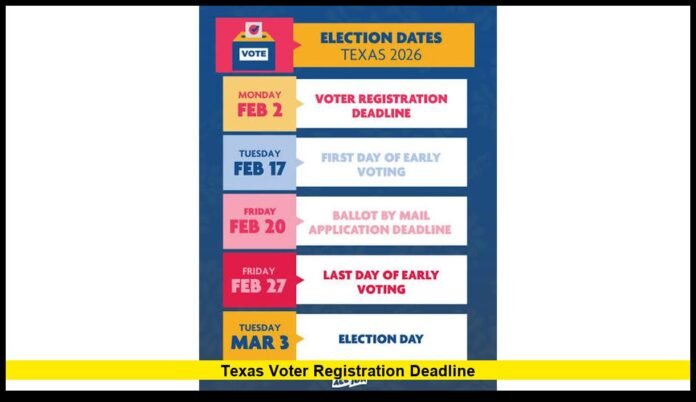

Texas voter registration deadline information is especially important right now, with the deadline for the November 3, 2026, election set for Monday, October 5. As of September 15, eligible Texans still have time to register or update their voter registration, but the deadline is approaching quickly.
Texas law generally requires eligible voters to register at least 30 days before Election Day. Because the 30th day before the November 3 election falls on Sunday, October 4, the registration cutoff moves to the next regular business day, Monday, October 5.
That date applies to voters who want their registration to be effective for the November 3, 2026, election. It also applies to eligible voters who need to update their registration after moving or changing other registration information.
With the deadline less than three weeks away, voters who are not registered should complete the process as soon as possible. Those who believe they are already registered can also check their status and confirm that their information is current.
Texas Voter Registration Deadline for November 2026
The official registration deadline for the November 3, 2026, election is Monday, October 5, 2026.
The date is important because Texas uses a 30-day registration rule. Normally, the deadline falls 30 days before Election Day. For this election, however, the 30th day is Sunday, October 4.
Texas election law moves the deadline to the next regular business day. That makes Monday, October 5, the final registration date for the November 3 election.
Important November 2026 dates
| Election milestone | Date |
|---|---|
| Voter registration deadline | Monday, October 5, 2026 |
| Early voting begins | Monday, October 19, 2026 |
| Early voting ends | Friday, October 30, 2026 |
| Election Day | Tuesday, November 3, 2026 |
| Mail ballot application deadline | Friday, October 23, 2026 |
The registration deadline comes before the early voting period begins. Voters should not wait until early voting starts to discover that their registration is incomplete or that their address needs updating.
Why October 5 Matters
Registration must be completed in time for a voter to become eligible for the November election. Texas registration does not become effective immediately after an application is submitted.
Under Texas rules, a registration becomes effective on the 30th day after the application is submitted to the voter registrar, or when the applicant turns 18, whichever occurs later.
This timing explains why the state establishes an advance registration cutoff rather than allowing people to register immediately before voting.
For voters planning to participate in the November election, waiting until the final possible moment can create unnecessary problems. An incomplete application, missing signature, incorrect address, or mailing delay can interfere with timely processing.
Submitting the application early gives voters more time to resolve an issue if one is identified during processing.
Who Can Register to Vote in Texas?
Texas establishes specific qualifications for voter registration.
Generally, a person must meet the state’s eligibility requirements, including the following:
- Be a United States citizen.
- Be a resident of the Texas county where the registration application is submitted.
- Be at least 18 years old on Election Day.
- Not have a final felony conviction that prevents voting because the sentence, probation, or parole has not been completed.
- Not have been determined by a qualifying court judgment to be totally mentally incapacitated or partially mentally incapacitated without the right to vote.
The age requirement is based on Election Day. A person who will be 18 by November 3, 2026, can qualify under the applicable voter registration rules.
Eligibility should be determined based on the facts of each person’s situation. Voters with questions about their status can contact their county voter registrar.
How to Register Before the Deadline
Texas provides several ways for eligible residents to complete voter registration.
A voter registration application can be completed and submitted to the county voter registrar. Texas also provides an online application tool that allows an applicant to enter the required information before printing, signing and mailing the completed application.
The process is different from a system in which a voter completes an entirely electronic registration without submitting a signed application. Texas requires the completed application to be submitted to the appropriate county voter registrar.
Eligible Texans can also obtain a printed voter registration application or contact their county voter registrar for assistance.
The most important step is making sure the completed application reaches the appropriate election authority in a timely manner.
Mailing a Voter Registration Application
Mail delivery deserves particular attention as the October 5 deadline approaches.
For a mailed voter registration application, Texas recognizes the postmark date or the date the application is received by the county voter registrar for determining whether it was submitted by the registration cutoff.
The state has also warned that changes in postal transportation operations can sometimes mean that a mailpiece does not receive a postmark on the same day it is collected.
Because of that issue, voters who mail a registration application should avoid waiting until the last day.
A voter who wants additional assurance about the postmark can visit a USPS retail location and request a manual local postmark when presenting the registration application. This service is provided without a fee.
The safest approach is still to submit the application well before October 5.
What Information Is Needed?
A voter registration application requires information needed to establish the applicant’s identity, residence and eligibility.
Applicants should carefully review the form before submitting it. Common problems can include incomplete responses, incorrect addresses, missing information and an absent or incorrect signature.
The application may require information such as:
- Full name
- Residential address
- Mailing address when applicable
- County of residence
- Date of birth
- Previous Texas residence when applicable
- Texas driver’s license number or Texas personal identification number
- Certain Social Security information when applicable
- Signature and date
Applicants should use accurate and current information.
An outdated address can create problems, particularly for voters who have recently moved. Anyone who has relocated within Texas should check the voter record rather than assuming that an old registration automatically follows the voter to a new address.
Checking Voter Registration Status
Texans who are unsure whether they are registered do not need to submit a new application simply because they cannot remember their status.
The state provides an online voter registration lookup tool that allows voters to check their records.
A voter can search using information such as a Voter Unique Identifier, Texas driver’s license information when it was provided during registration, or the voter’s first and last name.
Checking the record before October 5 can help identify problems early.
Voters should pay particular attention to the registered address and other identifying information. If something has changed, the voter may need to update the registration.
What If You Recently Moved?
Moving is one of the most important reasons to review a voter registration record before an election.
A voter who moves within Texas should update the registration information with the appropriate voter registrar. Texas also provides an online option for eligible voters to update certain registration information.
For the November 3, 2026, election, October 5 is also the deadline for an address change to become effective for that election.
The consequences of moving can depend on whether the voter moved within the same county or to another county.
A person who moved within the same county may have certain options under Texas’s fail-safe voting rules if the registration address was not updated by the deadline. The voter may be able to return to the previous precinct if the applicable residency requirements are satisfied.
Moving to another county is different. A voter who has not registered in the new county by the deadline may, in certain circumstances, qualify for a limited ballot during early voting.
These situations have specific legal requirements, so voters who recently moved should verify their individual status with the appropriate county election office rather than relying on assumptions.
What Happens After an Application Is Submitted?
Submitting a voter registration application does not necessarily mean that the registration is already active.
The county voter registrar reviews the application to determine whether it is properly completed and whether the applicant meets the legal requirements.
Texas law gives the voter registrar a period to review the application. If the application is accepted, the registrar prepares a voter registration certificate containing information such as the voter’s precinct and registration number.
If an application is rejected, the applicant receives notice explaining the reason.
This is another reason to avoid waiting until October 5. Early submission allows time for a voter to respond if the registrar identifies a problem.
Does Voter Registration Expire?
Texas voter registrations do not simply expire after a fixed period.
A registration generally remains effective until it is canceled, although changes in residence and certain legal circumstances can affect a person’s registration status.
The state also renews voter registration records automatically in even-numbered years unless circumstances require a change or cancellation.
However, voters should not assume that an old registration record is correct after moving.
A voter who has changed addresses, particularly one who has moved to another county, should verify the current registration record before the October 5 cutoff.
What Happens After October 5?
October 5 is the registration cutoff for the November 3, 2026, election.
That does not mean every voter who misses the deadline automatically loses every possible voting option. Texas has specific provisions for certain voters who move after the registration deadline.
For example, a voter who changes address within the same county may qualify for fail-safe voting under particular circumstances.
A voter who moves to another county may also qualify for a limited ballot if the applicable requirements are met. Limited ballots are available during early voting and are generally restricted to races and measures that overlap between the voter’s former and new counties.
These provisions should not be viewed as substitutes for timely registration.
The best course for anyone who is eligible and not currently registered is to complete the registration process before October 5.
Registration Deadline vs. Mail Ballot Deadline
The voter registration deadline should not be confused with the deadline for requesting a ballot by mail.
For the November 3, 2026, election, the final day for the early voting clerk to receive an Application for Ballot by Mail is Friday, October 23.
That deadline applies to eligible voters who qualify to vote by mail under Texas law. Registration must already be in place for a voter to use the mail ballot process.
Texas limits eligibility for voting by mail to specific circumstances. Qualifying reasons include being 65 or older, being sick or disabled, expecting to give birth within three weeks before or after Election Day, being away from the county during the relevant voting period, or being confined in jail under the applicable rules.
Therefore, someone who needs to register should not wait until the October 23 mail ballot application deadline. Registration comes first.
Early Voting Comes After Registration
Early voting for the November 3 election begins Monday, October 19, and continues through Friday, October 30.
By that point, the registration deadline will already have passed.
This timeline is important for voters who prefer to cast a ballot before Election Day. Being eligible for early voting does not create a later opportunity to register for the election.
Voters should have their registration issue resolved before the early voting period begins.
Election Day itself is Tuesday, November 3, 2026. Polls are scheduled to operate from 7 a.m. to 7 p.m. on Election Day under the statewide election calendar.
A Simple Checklist Before October 5
Texas voters can take several practical steps now rather than waiting for the final day.
1. Check your registration.
Use the state’s voter registration lookup service to determine whether your record is active.
2. Review your address.
Make sure the residence information on the record matches where you currently live.
3. Register if necessary.
If you are eligible but not registered, complete the voter registration application as soon as possible.
4. Check the application carefully.
Review every required section before submitting it, and make sure the application is signed and dated.
5. Avoid last-minute mailing.
If you are submitting the application by mail, allow enough time for delivery and proper postmarking.
6. Follow up if necessary.
If you have questions about your application or registration record, contact your county voter registrar.
Key Facts About the October 5 Deadline
The most important information can be summarized quickly:
- Registration deadline: October 5, 2026
- Election: November 3, 2026
- Deadline day: Monday
- Reason for the October 5 date: The normal 30th-day cutoff falls on Sunday, October 4
- Early voting begins: October 19, 2026
- Early voting ends: October 30, 2026
- Mail ballot application deadline: October 23, 2026
- Election Day: November 3, 2026
The October 5 cutoff is therefore the date eligible Texans should keep at the top of their election calendar.
What Texas Voters Should Do Now
With September 15 now here, there is still time before the registration cutoff, but the window is narrowing.
Anyone who has never registered should start the process rather than waiting for the final day. Registered voters who recently moved should verify their information immediately.
Voters should also be careful when relying on old voter registration certificates or information from previous elections. A change in residence can require an update even when the person has previously voted in Texas.
Checking the official registration record provides a clearer picture of whether action is necessary.
The same approach applies to voters who are uncertain about their eligibility or registration status. Instead of waiting until early voting or Election Day, they should resolve questions with the appropriate county election office before the deadline.
The November election calendar has several separate deadlines, but October 5 is the critical date for voter registration. Once that date passes, voters may face restrictions or special procedures depending on their circumstances.
For eligible Texans who want to participate in the November 3 election, registering or updating their information before October 5 remains the most straightforward path.
The deadline is approaching, so check your Texas voter registration status now and make sure your record is ready for the November election.
Stay informed, check your registration early, and share your thoughts or questions about the October 5 deadline in the comments.