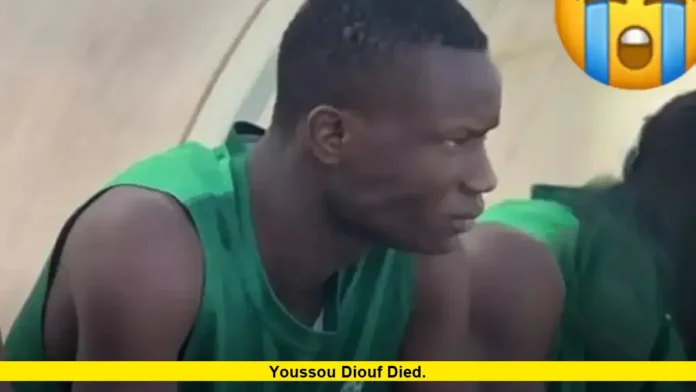

The football world woke up to heartbreaking news on February 22, 2026, as young Senegalese forward Youssou Diouf died following a sudden medical emergency at the Stade Maniang Soumaré in Thiès. The promising striker collapsed after the final whistle of a Ligue 2 match, leaving the entire Senegalese football community — and fans around the globe — in a state of profound grief.
The tragedy unfolded during what should have been a milestone moment in Diouf’s career. He had just made his debut appearance for AS Saloum, the club based in Kaolack, Senegal. A young talent who had worked his way through the ranks of domestic football, Diouf stepped onto the pitch full of hope and ambition. Nobody could have imagined it would be the last time he ever played the game he loved.
If this story has touched you, share it with a friend who loves the beautiful game — spreading awareness about athlete safety matters.
A Debut That Turned Into Tragedy
The match between AS Saloum and Amitié FC was the 16th fixture of the Senegalese Ligue 2 season. It ended in a goalless draw, a routine result that would ordinarily fade from memory within days. But this game will be remembered far longer than that, and for the most devastating of reasons.
Diouf started the game on the bench. He came on as a substitute with roughly ten minutes left to play, entering the pitch for what was his very first appearance wearing the AS Saloum jersey. By all accounts, he showed no signs of distress during his time on the field. He played without issue, and the final whistle blew with the scoreline still level at 0-0.
It was only after the game ended that everything changed. While seated on the touchline bench following the match, Diouf suddenly felt unwell. He suffered what witnesses described as a severe medical emergency. Medical personnel on site responded immediately, doing everything in their power to revive him. Despite their rapid intervention, Youssou Diouf could not be saved. He was pronounced dead at the scene.
Who Was Youssou Diouf?
Youssou Diouf was a young forward who had steadily built his career through the ranks of Senegalese club football. He had previously trained at Casa Sports and represented Olympique de Ziguinchor before joining AS Saloum. He was regarded as a dedicated, hardworking player whose determination stood out to coaches and teammates alike.
Reports put his age between 20 and 24 years old — a man in the prime of his life and career. For those who knew him, he was not just a footballer. He was a son, a friend, and a symbol of what African youth can achieve through passion and perseverance on the pitch. His death, so sudden and so unexpected, has left those who knew him struggling to find words.
Génération Foot Academy, one of Senegal’s most respected football development institutions, released a statement mourning his passing. The academy called it an “immense pain” for his family, his club, and the entire Senegalese sporting community. Tributes have poured in across social media ever since the news broke.
The Official Response From Senegalese Football Authorities
The Senegalese Professional Football League, known as the LSFP, issued a formal statement addressing the tragedy. The league expressed deep condolences to Diouf’s family, loved ones, and teammates, as well as to the officials and supporters of AS Saloum.
Importantly, the LSFP also moved to address early speculation that began circulating on social media. Because the incident occurred during the Muslim holy month of Ramadan, some observers suggested that fasting might have contributed to the collapse. The league was direct in pushing back on this narrative, stating in their official communication that Diouf was not fasting at the time of the incident.
The league also indicated that it would work closely with relevant authorities to monitor the circumstances surrounding the tragedy and provide all necessary support to AS Saloum during this painful time. As of now, no official medical conclusion has been released publicly regarding the exact cause of death, though early reports indicate cardiac arrest as a likely factor.
A Pattern That Cannot Be Ignored
The death of Youssou Diouf has reignited an urgent conversation about athlete health and stadium safety infrastructure in West African football. This is not the first time Senegalese football has experienced a tragedy of this nature. Last season, Union Sportive de Ouakam lost their captain, Fadiouf Ndiaye, under similar circumstances — a player who also collapsed mid-game due to a sudden illness.
Critics and football administrators have pointed to the lack of readily available defibrillators in many local stadiums across Senegal and other parts of the continent. Cardiac emergencies can be survivable with immediate defibrillation, yet that equipment is far from guaranteed at lower-division venues. The conversation around this issue has grown louder in the hours since Diouf’s passing, with fans and journalists alike calling for urgent reform.
There are also broader questions being raised about the depth of pre-competition medical screenings for players in Senegal’s lower divisions. In many lower-league environments across Africa, players may go without the kind of thorough cardiovascular testing that could detect hidden conditions before they become fatal. Advocates for player safety argue that investing in those screenings — even at modest cost — could save lives.
An Outpouring of Grief Across the Globe
Since the news broke on Sunday evening, tributes have flooded in from every corner of the football world. Fans from Senegal, across Africa, and beyond have shared messages of condolence on social media, expressing grief for a young man they may never have met, but whose story resonated deeply.
Many messages have emphasized the cruelty of the timing — a player dying on the very day of his debut, during the holy month of Ramadan, in what should have been one of the happiest moments of his career. The outpouring reflects not just sadness for Diouf himself, but also a collective recognition of how fragile life can be, even at its most vibrant moments.
AS Saloum, the club he had just joined, is receiving support from across the Senegalese football community as players and staff cope with an unimaginable loss.
What Happens Next
Football authorities in Senegal are expected to review safety protocols at Ligue 2 stadiums in the wake of this tragedy. There are growing calls for mandatory defibrillator units at every professional and semi-professional venue in the country, along with standardized emergency response training for all medical staff present at matches.
The broader issue of athlete welfare — particularly for players in developing football markets — deserves attention not just in Senegal but across the continent and the world. Youssou Diouf’s death is a reminder that the love of the game must be matched by a commitment to protecting those who play it.
He died doing what he loved, on the day he had worked so hard to reach. That story deserves more than mourning. It deserves action.
If you have thoughts on athlete safety in football or want to share a tribute to Youssou Diouf, drop a comment below — stories like his deserve to be heard, and the conversation around player safety needs to keep going.