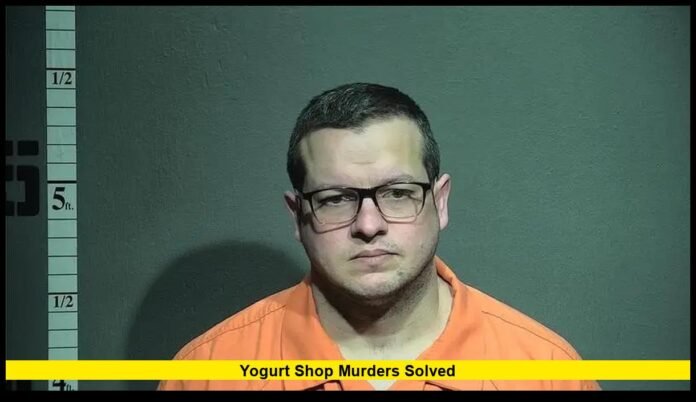

The shocking confirmation that the yogurt shop murders solved is no longer just a hope but a reality has shaken Texas and the entire United States. On September 26, 2025, Austin officials announced that advances in DNA technology and ballistics have identified Robert Eugene Brashers, a deceased serial killer, as the prime suspect behind the 1991 murders of four teenage girls in an “I Can’t Believe It’s Yogurt!” shop.
For more than three decades, families of the victims and the Austin community have waited for justice. Now, while Brashers cannot be tried — he died by suicide in 1999 — investigators say the evidence finally closes one of the state’s most haunting cold cases.
The Night of the 1991 Yogurt Shop Murders
On December 6, 1991, four young girls were brutally murdered in Austin, Texas:
- Eliza Thomas, 17
- Jennifer Harbison, 17
- Sarah Harbison, 15
- Amy Ayers, 13
The Harbison sisters were waiting for a ride home while helping close the shop with Eliza, their coworker. Amy Ayers, a close friend, had joined them that evening.
Shortly before midnight, the shop caught fire. Firefighters responding to the blaze discovered the unimaginable — the four girls bound, gagged, shot, and burned in what was clearly a staged arson to cover the crime.
The brutality of the murders and the young age of the victims sent shockwaves through Texas. Almost overnight, the “yogurt shop murders” became one of the most infamous cases in U.S. history.
Years of Missteps and Wrongful Convictions
The case initially seemed unsolvable. More than 50 people confessed at one point or another, many of them falsely.
By the early 2000s, investigators secured convictions against Robert Springsteen and Michael Scott. Their guilty verdicts were based largely on confessions taken during lengthy interrogations. However, DNA tests later excluded both men from the crime scene.
In 2009, their convictions were overturned, leaving the case wide open again. For families, the vacated verdicts meant renewed grief — not only had their daughters’ murders gone unpunished, but innocent men had been caught in the justice system’s failures.
The Breakthrough: DNA and Ballistics
The turning point came in 2025. With advances in Y-STR DNA profiling, which tracks paternal lineage, investigators re-examined preserved evidence from the crime scene.
The new testing revealed a clear genetic link to the family line of Robert Eugene Brashers. Subsequent forensic work, including genealogical matching and sample verification, confirmed that Brashers’ DNA matched biological material recovered from the victims.
But that wasn’t the only breakthrough. A .380 caliber bullet casing recovered inside the yogurt shop was reanalyzed and found to be consistent with the type of ammunition Brashers used in other violent crimes. Investigators had previously tied this ammunition to him before his death.
Together, the DNA and ballistic findings provided the strongest evidence yet that Brashers was directly involved in the murders.
Who Was Robert Eugene Brashers?
Robert Eugene Brashers (1958–1999) lived a life of violence that spanned multiple states. Known to law enforcement as a dangerous drifter, he was a confirmed serial killer and rapist.
- Brashers committed assaults and murders in states including Missouri, Tennessee, and South Carolina.
- He was described by investigators as highly mobile, using fake identities and avoiding long-term detection.
- His known crimes included brutal attacks on women and children, often involving firearms.
In 1999, facing arrest in Missouri, Brashers died by suicide during a police standoff. At the time, investigators did not realize just how many cases across the country could be tied to him.
Now, the yogurt shop murders are among the crimes attributed to him, expanding the known scope of his violence.
Why the Case Took 34 Years to Solve
Several factors explain why it took so long for the yogurt shop murders solved announcement to finally arrive:
- Fire destruction: The arson destroyed valuable physical evidence, making early forensic testing nearly impossible.
- False confessions: Investigators were overwhelmed by misleading confessions that distracted from real leads.
- Limited technology: Forensic DNA technology in the 1990s lacked the precision and sophistication available today.
- Narrow investigations: Early focus on local suspects meant that out-of-state offenders like Brashers were overlooked.
The persistence of investigators, combined with new science, ultimately cracked the case.
Impact on the Families
For the families of Eliza, Jennifer, Sarah, and Amy, the news brings bittersweet relief. After decades of waiting, they finally know the truth about who killed their daughters.
Yet the fact that Brashers is dead denies them a trial, testimony, or a formal conviction. Instead, closure comes in the form of confirmation, not courtroom justice.
Family members have expressed gratitude to detectives who never gave up but have also voiced frustration at the long years of uncertainty and wrongful convictions that complicated their grief.
Effect on Wrongfully Convicted Men
The identification of Brashers also strengthens the case for clearing the names of Robert Springsteen and Michael Scott once and for all.
Although their convictions were overturned in 2009, many in the community still associated them with the crime. Officially naming Brashers as the suspect provides further evidence that they were innocent.
Exoneration proceedings may soon follow to formally close this chapter of wrongful prosecution.
Lessons for Law Enforcement
The resolution of the yogurt shop murders offers several lessons for investigators and policymakers:
- Preserve evidence: Even when technology cannot yet provide answers, evidence must be saved for future breakthroughs.
- Avoid tunnel vision: Focusing only on local suspects delayed the case for years. Broader suspect pools must always be considered.
- Question confessions: High-pressure interrogations led to false convictions, showing the risks of overreliance on confessions.
- Embrace new technology: Genetic genealogy and advanced DNA profiling are revolutionizing cold case investigations.
The Broader Significance
The resolution of this case is not just about Austin or Texas — it resonates across the country.
- Forensic genealogy is increasingly being used to solve decades-old cases, from the Golden State Killer to unidentified victim cases.
- Cold case units are now more confident than ever that no case is truly unsolvable.
- Public trust in justice may be restored when authorities show persistence, even after decades of setbacks.
The yogurt shop murders stand as proof that science can catch up with even the most carefully concealed crimes.
Unanswered Questions
Even with the identification of Brashers, some mysteries remain:
- Did he act alone, or were accomplices involved?
- What was his motive for targeting the yogurt shop that night?
- Could Brashers be linked to other unsolved cases in Texas or nearby states?
Authorities say the investigation remains technically open as they continue to explore these questions.
Conclusion
The announcement that the yogurt shop murders solved after 34 years is both heartbreaking and groundbreaking. For the families of four young girls, the city of Austin, and cold case detectives across the nation, it represents the triumph of science, persistence, and justice — even if imperfect.
While Robert Eugene Brashers cannot be prosecuted, his identification ends decades of uncertainty. More importantly, it shows that no matter how much time passes, the pursuit of truth never stops.
The closing of this chapter reminds us all: justice delayed does not have to mean justice denied. What are your thoughts on this breakthrough? Share your perspective in the comments below.