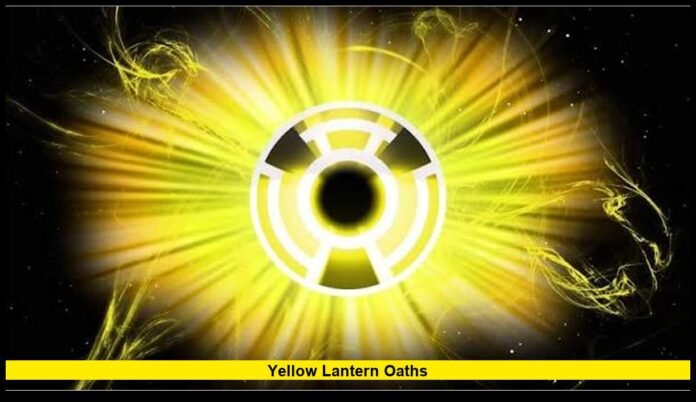

The yellow lantern oath has become a major point of discussion among DC fans following the Season 1 finale of HBO’s Lanterns. The series has taken the familiar Green Lantern mythology in a different direction, particularly through John Stewart’s unusual journey, Sinestro’s return and the introduction of a lantern connected to fear. While the comics have long associated yellow energy with the Sinestro Corps, the live-action series has given that mythology a fresh interpretation that could become increasingly important to the DC Universe.
What Is the Yellow Lantern Oath?
The yellow Lantern oath belongs to the Sinestro Corps, the fear-powered organization created by former Green Lantern Thaal Sinestro in DC Comics.
In the comics, Lantern oaths are more than ceremonial declarations. They are closely connected to the identity and philosophy of each Lantern organization. Green Lanterns draw upon willpower, while the Sinestro Corps draws upon fear. Their respective oaths reflect those opposing approaches to power.
The traditional Sinestro Corps oath is built around darkness, brightness, fear and the consequences faced by those who oppose Sinestro’s version of order. It reinforces the central belief that fear can be transformed into power.
That idea has always been fundamental to Sinestro’s character.
He does not believe fear is something that must simply be defeated. Instead, he believes fear can be controlled and used to establish order.
Why Fear Is So Important to Yellow Lanterns
Fear occupies a unique position within DC’s Emotional Spectrum.
The Green Lantern Corps traditionally represents willpower. A Green Lantern can experience fear but must possess enough will to overcome it. Yellow Lantern mythology reverses that relationship.
A Yellow Lantern does not need to defeat fear in order to become powerful. Fear itself becomes the source of power.
That distinction gives the Sinestro Corps its identity.
It also explains why yellow and green have always been natural rivals. One side represents the strength required to face fear, while the other turns fear into a weapon against others.
This conflict has allowed DC writers to build stories around much more than physical battles. Green Lantern and Sinestro Corps conflicts often become arguments about morality, authority, freedom and the price of maintaining peace.
Sinestro’s Connection to Yellow Power
Thaal Sinestro is the central figure behind the yellow Lantern mythology.
Before becoming associated with yellow power, Sinestro was one of the Green Lantern Corps’ most respected members. He served as a Lantern of Sector 1417 and developed a reputation for maintaining order.
His methods, however, eventually became impossible for the Guardians of the Universe to accept.
Sinestro believed that strict control could produce lasting peace. His increasingly authoritarian approach ultimately placed him in conflict with the Green Lantern Corps.
After his fall from the organization, he became one of its greatest enemies.
The creation of the Sinestro Corps transformed his philosophy into an entire Lantern army. Rather than relying on willpower, the Corps harnessed fear and recruited individuals capable of imposing that emotion on others.
This history explains why yellow light has such a strong association with Sinestro.
The Sinestro Corps in DC Comics
The Sinestro Corps became one of the defining elements of modern Green Lantern mythology during Geoff Johns’ influential Green Lantern stories.
Its introduction dramatically expanded the mythology beyond the traditional green-versus-yellow rivalry.
The Sinestro Corps demonstrated that Lantern power could be connected to different emotions and that the universe contained multiple organizations competing for control of those forces.
Yellow Lanterns became particularly dangerous because fear can be used against almost anyone.
A powerful warrior can still be afraid.
A superhero can still have something to lose.
A leader can still worry about failure.
A Yellow Lantern can exploit those vulnerabilities.
That psychological dimension makes fear-based Lanterns different from conventional supervillains.
How the Yellow Oath Differs From the Green Lantern Oath
The Green Lantern oath traditionally emphasizes light, duty and the ability to protect others.
The Sinestro Corps oath has a much darker outlook.
Its imagery turns fear into illumination and warns opponents about the consequences of resistance. Instead of reassuring people, it is designed to intimidate them.
That contrast is intentional.
The Green Lantern philosophy effectively argues that courage allows someone to stand against darkness.
The Sinestro philosophy argues that darkness can be used to force people into obedience.
Both ideas are built around power, but they reach radically different conclusions about how power should be used.
What Happened to Sinestro in Lanterns?
The live-action Lanterns series has introduced a version of Sinestro played by Ulrich Thomsen.
Rather than immediately presenting him as the fully established yellow-armored leader familiar to comic readers, the series approaches him through the show’s grounded mystery and John Stewart’s developing relationship with the Lantern world.
By the finale, Sinestro’s importance becomes considerably clearer.
He has been imprisoned, but his knowledge and abilities remain crucial to the larger story. He becomes connected to the creation of a new lantern that carries an unusual relationship with fear.
That development is especially significant because it links the show’s grounded character drama to the broader mythology of the Emotional Spectrum.
John Stewart’s Unusual Lantern Journey
John Stewart’s path in Lanterns has never been straightforward.
Instead of immediately becoming a traditional Green Lantern, John spends much of the season wrestling with his relationship to fear, responsibility and the legacy of Hal Jordan.
His history gives that struggle additional weight.
John has been trained to suppress weakness and confront danger without hesitation. His experiences with Hal and the Lantern Corps force him to reconsider what strength actually means.
The Season 1 finale brings that internal conflict to the surface.
John ultimately embraces fear rather than pretending that he is unaffected by it.
That decision becomes one of the most important moments in his development.
Does John Stewart Become a Yellow Lantern?
The finale deliberately leaves room for interpretation.
John uses a ring connected to an unusual lantern created by Sinestro. The lantern has been affected by fear-based material from the alien world involved in the finale, giving it a distinctive yellow influence.
However, John is not simply presented as a standard member of the Sinestro Corps.
Instead, the series creates something more complicated.
John establishes himself as an independent Lantern operating according to his own principles. He does not simply accept the authority of the Guardians, and he does not appear to embrace Sinestro’s authoritarian philosophy.
That makes his situation different from the traditional comic-book definition of a Yellow Lantern.
The color symbolism nevertheless matters.
John’s decision to embrace fear opens the door to a possible future in which green and yellow Lantern mythology becomes more closely connected.
John’s New Oath
One of the most important developments in the Lanterns finale is John’s decision to create an oath that reflects his own philosophy.
Rather than simply repeating the traditional Green Lantern oath, John acknowledges fear as part of his identity while affirming his determination to do what is right.
His new oath represents a major change in his relationship with the Guardians and the Lantern organization.
It also reflects the larger message of his character arc.
John does not become heroic because he is incapable of fear.
He becomes heroic because he recognizes fear and chooses to act responsibly anyway.
That distinction is especially important when viewed alongside Sinestro’s philosophy.
Why John’s Story Could Change the DC Universe
John Stewart’s future could have major consequences for the developing DC Universe.
The character is already confirmed to continue beyond the first season of Lanterns, including an appearance in the upcoming Man of Tomorrow. That means the choices made during the finale are not simply isolated television developments.
John now occupies an unusual position.
He has a Lantern ring.
He has a custom charging source.
He has rejected conventional dependence on the Guardians.
And he has embraced an understanding of fear that traditional Green Lantern mythology does not usually emphasize.
This gives DC Studios considerable flexibility.
John could remain a Green Lantern operating independently of the Corps. He could develop a new form of Lantern identity. Or the story could eventually explore the possibility that fear and willpower can coexist within the same character.
The Difference Between Yellow Power and Evil
It is important to remember that yellow Lantern energy does not automatically make someone evil.
The Sinestro Corps has historically been antagonistic because of the way its members use fear.
But fear itself is not inherently immoral.
Everyone experiences fear.
Fear can warn someone of danger, motivate preparation and prevent reckless decisions. The problem arises when fear becomes a method of controlling other people.
This distinction appears increasingly important to John’s story.
He can acknowledge fear without allowing it to dictate his choices.
Sinestro, by contrast, has historically attempted to use fear as a mechanism of control.
That philosophical difference could become one of the most interesting elements of future Lantern stories.
Why the Yellow Lantern Mythology Works So Well
The appeal of yellow Lantern mythology comes from its psychological foundation.
Superhero powers are often based on physical strength, speed, technology or magic. Lantern powers are different because they are connected to emotion.
The yellow light takes one of humanity’s most universal experiences and turns it into a source of extraordinary power.
That creates immediate storytelling possibilities.
A Yellow Lantern can attack someone physically, but the more interesting threat is often psychological.
What does the character fear?
What memory can be exploited?
What would happen if that fear became overwhelming?
Those questions make fear-powered characters particularly effective in stories focused on identity and personal growth.
The Role of Sinestro Going Forward
Sinestro remains one of the most important pieces of the Lantern mythology.
His relationship with Hal Jordan is central to the history of the franchise, while his philosophy provides a natural counterpoint to John Stewart’s emerging worldview.
The events of the Lanterns finale suggest that his influence is not finished.
The mysterious lantern he creates may become particularly important if the series continues exploring fear-based power.
The showrunner has also indicated that the unusual lantern creates considerable possibilities for the future, leaving the door open for consequences that have not yet been revealed.
That uncertainty is useful because it prevents the mythology from becoming predictable.
What the Yellow Lantern Oath Could Mean for Future Stories
The yellow lantern oath now has an interesting place between established DC Comics mythology and the new continuity being built for live action.
The traditional oath represents Sinestro’s belief that fear should be weaponized.
John’s new oath represents almost the opposite idea: fear can be acknowledged without surrendering to it.
That difference could become important if John eventually encounters a larger Yellow Lantern movement.
Instead of presenting yellow and green as simple opposites, DC could explore whether different emotional forces can coexist.
Such an approach would give the Lantern mythology more depth while allowing the live-action universe to create its own interpretation.
Final Thoughts
The yellow Lantern mythology has always been about more than a color.
It represents fear, control and the complicated question of whether an emotion can be used for good without becoming destructive.
Sinestro’s philosophy turns fear into a tool of authority. John Stewart’s journey offers another possibility: recognizing fear while maintaining the courage to make the right decision.
The Season 1 finale of Lanterns makes that distinction particularly important. John does not simply inherit Hal Jordan’s role. He creates his own path, accepts an unusual Lantern power source and establishes a personal code that reflects what he has learned.
That leaves the door open for one of the most intriguing possibilities in the new DC Universe: a Lantern who understands both willpower and fear, but refuses to let either one define him completely.
With John’s story continuing beyond the first season, the relationship between green and yellow energy could become an important part of the next chapter of DC’s Lantern mythology.