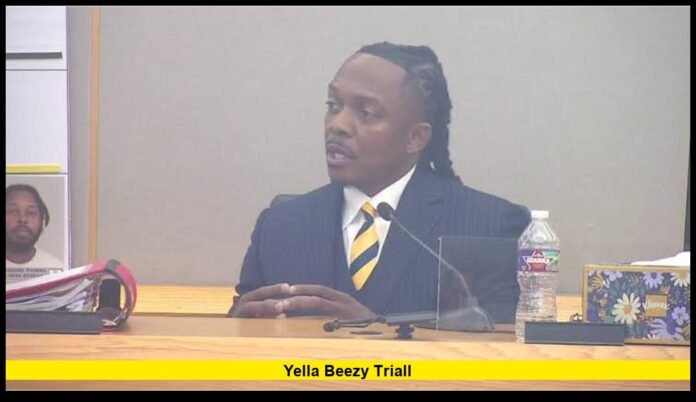

The yella beezy trial remains a major point of interest in the Dallas hip-hop community following the conviction of Kewon White in the 2020 killing of rapper Mo3. White was found guilty of capital murder on September 4, 2026, and sentenced to life in prison without the possibility of parole. Prosecutors alleged that White was the gunman in a murder-for-hire scheme involving Dallas rapper Yella Beezy, whose legal name is Markies Conway. Conway has pleaded not guilty to capital murder and has denied involvement in Mo3’s death.
White’s conviction represents the first major courtroom outcome in a case that has remained unresolved for nearly six years. Attention now turns toward the separate criminal proceedings involving Conway and co-defendant Devin Brown.
Kewon White Found Guilty in Mo3 Killing
Kewon White became the first defendant connected to the alleged murder-for-hire scheme to face a jury.
After hearing evidence for roughly two weeks, jurors found White guilty of capital murder in the death of Melvin Noble, better known professionally as Mo3. Judge Chika Anyiam sentenced White to life in prison without parole.
The verdict came after prosecutors presented a case centered on the argument that White was hired to kill Noble following a long-running dispute involving Dallas-area rappers.
White did not testify in his own defense.
The prosecution maintained that White tracked Noble before confronting him on Interstate 35E in Dallas on November 11, 2020. Noble was shot after being chased on foot along the highway.
The conviction gives prosecutors a significant courtroom victory, but it does not automatically establish the guilt of the other defendants.
Conway and Brown have separate cases, and prosecutors will still have to prove the allegations against each defendant individually.
Who Is Yella Beezy?
Markies Conway, known professionally as Yella Beezy, is a Dallas rapper who developed a national profile through his music and collaborations.
His career expanded considerably during the late 2010s, when he became known for songs that received substantial attention in the Texas hip-hop scene and beyond. He also performed alongside major names in the music industry.
His connection to Mo3 became increasingly controversial because the two artists were involved in a public dispute before Noble’s death.
Investigators later developed the theory that the conflict escalated into a planned killing.
Conway was arrested in March 2025 after a Dallas County grand jury indicted him on a capital murder charge involving remuneration. In Texas, a capital murder allegation involving remuneration can apply when prosecutors contend that someone hired another person to commit a killing.
Conway has consistently denied the accusation.
What Happened to Mo3?
Mo3 was killed during a daytime shooting in Dallas on November 11, 2020.
According to evidence presented in court, Noble was traveling on Interstate 35E when another vehicle approached. The confrontation eventually moved onto the highway, where Noble was chased and shot.
The killing shocked Dallas’ music community because Mo3 was an established local artist with a growing national audience.
His 2018 song “Errybody” had become one of his best-known releases, and his career was continuing to develop before his death.
Investigators initially worked to identify the person responsible for the shooting. Kewon White was eventually arrested and later became the first defendant to face trial in the case.
Prosecutors subsequently connected the shooting to an alleged conflict between Noble and Conway.
Prosecutors’ Murder-for-Hire Theory
The prosecution’s central theory is that Mo3’s killing was not a random highway shooting.
Prosecutors allege that Conway wanted Noble killed because of their longstanding rivalry and that White was recruited to carry out the shooting.
Devin Brown is also accused of helping coordinate the alleged operation.
The state has relied on a combination of witness testimony, financial records, phone evidence, surveillance footage, social-media activity and music to establish the alleged relationships among the defendants.
The evidence presented during White’s trial was intended to show jurors how prosecutors believe the alleged operation developed and how White became involved.
However, evidence introduced during White’s trial must still be evaluated separately in any future proceeding involving Conway.
The $40,000 Withdrawal
One of the most closely watched pieces of financial evidence was a $40,000 bank withdrawal associated with Conway.
During testimony, Dallas Police Detective Eric Barnes discussed financial records that prosecutors said were relevant to their theory of the alleged murder-for-hire arrangement.
The state argued that the transaction formed part of a larger financial trail surrounding the killing.
Prosecutors alleged that money was used to finance the operation, including an alleged payment to White.
The defense challenged the interpretation of financial evidence and questioned whether the withdrawal itself proved that money had been used for a murder.
That distinction is important.
A financial transaction, standing alone, does not establish that a person committed a crime. Prosecutors would need to connect the transaction to the alleged criminal conduct through additional evidence.
The financial records nevertheless became an important part of the state’s presentation as prosecutors attempted to establish motive, relationships and alleged payments.
Rap Lyrics Become a Key Legal Issue
Another major issue surrounding the case has involved Yella Beezy’s music.
Prosecutors wanted to introduce portions of Conway’s songs to support their argument about his relationship with Mo3 and the alleged motive behind the killing.
The defense objected, arguing that rap lyrics are artistic expression and should not automatically be treated as factual statements or admissions.
A Dallas judge ultimately ruled that only certain material could be presented.
Among the material allowed were portions of “On Ya Head” and “Keep It in the Streets.” Mo3’s “2 Nineteen” was also allowed to be considered.
The judge excluded much of Conway’s other lyrical material.
The dispute reflects a broader legal question that has appeared in criminal cases involving rappers: when can lyrics be considered evidence of real-world conduct?
Defense lawyers have argued that rap commonly includes exaggeration, fictional storytelling, threats, metaphors and characters. Prosecutors, meanwhile, can argue that lyrics may have evidentiary value when they are connected to independently established facts.
Texas courts have previously examined the potential prejudice involved when prosecutors introduce rap lyrics in criminal trials.
Evidence Presented During White’s Trial
The trial of Kewon White featured a wide range of evidence.
Jurors heard testimony from law enforcement officials, witnesses and experts. Surveillance video played a role in reconstructing events surrounding the shooting.
Investigators also discussed White’s phone records and financial information.
Social-media posts became part of the prosecution’s effort to explain the relationships among the people involved.
Music was another important component.
The jury heard songs connected to the dispute between Mo3 and Yella Beezy, while prosecutors attempted to use selected lyrics to support their interpretation of the feud.
The defense challenged portions of the prosecution’s evidence, including questions about whether investigators adequately explored other possibilities.
Defense attorneys also questioned Detective Barnes about financial transactions, text messages, flight information and other investigative details.
The defense’s broader strategy was to challenge the state’s interpretation of circumstantial evidence and the strength of the connection between White and the alleged murder-for-hire arrangement.
The Role of Devin Brown
Devin Brown is the third defendant connected to the case.
Prosecutors allege that Brown helped coordinate the operation and was connected to White around the time of the shooting.
Evidence presented during White’s trial included testimony and surveillance material that prosecutors said supported their theory concerning Brown’s involvement.
Like Conway and White, Brown has pleaded not guilty.
His case remains separate from White’s conviction.
That means the guilty verdict against White does not automatically determine Brown’s legal outcome.
Each defendant must receive an individual determination based on the evidence and arguments presented in that defendant’s case.
What Happens to Conway Now?
The most important question following White’s conviction is what comes next for Conway.
Conway was originally scheduled for a February 2026 trial, but his case did not proceed to a completed jury trial at that time. White was ultimately tried first.
The timing of Conway’s own proceedings has therefore become a major issue for people following the case.
The state is expected to continue pursuing the capital murder allegation against him.
Conway remains legally presumed innocent unless prosecutors prove the charge beyond a reasonable doubt in court.
His defense will have the opportunity to challenge the state’s evidence, question witnesses and present its own arguments.
The fact that White has now been convicted could make the next stage of the case particularly significant because prosecutors have already presented their theory of the alleged scheme in open court.
However, White’s conviction does not legally establish that Conway is guilty.
What Could Conway Face If Convicted?
Conway faces a capital murder charge involving an allegation that the killing was carried out for remuneration.
Under Texas law, a conviction for capital murder can carry extremely serious consequences.
Depending on the circumstances and decisions made in the case, the punishment can include life imprisonment without parole or the death penalty.
The prosecution would have to establish the required elements of the charge before a jury could return a conviction.
For Conway, the stakes therefore remain exceptionally high.
His attorneys are expected to challenge the state’s interpretation of the evidence, including financial records, alleged communications, the history of the feud and the use of music as evidence.
Why White’s Verdict Matters
White’s conviction is significant because it establishes a courtroom finding against the person prosecutors identified as the shooter.
The jury accepted the state’s case against White beyond a reasonable doubt.
That does not mean every allegation made by prosecutors regarding the broader conspiracy has automatically been proven against every defendant.
Still, the verdict gives the prosecution a substantial development as it moves forward with the remaining cases.
It also provides the public with a clearer understanding of the evidence the state intends to emphasize.
Financial transactions, communications, surveillance footage, social-media activity and the alleged history between the rappers are likely to remain important topics as the remaining proceedings develop.
The History Between Yella Beezy and Mo3
The relationship between Conway and Noble is central to the prosecution’s theory.
The two rappers were part of Dallas’ competitive hip-hop scene and had a public history of conflict.
Prosecutors argue that the rivalry eventually escalated into an alleged plot against Noble.
The defense disputes the state’s interpretation of that history.
The distinction between a public rap rivalry and evidence of a criminal agreement is one of the issues that could become especially important during Conway’s proceedings.
A history of disagreement does not by itself establish that one person ordered another person’s killing.
Prosecutors must connect the alleged rivalry to the specific criminal conduct charged.
The Broader Debate Over Rap and Criminal Evidence
The case has also attracted attention because of its implications for hip-hop artists.
The use of rap lyrics in criminal prosecutions has become a controversial legal subject across the United States.
Supporters of restrictions argue that lyrics should receive the same artistic protections as other forms of creative expression. They contend that fictional or exaggerated lyrics should not be presented to jurors as literal confessions.
Prosecutors argue that lyrics can sometimes provide context when they directly relate to independently established evidence.
The Dallas case demonstrates why courts have to evaluate such material carefully.
The judge’s decision to permit some songs while excluding much of the remaining material reflects the continuing effort to balance evidentiary relevance against the risk that artistic expression could unfairly influence jurors.
What to Watch Next
With White’s conviction now entered, attention shifts toward the remaining defendants.
The next major development will be the scheduling and preparation of Conway’s case.
Potential pretrial hearings could address evidence, witnesses, motions and the admissibility of additional material.
The prosecution will also have to determine how it intends to present the case against Conway independently.
For the defense, the key questions will include whether prosecutors can establish a direct connection between Conway and the alleged killing, how financial evidence should be interpreted and whether selected music or social-media material should be permitted at trial.
The outcome could have major consequences for Conway’s future and could bring another major chapter to one of Dallas hip-hop’s most closely followed criminal cases.
Bottom Line
The latest developments have dramatically changed the status of the Mo3 murder investigation.
Kewon White has now been convicted of capital murder and sentenced to life without parole for the 2020 killing of Mo3. Prosecutors successfully argued that White was responsible for the shooting they said was connected to a larger murder-for-hire scheme.
Conway remains a separate defendant.
He has pleaded not guilty and denied involvement in Noble’s death. His legal case has not been resolved by White’s conviction.
The yella beezy trial will therefore remain an important story to watch as prosecutors and defense attorneys prepare for the next stage of the proceedings.
For now, the central facts are clear: Mo3 was killed in Dallas in 2020, Kewon White has been convicted for the killing, Conway faces a separate capital murder case, and prosecutors continue to allege that the shooting was connected to a larger plan.
Until a jury reaches a verdict in Conway’s own case, allegations against him remain allegations, and he remains entitled to the presumption of innocence.