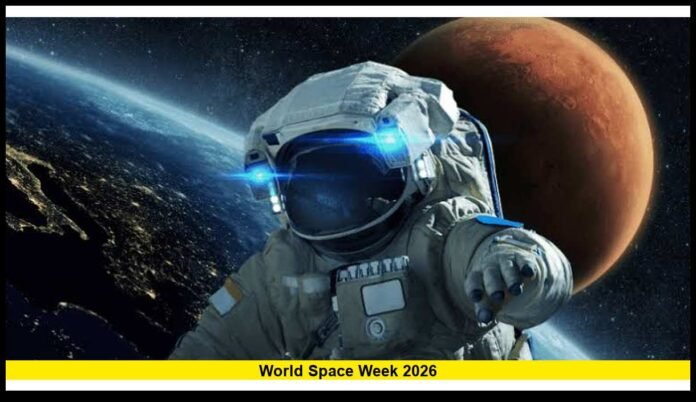

World Space Week 2026 is taking place from October 4 through October 10, bringing attention to rocket technology, space exploration, STEM education and the growing role of commercial spaceflight. The 2026 celebration carries the theme “Rocket Revolution,” placing modern launch systems and their impact on access to space at the center of this year’s worldwide observance.
The annual event connects people across the United States and around the world through educational programs, astronomy activities, public presentations and space-focused events. NASA is also participating in the 2026 observance, with programming that highlights Artemis II communications technology and the changing capabilities supporting human exploration.
When Is World Space Week 2026?
The 2026 celebration officially runs from October 4 through October 10.
The United Nations selected these dates because of two major milestones in space history.
October 4 marks the anniversary of the launch of Sputnik 1 in 1957. The Soviet satellite became the first artificial satellite to orbit Earth and marked a defining moment in the beginning of the Space Age.
October 10 has a different significance. It marks the anniversary of the Outer Space Treaty entering into force in 1967.
These two dates connect the beginning of human activity in space with the development of international rules for outer-space activities.
The United Nations General Assembly established World Space Week in 1999. Since then, the October 4–10 period has become an annual opportunity to promote awareness of space science and technology.
What Is the Theme for 2026?
The official 2026 theme is “Rocket Revolution.”
The theme focuses on the rapid development of launch technology and the way rockets are changing access to space.
Modern launch systems differ significantly from the vehicles used during the earliest decades of space exploration. Advances in propulsion, manufacturing, materials, software and vehicle design have changed how launch missions are planned and conducted.
Reusable launch technology has become particularly important.
Instead of treating an entire launch vehicle as disposable after a single mission, reusable systems allow major components to return and fly again. This approach has influenced the commercial launch industry and helped create a faster-moving space economy.
The theme also recognizes that space activity now involves a broader group of participants.
Government agencies remain central to major exploration programs. At the same time, private companies, research institutions, universities and other organizations contribute increasingly to launch services, spacecraft development and space-based applications.
Why Rockets Are at the Center of the Celebration
Rockets provide the transportation required to place spacecraft, satellites and other payloads into space.
Without reliable launch systems, many of the services people associate with modern space activity would not exist.
Satellites support communications, navigation, weather monitoring, scientific research and Earth observation. Human spaceflight also depends on launch vehicles capable of carrying crews and cargo safely beyond Earth’s atmosphere.
The Rocket Revolution theme gives educators and the public an opportunity to examine the technology behind these capabilities.
A rocket launch involves much more than propulsion.
Engineers must consider structural strength, fuel management, guidance, navigation, control systems, thermal protection and communications. Mission teams must coordinate ground equipment and flight operations while monitoring the vehicle throughout its journey.
These challenges make rocketry a natural subject for STEM education.
NASA’s Role in World Space Week 2026
NASA remains one of the most visible U.S. organizations participating in space education and exploration.
During the 2026 celebration, NASA is highlighting an event titled “From Space to Screen: Connecting the World Through Artemis II.”
The program is scheduled for October 8 and focuses on laser communications technology associated with Artemis II operations.
The presentation examines how high-definition astronaut video can be transmitted across the vast distance between Earth and the Moon.
That capability demonstrates an important part of modern space exploration.
Sending astronauts into space is only one element of a successful mission. Spacecraft and crews must communicate with teams on Earth, transmit scientific information and provide mission data.
Advanced communications systems therefore play an important role alongside rockets and spacecraft.
Artemis II and the 2026 Celebration
Artemis II is an important part of NASA’s human exploration efforts and provides a direct connection between the 2026 World Space Week theme and current U.S. space activity.
The mission’s communications technology demonstrates how space exploration increasingly depends on several sophisticated systems working together.
Launch vehicles provide transportation. Spacecraft provide the platform for crewed missions. Communications systems connect astronauts and spacecraft with Earth-based teams.
Each element must operate as part of the larger mission architecture.
The Artemis program also demonstrates the continuing importance of lunar exploration in U.S. space policy and scientific activity.
The Moon serves as an important destination for testing technologies, conducting scientific research and developing capabilities needed for more ambitious human exploration.
How World Space Week Is Celebrated in the United States
World Space Week does not depend on a single national event.
Instead, organizations across the United States can hold their own programs during the October 4–10 period.
Astronomy clubs, schools, museums, science organizations and community groups can organize activities connected with the annual celebration.
Programs may include telescope observations, educational presentations, astronomy demonstrations, space exhibitions and discussions about current missions.
NASA’s Night Sky Network also provides a connection between astronomy clubs and the public.
These local programs are particularly useful for people who want to participate without traveling to a major aerospace center.
Astronomy Activities Add a Local Dimension
Not every World Space Week activity requires a rocket launch or a large scientific facility.
Local astronomy groups can offer people opportunities to observe the night sky and learn more about planets, stars and other celestial objects.
Solar observing can also become part of community programming when appropriate equipment and trained observers are available.
Astrophotography provides another way to participate.
These activities give families and students an opportunity to connect the broader themes of space exploration with something they can experience from their own communities.
For many Americans, a local astronomy club may be the most accessible way to take part in the celebration.
World Space Week and STEM Education
Education remains one of the most important elements of World Space Week.
Rockets provide practical examples of scientific principles that students encounter in the classroom.
Physics lessons can explore motion, forces and acceleration. Mathematics can be applied to trajectories and orbital calculations. Engineering lessons can examine how launch vehicles are designed to withstand extreme conditions.
Computer science also plays an important role.
Modern spacecraft and launch systems depend heavily on software for navigation, control, communications and mission operations.
Students can therefore use space exploration as a starting point for learning about several technical disciplines at once.
The Rocket Revolution theme is particularly suitable for discussions about engineering innovation and the development of new launch systems.
The Growing Importance of Commercial Spaceflight
One of the biggest changes in the modern space sector has been the growing participation of commercial companies.
For decades, governments dominated orbital launch activity.
Today, commercial providers play major roles in launching satellites and supporting government and private missions.
The commercial sector has also contributed to the development of reusable launch systems and other technologies designed to increase operational efficiency.
This transition has created a broader space ecosystem.
Companies now work alongside government agencies, universities, research institutions and international partners.
The result is a space industry that covers a wide range of activities, from rocket manufacturing and satellite operations to communications and data services.
Reusable Rockets and the Changing Launch Industry
Reusable launch technology is one of the most important subjects connected with the 2026 theme.
Traditional launch vehicles were generally designed for limited use, with major components discarded after a mission.
Reusable systems approach the problem differently.
By recovering and refurbishing major hardware, launch providers can use the same components for multiple missions.
The technology requires sophisticated engineering.
Vehicles must survive the intense forces and temperatures associated with launch and atmospheric return. They also require guidance systems capable of controlling the vehicle during descent and landing.
The development of these systems represents a significant engineering challenge.
It also illustrates why the Rocket Revolution theme extends beyond the launch itself.
The Broader Space Economy
The launch industry supports a much larger economic ecosystem.
Satellites provide services used by businesses, governments and consumers.
Communications satellites support connectivity. Earth-observation spacecraft provide data about the planet. Navigation satellites support positioning and timing applications.
Weather satellites contribute to forecasting and storm monitoring.
Scientific spacecraft support research that expands knowledge about Earth, the solar system and the wider universe.
Every one of these applications depends on the ability to place hardware into space.
That makes rocket technology an essential foundation of the modern space economy.
Why October 4 Remains Historically Important
Sputnik 1’s launch on October 4, 1957, changed the relationship between humanity and space.
The small satellite demonstrated that an artificial object could be placed into orbit around Earth.
The achievement triggered rapid developments in space technology and helped establish the Space Age.
World Space Week begins on the anniversary of that historic launch.
The date provides an opportunity to look at how far launch technology has progressed since the earliest orbital missions.
Today’s spacecraft and launch systems are dramatically more capable than the first generation of space hardware.
Yet the basic challenge remains familiar: engineers must develop reliable systems capable of overcoming Earth’s gravity and reaching space.
Why October 10 Is Part of the Celebration
The final day of World Space Week connects space exploration with international cooperation.
The Outer Space Treaty entered into force on October 10, 1967.
The treaty established fundamental principles for activities in outer space.
Among its central principles is the idea that outer space is not subject to national appropriation.
It also establishes important rules concerning peaceful activities and responsibility for space operations.
Including October 10 in World Space Week therefore emphasizes that space exploration involves both technological progress and international responsibilities.
Global Participation in World Space Week
The celebration extends well beyond the United States.
Organizations around the world organize events during the October 4–10 period.
The World Space Week Association coordinates international participation and promotes activities related to the annual theme.
The previous year’s reported participation reached 50,000 events in 102 countries, demonstrating the scale that the celebration can reach.
Those figures relate to the 2025 observance and should not be treated as a final count for 2026.
The international structure allows participating organizations to create activities that match their communities.
Some focus on education. Others emphasize astronomy, engineering, space policy or current missions.
World Space Week 2026 Activities for Students
Students can participate in several ways.
A school may organize a rocket science lesson, host a space presentation or conduct an astronomy activity.
Teachers can use the Rocket Revolution theme to introduce students to the history of launch technology.
Classroom discussions can compare early rockets with modern reusable systems.
Students can also explore the different careers connected with spaceflight.
Those careers include aerospace engineering, mechanical engineering, software development, physics, astronomy, communications, data science and many other fields.
The celebration provides an accessible starting point for introducing young people to those opportunities.
World Space Week 2026 Activities for Families
Families can also participate without specialized equipment.
Public astronomy events can provide opportunities to view the night sky.
Science centers and museums may host space-related programs.
Online presentations can make participation possible for people who cannot attend events in person.
Families interested in the celebration can also use the week to learn about NASA missions, rockets, satellites and astronomy.
The central theme makes it especially easy to connect activities with the technology behind space exploration.
Confirmed U.S. Participation
Several U.S. organizations and groups are participating in activities connected with the 2026 celebration.
NASA’s programming provides a national-level example, while local astronomy groups offer community-based opportunities.
The Elkins Park SkyWatchers in Pennsylvania is among the organizations listing World Space Week activities.
Its program includes astronomy-related activities such as telescope observing, solar observation and astrophotography.
The group also uses its program to provide public education and community engagement.
Such local events show how the international celebration reaches individual communities across the United States.
Key Facts About World Space Week 2026
| Category | 2026 information |
|---|---|
| Official dates | October 4–10, 2026 |
| Theme | “Rocket Revolution” |
| Main focus | Launch technology and access to space |
| Beginning date | Sputnik 1 anniversary |
| Ending date | Outer Space Treaty anniversary |
| U.S. participant | NASA |
| NASA highlighted program | Artemis II communications presentation |
| International coordinator | World Space Week Association |
| Previous reported event total | 50,000 events in 2025 |
| Previous reported participating countries | 102 in 2025 |
The previous-year participation figures provide context for the scale of the annual observance. They do not represent the final 2026 totals.
Latest Confirmed Developments During the 2026 Week
The 2026 observance is currently underway.
The Rocket Revolution theme remains at the center of the international program, while organizations continue to hold educational and public events.
NASA’s October 8 Artemis II communications presentation is one of the notable U.S. activities connected with the celebration.
The World Space Week Association has also highlighted programming focused on lunar missions and the technologies supporting future lunar exploration.
Local astronomy organizations are continuing their own community programs during the week.
These activities give the public several ways to engage with the celebration.
Why World Space Week 2026 Matters to Americans
The celebration offers Americans an opportunity to understand how space technology affects life on Earth.
Satellite systems influence communications, navigation, weather forecasting and many other services.
At the same time, NASA and commercial space companies continue to develop technologies for future exploration.
The Rocket Revolution theme brings these developments together by focusing attention on the launch systems that make space missions possible.
It also highlights the importance of education.
The next generation of engineers, scientists, programmers and researchers will help determine how the United States and other countries use space in the future.
World Space Week provides a public platform for encouraging that interest.
Looking at the Future Through the Rocket Revolution Theme
The 2026 celebration reflects a major transition in spaceflight.
Early missions demonstrated that humans could place objects into orbit.
Modern missions use increasingly sophisticated rockets, spacecraft and communications systems.
Commercial launch providers now operate alongside government programs.
Reusable technology has changed discussions about launch operations.
Lunar exploration has returned to the center of human spaceflight planning.
At the same time, satellites continue to provide services that have become part of everyday life.
The Rocket Revolution theme brings these developments together under one central idea: access to space is changing.
World Space Week 2026 gives the public an opportunity to examine that change while remembering the historic milestones that made today’s space activities possible.
The celebration continues through October 10, linking the history of the Space Age with the technologies, missions and educational opportunities shaping the present.
What part of the Rocket Revolution interests you most? Share your thoughts and follow the latest confirmed developments as World Space Week 2026 continues.
Frequently Asked Questions
When is World Space Week 2026?
World Space Week 2026 takes place from October 4 through October 10.
What is the 2026 World Space Week theme?
The 2026 theme is “Rocket Revolution,” which focuses on developments in rocket technology and the changing accessibility of space.
Why does the celebration begin on October 4?
October 4 marks the anniversary of Sputnik 1’s launch in 1957, the first artificial satellite to orbit Earth.
Why does the celebration end on October 10?
October 10 marks the anniversary of the Outer Space Treaty entering into force in 1967.
Is NASA participating in World Space Week 2026?
Yes. NASA has scheduled programming during the 2026 observance, including a presentation focused on Artemis II communications technology.
Can Americans participate in World Space Week?
Yes. Astronomy clubs, schools, museums, educational organizations and other groups can host activities during the celebration.
Are World Space Week events limited to rocket launches?
No. Activities can include astronomy observations, educational programs, presentations, exhibitions and other space-related events.
What does the Rocket Revolution theme focus on?
It highlights changes in launch technology, including advances that are making space access more capable and increasingly accessible to a broader range of organizations.
How does World Space Week support STEM education?
Space activities provide practical examples of physics, mathematics, engineering, computer science and other STEM subjects.
How long has World Space Week existed?
The United Nations General Assembly established World Space Week in 1999. The first annual observance followed the designation of October 4–10 as the official period.
What was reported for the 2025 celebration?
The World Space Week Association reported 50,000 events across 102 countries for the 2025 observance. Those figures do not represent a final 2026 total.
Where can Americans find local space activities?
Local astronomy clubs, science organizations, museums and NASA-affiliated astronomy groups can provide information about activities in individual communities.