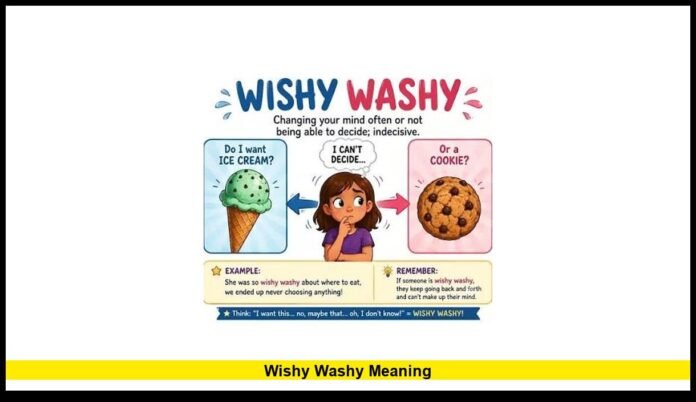

The phrase wishy washy meaning is commonly associated with indecision, weak opinions, unclear communication, or something that lacks strength and character. In American English, it is an informal and usually disapproving expression. It can describe a person who struggles to take a firm position, an answer that avoids a clear response, or even a color that looks pale and lacking in intensity.
The expression remains a recognizable part of everyday English. Current dictionary definitions continue to connect it with a lack of firm ideas, principles, determination, or noticeable qualities. It can also describe something watery, thin, weak, or visually dull.
Understanding the expression requires looking at the situation in which it appears. A person, statement, decision, drink, painting, or color can all be described with the same word, but the intended meaning can change slightly.
What Does Wishy-Washy Mean?
The most common use describes someone or something that lacks firmness.
When used for a person, it usually suggests indecision or a lack of strong beliefs. Someone may know the choices available but continue avoiding a final decision. They may also change their position frequently or give answers that leave others unsure about what they actually believe.
When used for communication, the expression points to a lack of clarity or force. A response may contain plenty of words but still fail to provide a direct answer.
The term can also describe something that seems weak or lacking in distinctive qualities. This broader use explains why it can appear in discussions about writing, colors, artwork, food, drinks, and other subjects.
The Main Definition in American English
In American English, the expression is an adjective. It is informal and normally carries a negative or critical tone.
Its main uses can be summarized as follows:
- Lacking firm ideas or beliefs
- Unable or unwilling to make a clear decision
- Weak in character or determination
- Vague or ineffective
- Lacking strength or substance
- Pale or lacking intensity when describing color
- Thin or watery in certain contexts
The central idea remains the same: something does not have enough firmness, strength, clarity, or character.
That is why the expression works in many different situations without changing its basic emotional effect.
How the Expression Describes a Person
Calling someone wishy-washy usually means that the person does not appear decisive.
For example, imagine a person who has spent several weeks considering two job offers. Each time someone asks which position they prefer, the person gives a different answer. They discuss the advantages of both jobs but never settle on one.
A friend might describe that behavior as wishy-washy.
The expression does not necessarily mean that the person is incapable of thinking carefully. Someone can take time to make an important choice without being indecisive. The criticism usually appears when hesitation becomes excessive or when a person repeatedly avoids taking a position.
It can also describe someone who agrees with different opinions depending on who is speaking. In that situation, the expression suggests that the person lacks a stable or clearly stated position.
Why the Term Sounds Critical
The expression is not generally neutral.
If someone says, “She is considering all her options,” the statement sounds reasonable. It suggests careful thought.
If someone says, “She is wishy-washy,” the statement communicates criticism. The speaker believes the person is not being firm enough.
That distinction matters in workplace communication and other formal situations. Calling a colleague or manager wishy-washy may sound insulting.
For casual conversations, however, the word can be useful because it communicates several ideas at once. It can suggest hesitation, uncertainty, weak commitment, and frustration with a lack of action.
Wishy-Washy Meaning When Talking About Answers
One of the clearest uses appears when people describe answers.
A direct question usually creates an expectation of a direct response. When the answer repeatedly avoids that expectation, the speaker may call it wishy-washy.
For example:
“Are you going to the meeting?”
A clear response would be:
“Yes, I will be there.”
Another clear response would be:
“No, I cannot attend.”
A response such as “I am not sure yet, but I might be able to make it depending on what happens later” could be described this way if the speaker has repeatedly avoided giving a definite answer.
The issue is not necessarily the length of the response. The problem is the absence of a firm conclusion.
This is why the term frequently appears in discussions involving interviews, debates, management decisions, public statements, and everyday disagreements.
Wishy-Washy Does Not Always Mean Indecisive
Although indecisiveness is one of the most common meanings, the expression has a wider range.
Something can be described this way because it lacks strength rather than because someone cannot make a decision.
For example, a person could describe a weak argument as wishy-washy. The argument may have a clear subject, but it could lack convincing evidence, force, or a strong conclusion.
A piece of writing could also receive the label if it feels bland or fails to communicate a strong idea.
This broader meaning is important because it explains why the expression appears in contexts that have nothing to do with decision-making.
Examples in Everyday Sentences
The following examples demonstrate how the expression can work naturally:
- His response was too wishy-washy to help us make a decision.
- She gave a wishy-washy answer when asked about her plans.
- The proposal sounds wishy-washy and needs a clearer direction.
- He became frustrated with his manager’s wishy-washy instructions.
- I do not want another wishy-washy explanation.
- The statement was so vague that it sounded wishy-washy.
- Her position on the issue seemed wishy-washy.
- The painting uses a wishy-washy shade of blue.
- The coffee tasted wishy-washy because it was too weak.
- The story felt wishy-washy because it lacked a strong ending.
Each sentence uses the word slightly differently. The first several examples focus on clarity and determination. The later examples demonstrate its broader sense of weakness or lack of intensity.
Wishy-Washy and Indecisive
“Indecisive” is one of the closest alternatives, but it does not cover every use.
Indecisive specifically refers to difficulty making decisions. Someone can be indecisive about where to eat, which car to purchase, or whether to accept an offer.
Wishy-washy can describe that same behavior, but it can also criticize weak communication or a lack of firm beliefs.
Consider these two sentences:
“Mike is indecisive about which house to buy.”
“Mike is wishy-washy about the entire issue.”
The first sentence focuses on one decision. The second can suggest a broader lack of conviction.
That makes the expression more flexible, but also more subjective.
Other Similar Words
Several English words overlap with its meaning.
Depending on the context, alternatives include:
- Indecisive
- Hesitant
- Uncertain
- Irresolute
- Vacillating
- Vague
- Weak
- Ineffective
- Bland
- Watery
- Unconvincing
- Uncommitted
These words should not be treated as perfect substitutes.
“Hesitant” can sound relatively neutral. “Wishy-washy” usually sounds more critical.
“Vague” describes unclear communication. “Indecisive” focuses more specifically on difficulty choosing.
“Bland” describes a lack of distinctive character, especially in things such as writing, food, or creative work.
Choosing the right synonym therefore depends on what aspect of the situation needs emphasis.
The Meaning When Describing a Color
The expression has an established use involving color.
A wishy-washy color is generally pale, muted, weak, or lacking brightness.
For example:
“The room was painted a wishy-washy blue.”
That sentence does not refer to uncertainty. It describes the visual quality of the blue.
A color may look washed out or lack the intensity expected by the person describing it. The word therefore creates a connection between visual weakness and the broader idea of lacking strength.
This usage is less common in ordinary conversation than the meaning involving indecision, but it remains part of the established definition.
The Meaning When Describing Food or Drinks
Another use relates to something that is thin or watery.
A person might describe weak coffee as wishy-washy if it lacks the strong taste they expect. A diluted drink could receive the same description.
This usage works because the word can communicate a sense of insufficient strength.
For example:
“The coffee tasted wishy-washy this morning.”
The speaker is saying that the drink did not have enough flavor or intensity.
This is different from saying that the coffee was indecisive. The word is instead being used to communicate weakness.
Wishy-Washy in Writing and Communication
Writers sometimes use the expression to criticize material that lacks force.
A paragraph may contain correct information but still feel weak. Perhaps the main argument is never clearly stated. Maybe the conclusion does not follow strongly from the evidence. In such a case, someone might describe the writing as wishy-washy.
The same criticism can apply to a speech.
A speaker may discuss an important subject for several minutes without clearly stating a position. Listeners may leave without understanding what the speaker actually wants.
That is where the expression becomes especially useful. It does not simply mean “long” or “complicated.” It suggests that the communication lacks firmness or impact.
The Expression in Public Discussions
The term can also appear when people evaluate public statements.
Political discussions, interviews, business commentary, and opinion pieces may use the word when a person appears unwilling to take a clear position.
A candidate may be described this way if their answers repeatedly avoid a direct response. A company statement might receive the same criticism if it does not clearly explain a decision.
However, calling something wishy-washy remains an evaluation. It is not an objective category that can be measured in the same way as a date, number, or official title.
A statement should therefore be examined on its own before accepting the description.
Someone may deliberately avoid a simple yes-or-no answer because the subject genuinely requires a nuanced explanation. That does not automatically make the response weak or indecisive.
The Origin of the Expression
The expression has been part of English for centuries.
Dictionary records trace it to a reduplicated form associated with “washy.” Historical dictionary sources place its earliest recorded use in the late 17th century or around the beginning of the 18th century.
The structure is characteristic of English expressions that repeat or modify sounds to create an expressive effect.
Its connection with “washy” also helps explain meanings involving something thin, watery, weak, or lacking intensity.
Over time, the expression developed broader uses. Today, its most recognizable sense concerns people, opinions, answers, and decisions that lack firmness.
Why the Hyphen Matters
The standard written form is “wishy-washy.”
It is normally written with a hyphen when used as an adjective.
For example:
“His answer was wishy-washy.”
“The company issued a wishy-washy statement.”
“The walls were painted a wishy-washy blue.”
Searches may appear without the hyphen, especially when people type the expression into search engines. The spelling without punctuation can still refer to the same word.
For edited website content, the conventional dictionary form with the hyphen is the stronger choice.
What Is the Opposite?
The opposite depends on the context.
When describing a person, suitable contrasts include:
- Decisive
- Firm
- Determined
- Confident
- Resolute
- Strong-minded
For an answer, useful opposites include:
- Clear
- Direct
- Definite
- Specific
- Straightforward
For writing, a contrasting description might be:
- Strong
- Compelling
- Forceful
- Focused
- Distinctive
The basic difference is straightforward. One side avoids firmness or lacks strength, while the other communicates a clear position or noticeable character.
When You Should Avoid Using the Term
The expression is useful, but it should not be applied to every uncertain situation.
A person who is gathering information before making an important decision may simply be careful.
Someone who changes an opinion after receiving new evidence is not necessarily indecisive.
Likewise, a nuanced answer should not automatically be labeled weak. Some questions genuinely cannot be answered with a simple yes or no.
The term works best when the criticism is specifically about a noticeable lack of firmness, clarity, strength, or commitment.
This distinction can make writing more precise and fair.
A Simple Way to Remember the Definition
A useful way to remember the expression is to connect it with the idea of something lacking strength.
For people, think “not decisive.”
For opinions, think “not firmly held.”
For answers, think “not clear or direct.”
For arguments, think “not convincing or forceful.”
For colors, think “not bright or intense.”
For liquids or drinks, think “too thin or weak.”
These meanings are different, but they share the same general concept.
Final Takeaway
The expression is an informal term used when something appears weak, uncertain, unclear, indecisive, or lacking in distinctive character. Its most familiar use involves people and communication, particularly when someone avoids making a firm decision or expressing a definite position.
It can also describe weak writing, ineffective arguments, pale colors, and thin or watery substances. The context determines which meaning the reader should understand.
The expression has a long history in English and remains recognizable in modern American usage. Its informal and critical tone makes it particularly useful in conversation, commentary, and casual writing, while more neutral alternatives may work better in formal communication.
Knowing the difference between hesitation and genuine indecision also helps prevent the word from being overused. Not every careful decision is a sign of weakness, and not every complicated answer is unclear.
Have you come across this expression in a conversation or online recently? Share your example in the comments and stay informed about more everyday English expressions and their meanings.