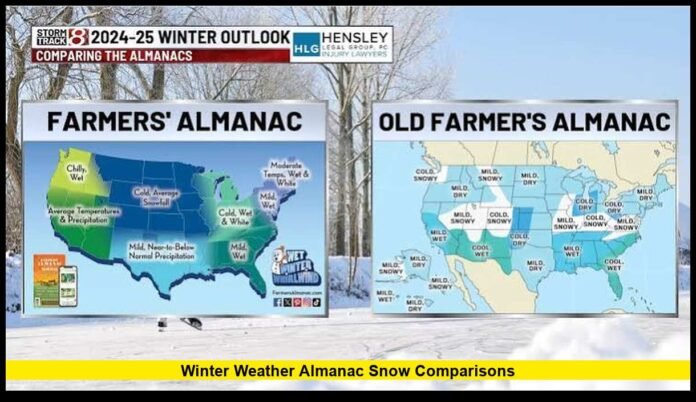

The winter weather almanac snow comparison for the 2026–27 season is revealing a winter marked less by a single nationwide pattern than by sharp regional contrasts. A strengthening El Niño is expected to play a major role, while long-range outlooks point toward a mixture of heavy precipitation, brief cold outbreaks, rain, ice and significant snowfall depending on location.
The developing climate pattern is already drawing attention because the tropical Pacific is unusually warm. Current projections indicate that El Niño has a greater than 90% chance of becoming very strong during the Northern Hemisphere fall and winter. There is also a 75% chance that the October-through-December period will produce an event stronger than previous El Niño episodes in the historical record dating to 1950.
A Winter Divided by Region
The latest forecasts suggest that Americans should not expect the same type of winter from coast to coast.
Some areas could experience frequent storms and substantial snowfall, while others may see a predominately mild season interrupted by short-lived blasts of Arctic air.
The Northeast could be among the most complicated regions. Inland areas have a greater chance of significant snow, while coastal locations may repeatedly fluctuate between rain, sleet, freezing rain and snow.
Farther south, moisture may be plentiful because of the expected storm track. The challenge will be determining whether enough cold air arrives at the right time for that moisture to fall as snow.
Why El Niño Is So Important
El Niño develops when ocean temperatures become unusually warm across the central and eastern tropical Pacific.
That warming can influence the jet stream, storm tracks and the distribution of precipitation across North America. The current event has strengthened rapidly, with ocean temperature anomalies in parts of the eastern equatorial Pacific exceeding 3 degrees Celsius.
The latest outlook indicates that the event should continue strengthening into late 2026 and remain influential into early 2027.
However, a powerful El Niño does not automatically translate into a snowy winter for every location. Temperature, storm position, elevation and the timing of cold-air outbreaks all determine whether precipitation becomes snow.
Northeast Could See Major Snow Swings
The Northeast has one of the most interesting setups in the current winter outlook.
Southern and inland portions of the region have an elevated opportunity for below-average temperatures and above-average snowfall. January and February could become particularly important for accumulating snow.
The coast presents a different possibility. Storms tracking close to the Atlantic shoreline could produce rain or mixed precipitation when temperatures hover near freezing.
That creates the potential for substantial differences over relatively short distances. A location several dozen miles inland could receive heavy snow while a coastal community experiences rain.
Appalachians Remain a Snow Zone to Watch
The Appalachian region is another area with increased snow potential.
Cold air spilling southward can interact with moisture-rich storm systems, creating favorable conditions for accumulating snow at higher elevations.
Mountain communities could therefore experience more persistent snow cover than nearby lowlands.
The timing of individual storms will remain critical. A warmer interval between systems could quickly reduce snowpack, even if several major snow events occur later in the season.
The South May Become a Major Storm Corridor
The southern United States could see a much more active winter storm pattern than its snow totals alone would suggest.
The expected southern jet stream may carry frequent disturbances from the Southwest across Texas and toward the Gulf Coast and Southeast.
These systems will have plenty of moisture to work with. The main question will be whether cold air is present when they arrive.
During warmer episodes, heavy rain could dominate. During colder intrusions, the same general storm track could produce sleet, freezing rain or wet snow.
Northern sections of the South have a better chance of seeing wintry precipitation than locations along the Gulf Coast.
Texas Faces an Uncertain Winter
Texas is particularly sensitive to small changes in winter temperatures.
An active southern storm track could increase the number of significant precipitation events, but most storms will not automatically produce snow.
For snow or ice to develop, cold air must reach the state at the right time. A storm arriving several hours earlier or later can make a major difference in precipitation type.
Northern and western portions of Texas generally have greater opportunities for winter precipitation than the Gulf Coast, where warmer temperatures make snow considerably less common.
Western Snow Prospects Depend on Elevation
The West is also expected to have a highly variable winter.
The southern storm track could bring substantial moisture into California and the Southwest. Higher elevations of the Sierra Nevada and southern Rockies could benefit when temperatures remain cold enough for that moisture to fall as snow.
Lower elevations are a different story.
A wet winter does not necessarily mean a snowy winter in valleys and deserts. Warm temperatures can turn potentially snowy systems into rain events.
For ski areas, the most important period may come during the heart of winter, when repeated storms can build a more durable mountain snowpack.
Pacific Northwest Outlook Is More Complicated
The Pacific Northwest may experience a changeable season rather than uninterrupted cold and snow.
Milder periods could dominate lower elevations, with precipitation frequently falling as rain. Higher mountain areas will have better chances of accumulating snow when colder systems arrive.
This distinction is especially important for communities that depend on mountain snowpack for water resources.
Short cold spells could still produce significant mountain snowfall, even if seasonal temperatures end up near or above normal in some areas.
Midwest Could See Fast Changes
The Midwest is likely to experience frequent transitions.
Some long-range projections favor temperatures near normal across portions of the northern Plains, Upper Midwest and Great Lakes. That does not rule out intense winter episodes.
Fast-moving storm systems could bring sudden snow squalls, strong winds and short periods of bitter cold.
The Great Lakes also retain their potential for lake-effect snow whenever sufficiently cold air crosses the relatively warmer lake waters.
This means residents could move quickly from mild conditions to dangerous winter weather within a matter of days.
Alaska Remains a Snow-Watching Region
Alaska is among the areas where seasonal snowfall could run above normal in parts of the state.
Its enormous geographic range makes statewide predictions difficult, however. Coastal communities, interior locations and mountain regions can experience very different conditions during the same storm.
Snowfall totals will depend on local temperatures, storm tracks and elevation as the season progresses.
What the Snow Comparison Really Shows
The most useful takeaway from the winter weather almanac snow comparison is that a national snowfall number cannot describe the coming season accurately.
One region may experience a mild winter with only a few significant storms. Another may receive repeated snow events despite having temperatures that average close to normal.
Precipitation type can also change dramatically during individual storms.
A temperature difference of only a few degrees can determine whether a storm produces snow, freezing rain or ordinary rain. That makes the Northeast, Appalachians and southern storm corridor especially difficult to forecast months in advance.
When the Forecast Will Become More Reliable
Seasonal outlooks are useful for identifying broad patterns, but confidence increases considerably as individual storms come into view.
As winter approaches, forecasters will pay close attention to the evolution of El Niño, the polar jet stream, Atlantic pressure patterns, Arctic air availability and the position of storm tracks.
Once a storm is within the shorter-range forecast window, meteorologists can better determine its expected path, precipitation type and potential snowfall totals.
That information will matter far more to residents planning for a specific snowstorm than a seasonal prediction issued months earlier.
The 2026–27 Winter Outlook
The coming winter is shaping up to be a season of contrasts.
The strongest El Niño in decades is possible, but its effects will not be uniform across the United States. The Northeast and Appalachians have areas with elevated snowfall potential, while the South could experience an active and moisture-rich storm track.
The West could see significant mountain precipitation, with snowfall depending heavily on elevation and temperature. The Midwest may face rapid swings between mild weather and short but intense cold and snow episodes.
The overall message is not that every part of the country will experience a severe winter. Instead, the developing pattern points toward regional extremes, rapidly changing conditions and several opportunities for significant winter storms.
As temperatures fall and storm tracks become clearer, the forecast will become increasingly specific. For now, residents across the country should prepare for a winter in which rain, snow, ice and sudden cold could all play important roles.