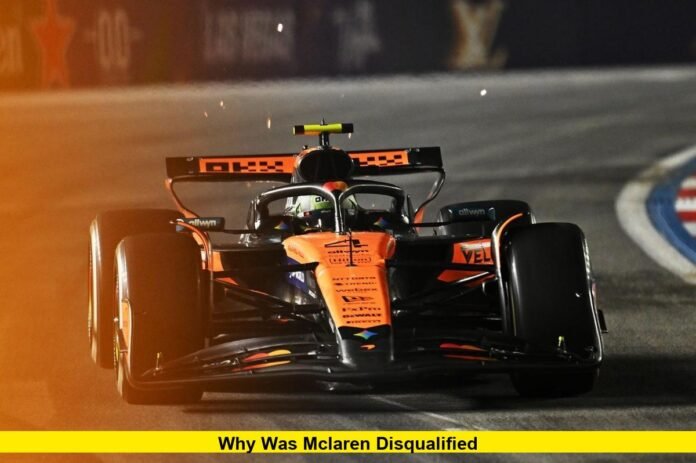

The question why was McLaren disqualified has taken center stage after both cars from the McLaren F1 Team were ruled out of the 2025 Las Vegas Grand Prix late on November 23. Team drivers Lando Norris and Oscar Piastri had originally finished 2nd and 4th, respectively, but post-race inspections revealed a technical breach that triggered the disqualifications.
What happened: the basics
McLaren entered the Las Vegas event with both cars performing strongly. Norris claimed pole position, and Piastri qualified well. On race day, Norris climbed to 2nd and Piastri to 4th. However, after the chequered flag, the cars underwent standard post-race technical checks by the FIA and its stewards. Both vehicles were found to have inadequate thickness in their underside “skid block” or “plank” assemblies — specifically the rear skid block measurement in both cars fell below the minimum allowed depth of 9 mm. The rule requires a new plank thickness of 10 mm ± 0.2 mm and allows wear down to a minimum of 9 mm.
Because the regulation provides no margin for alternate penalties in such cases, both McLaren entries were disqualified from the results.
The technical side: what rule was breached
The main technical regulation at issue is Article 3.5.9 (e) of the 2025 F1 technical regulations. That article states that the skid block assembly “measured normal to the lower surface must be 10 mm ± 0.2 mm and must be uniform when new,” and that teams are permitted wear down to a 9 mm minimum.
In this case:
- McLaren’s cars measured below 9 mm at several points of the skid block after the race.
- The team acknowledged that both cars suffered high levels of porpoising (vertical bouncing) during the race, which likely increased wear of the underside components beyond normal expectations.
- Weather-affected practice sessions and limited dry running time reportedly hampered McLaren’s ability to optimise setup to avoid the problem.
- Despite those mitigating factors, the regulation is strictly enforced: once a car fails to meet the minimum measurement, disqualification is the outcome.
Timeline of the incident
| Date | Event |
|---|---|
| November 22 2025 | Las Vegas GP held. McLaren finishes 2nd (Norris) and 4th (Piastri) on track. |
| Post-race | FIA technical delegate measures the skid assembly underneath both cars as part of scrutineering. |
| Later in evening | McLaren called before the stewards following measurement irregularities. |
| November 23 2025 | Stewards confirm both McLaren cars breached the minimum skid block thickness; both cars are disqualified. |
| Aftermath | McLaren issues apology; the championship implications intensify with just two races remaining. |
Implications for the championship
The disqualification carries far-reaching consequences:
- Norris loses the points from his 2nd-place finish; Piastri loses his points from 4th.
- This dramatically tightens the title race, benefiting rival Max Verstappen and others still in contention.
- For U.S. audiences and sponsors, the dramatic twist adds major intrigue to the final rounds of the season.
- The focus now shifts to both the remaining races in Qatar and Abu Dhabi, where every point counts and technical compliance becomes even more critical.
Why Was McLaren Disqualified: deeper examination
Unintended breach, but unwelcome result
McLaren has emphasised that the breach was unintentional. They highlighted unforeseen porpoising during the Las Vegas street circuit race, damage to the floor of both cars during the event, and limited dry-running time during practice due to weather and red-flags. The team pointed out that these combined factors contributed to accelerated wear of the skid blocks.
However, the FIA stewards reiterated that the regulations leave no room for discretion in such technical cases. Even when intent is not malicious, the result remains exclusion when the minimum specification isn’t met.
Why the skid block matters
The skid block — also known as the plank beneath the car — plays a key role in ensuring that cars maintain a regulated ride height. Lowering the car too much or allowing excessive underside wear can give aerodynamic advantages. The plank’s thickness acts as a gauge to prevent teams from running too close to the ground where airflow and downforce could be exploited beyond the intended limits.
In their investigation, the stewards measured multiple points on each McLaren car and confirmed the thickness was below 9 mm (despite being allowed to wear from 10 mm new). Once below that threshold, the car fails conformity.
Context: precedent and rarity
While disqualifications for plank wear are rare, they are not unprecedented. For example:
- Earlier this season, a car was excluded from a race due to the same type of infringement.
- The strictness of the rule emphasises how critical technical compliance is in modern F1 — even minute measurements matter.
McLaren’s double disqualification at a single event underscores just how quickly performance can turn to penalty when the regulation envelope is breached.
Reactions and team response
Team principal Andrea Stella described the result as “extremely disappointing” and apologised to Norris, Piastri, partners and fans for losing valuable championship points. He stated that McLaren would conduct a thorough investigation into why both cars experienced unexpected underside wear and would take steps to prevent recurrence.
The team also admitted mistakes in setup and monitoring of how the cars interacted with the track surface, especially under the unique demands of the Las Vegas street-circuit. Norris and Piastri accepted the result with professionalism and stressed their focus now turns to the final two races.
What this means for U.S. fans
For the growing U.S. Formula 1 audience, this moment adds drama to the final stretch of the 2025 season. The Las Vegas Grand Prix, held on the Strip and televised for American viewers, pushed F1 further into the U.S. sports consciousness. With McLaren disqualified, the storyline shifts significantly: the title fight is now wider open, unpredictable, and ripe for dramatic moments.
If you’ve followed Norris’s push or Piastri’s emergence, the turn of events creates even greater stakes for the next rounds. Meanwhile, American viewers will have a front-row seat for a championship conclusion that suddenly has new narrative tension.
Looking ahead: what to watch in the closing rounds
- Technical vigilance: McLaren and all teams must now ensure full compliance on every parameter. Even marginal mis-measurement could cost more than just this weekend.
- Championship dynamics: With fewer races remaining, the points swing from Las Vegas gives rivals real momentum.
- U.S. broadcast and fan attention: The drama plays well for American viewership, and every incident or ruling will likely generate commentary stateside.
- Track-specific setups: The special demands of street circuits and those held in hot climates (Qatar) or with high downforce loads (Abu Dhabi) will test teams’ car setup and reliability — including plank wear risk.
Final thoughts
The question why was McLaren disqualified has a clear technical answer: both of its cars failed to meet the regulatory minimum thickness for the skid block after the Las Vegas race, triggering their exclusion. While the team cited mitigating factors like porpoising, setup constraints and damage, the rules permit no leniency. The result shifts the championship battle into dramatic territory with American fans set for an exciting finish.
Stay tuned for what’s sure to be an unforgettable two-race dash to the title.