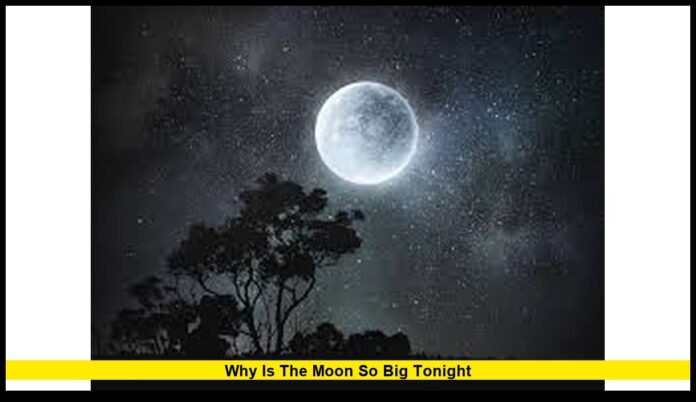

Many skywatchers across the United States are stepping outside and asking why is the moon so big tonight. The sight feels unusually dramatic, and for good reason. Tonight’s full Moon aligns with one of the closest points in its orbit, creating a bright and oversized appearance that stands out even to people who do not usually follow astronomical events. Combined with the well-known Moon illusion, this moment delivers a striking natural display that many Americans are noticing as soon as the Moon rises above the horizon.
A Full Moon Near Its Closest Point to Earth
The Moon’s orbit around Earth is not a perfect circle. It is slightly elliptical, which means the Moon travels through points of varying distance. When it reaches the closest part of its orbit, known as perigee, the Moon sits roughly tens of thousands of miles nearer to Earth than it does at its farthest point. If a full Moon occurs during this closer portion of its orbit, the result is what many people call a supermoon.
A full Moon at this distance appears larger in angular size and noticeably brighter than an average full Moon. Even without scientific instruments, the difference is easy to observe when clouds stay clear. The Moon’s disc seems fuller, sharper, and more luminous, especially when it rises early in the evening.
The December Cold Moon is one of the most visually impressive full Moons of the season. Winter skies tend to provide crisp viewing conditions, which magnify its bright glow. With long nights and early sunsets, people have more time to observe the Moon from the moment it appears on the horizon until it climbs to its highest point.
Why Winter Makes This Moon More Dramatic
Winter plays a major role in how the full Moon appears. Because sunset happens earlier during December, the Moon rises when many people are still outdoors, commuting, shopping, or relaxing after work. This timing makes the Moon highly visible during one of the most active parts of the day.
As the Cold Moon rises close to sunset, its light travels through a thicker layer of Earth’s atmosphere, which can give it deeper color or a warmer glow. The atmosphere can scatter shorter wavelengths of light, causing the moonrise to take on golden or reddish tones. This coloration makes the Moon appear even more striking before it brightens into its familiar silver tone.
December’s low-angle moonrise also combines with longer nights, which means viewers have extended visibility of the full Moon compared with other months. Whether you watch from a quiet rural area, a snowy neighborhood street, or a brightly lit city skyline, the Cold Moon offers a long, clear window for observation.
The Moon Illusion and Why Your Eyes See a Giant Moon
Even though the Moon’s actual physical size does not change as it moves across the sky, people almost always report that it looks bigger near the horizon than it does high overhead. This psychological effect is known as the Moon illusion.
The brain compares the Moon to objects on the ground — buildings, trees, hills, water, and distant structures. When the Moon is positioned next to those familiar reference points, the mind interprets it as farther away than it truly is. Anything that appears large while seeming far away must be even larger than normal, so the brain magnifies the Moon’s perceived size.
This illusion works consistently around the world. The Moon does not physically expand, and cameras show no measurable increase, yet the human eye interprets the view as much larger. When combined with a true perigee full Moon, the illusion becomes even more powerful. What people see tonight is the blending of real astronomical conditions and natural visual processing.
How the Moon’s Distance Changes Its Appearance
Although the Moon’s overall distance from Earth changes only modestly across a month, that change is enough to create a noticeable difference in brightness and size.
During perigee:
- The Moon appears up to around 14 percent larger in diameter compared with its smallest full Moon.
- Its brightness increases significantly, giving it a vibrant, glowing presence in the night sky.
- Details such as craters and maria may seem sharper when viewed through binoculars or a telescope.
While these numbers may sound small in scientific terms, they produce a dramatic visual shift. A person who steps outside on a clear night will immediately sense that tonight’s full Moon is brighter and more oversized than usual.
Visibility Conditions Across the U.S.
Across the United States, many regions have favorable conditions for viewing tonight’s Cold Moon. Because the Moon rises early, people from the East Coast to the West Coast can see it without staying up late. In cities, the Moon often appears especially striking as it rises above skylines, bridges, or waterfronts. In rural areas, open fields and distant tree lines create an unobstructed stage for the Moon’s enormous presence.
Even if some areas experience cloud cover, the Moon often becomes visible as the night progresses. A full Moon remains nearly full for about 24 hours on either side of peak illumination, so viewers have another chance to enjoy the bright spectacle on the following night.
How Tonight’s Moon Compares With an Average Full Moon
Several factors make tonight different from a typical monthly full Moon:
1. Increased brightness
A perigee full Moon can shine significantly brighter than a full Moon at apogee. The light intensity is enough to cast defined shadows and illuminate landscapes much like a distant streetlamp.
2. Greater apparent size
The Moon’s disc takes up noticeably more space in the sky. People unfamiliar with astronomy often sense this instinctively even without knowing why.
3. Enhanced color near the horizon
Atmospheric scattering gives the Moon warmer tones at moonrise, making the event more visually dramatic.
4. Longer winter visibility window
The early appearance and extended darkness allow Americans to view the Moon for more hours than during summer.
These combined effects create a uniquely memorable night sky display.
Tips for Photographing the Large Moon
Tonight’s full Moon offers excellent opportunities for photography. Even smartphones can capture impressive shots with the right techniques.
Use foreground elements:
A landscape feature — buildings, trees, lighthouses, bridges, mountains — enhances the sense of scale.
Choose a spot with a clear eastern horizon:
Moonrise photos are often the most stunning because this is when the Moon appears largest.
Try longer focal lengths:
A telephoto lens compresses distance, making the Moon appear even larger relative to the foreground.
Stabilize your device:
Use a tripod or stable surface to avoid motion blur.
Adjust exposure:
The Moon is brighter than most backgrounds. Lowering exposure helps preserve surface detail and avoids overexposure.
With patience and timing, viewers can capture dramatic images that show off the Moon’s unusually large appearance.
Understanding Tides During a Close Full Moon
A closer full Moon affects ocean tides more strongly than a typical full Moon. This happens because the Moon’s gravitational pull increases slightly when it moves closer to Earth.
Coasts may experience higher-than-average high tides, sometimes referred to as perigean spring tides. These tides are predictable and are monitored throughout the year. Most coastal communities are accustomed to slight fluctuations and experience them without major disruption unless weather patterns intensify local conditions.
The tidal difference is real but measured, and it does not cause sudden or extreme changes on its own.
Other Celestial Events Near the Cold Moon
The December sky brings more than just the bright full Moon. The winter season often includes early-evening visibility of major planets, crisp star fields, and later in the month, the Geminid meteor shower, one of the strongest meteor events of the year.
With tonight’s clear visibility in many states, skywatchers may enjoy brilliant surroundings beyond the full Moon itself. The winter constellations, including Orion, Taurus, and Gemini, appear especially bold under cold, transparent skies.
Why Many People Notice This Moon More Than Others
Not every full Moon receives widespread attention, but tonight’s combination of location, timing, distance, and seasonal setting makes it a standout event.
People are outdoors when it rises
The early winter moonrise coincides with evening activities, so more people notice it immediately.
Its glow stands out against the season
Bare trees, snow cover, longer nights, and crisp air create atmospheric conditions that make the Moon more dramatic.
Its closeness enhances every visual effect
A perigee full Moon intensifies both natural brightness and the psychological Moon illusion, creating a display that feels unmistakably larger than usual.
These elements contribute to why so many Americans are mentioning the Moon on social media, in conversations, and during nightly routines.
Where the Moon Goes From Here
Although tonight offers the largest appearance of the month, the Moon will stay nearly full for another night. Over the next several days, it will gradually wane, rising later each evening and becoming less bright.
Future full Moons will vary in size depending on their orbital positions. Some upcoming months may bring more supermoons, while others will show full Moons at greater distances. Each cycle provides its own visual character.
For now, tonight’s Cold Moon is one of the most impressive lunar views of the season, giving skywatchers across the country a moment worth pausing to appreciate.
Keyword included in body as required
Later in the article, many readers continue to ask why is the moon so big tonight as they notice its brightness and early appearance from different parts of the country.
Bottom Line
Tonight’s Moon looks extraordinarily large because it is a full Moon occurring near perigee while also rising low on the horizon, where human perception naturally magnifies its size. Combined with crisp winter skies and early moonrise timing, the Cold Moon creates a luminous, oversized display that stands out across the United States.