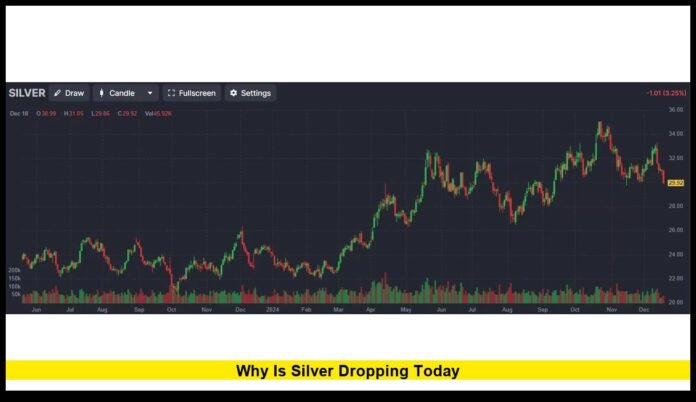

Why is silver dropping today is the question dominating market discussions as prices fall sharply after a period of extreme strength. As of today, silver is undergoing a rapid correction that has caught many U.S. investors off guard, especially those who viewed the metal as a stable hedge against inflation and economic uncertainty.
The decline reflects a powerful change in market dynamics rather than a single trigger. Interest rate expectations, currency strength, speculative positioning, and technical trading signals are all converging at once. Together, they are reshaping how silver is priced and traded across U.S. markets.
A Strong Start to the Year Ends Abruptly
Silver entered the year with strong momentum. Prices climbed rapidly over recent months, driven by investor demand for hard assets and optimism surrounding global manufacturing and clean energy growth. Many traders expected silver to maintain its upward path after outperforming other precious metals.
That optimism faded quickly. Once prices stalled near recent highs, selling pressure increased. What began as modest profit-taking turned into a broader retreat as traders rushed to protect gains. Today’s drop marks a sharp reversal from the bullish tone that dominated earlier trading sessions.
Interest Rate Expectations Are Pressuring Precious Metals
A major reason silver is dropping today lies in changing expectations around U.S. interest rates. Markets are adjusting to signals that borrowing costs may remain elevated longer than previously expected.
Silver does not pay interest. When yields on bonds and other fixed-income assets rise, the opportunity cost of holding silver increases. As investors recalibrate portfolios toward assets that offer income, demand for non-yielding metals weakens.
This adjustment has been swift. Traders who built positions anticipating lower rates are now unwinding exposure, contributing to today’s sell-off.
The U.S. Dollar’s Strength Is Reshaping Demand
The U.S. dollar has strengthened alongside revised interest rate outlooks. A stronger dollar often places downward pressure on commodities priced in dollars, including silver.
When the dollar rises, silver becomes more expensive for buyers using other currencies. This reduces global demand and places additional stress on prices during periods of heavy selling.
Today’s market action reflects that relationship clearly. As the dollar gained ground, silver struggled to attract fresh buyers willing to step in at current levels.
Heavy Profit-Taking Accelerates the Decline
Silver’s earlier rally created significant unrealized gains for traders who entered at lower prices. As market sentiment shifted, many of those participants chose to lock in profits.
Profit-taking alone does not usually cause extreme declines. However, when it coincides with rising rates and currency strength, the effect can be magnified. Selling begets more selling as prices move lower and confidence weakens.
This dynamic is especially visible in commodities like silver, where price swings tend to be sharper than in gold or other defensive assets.
Leverage and Margin Pressure Intensify Volatility
Leverage played a major role in today’s move. Futures markets saw an influx of leveraged positions during silver’s climb. When prices reversed, those positions quickly became vulnerable.
As volatility increased, margin requirements rose. Traders who could not meet higher capital demands were forced to reduce or close positions. This created a wave of automatic selling that pushed prices lower in a short period.
Such forced liquidations often exaggerate market moves, and today’s decline reflects that pattern clearly.
Technical Levels Break, Triggering More Selling
Technical trading signals also contributed to silver’s fall. Once prices dropped below key support levels, automated trading systems and short-term traders reacted quickly.
These systems often follow price trends rather than fundamentals. When downward momentum strengthens, they add selling pressure regardless of broader economic context.
The result is a fast-moving market where prices can overshoot to the downside before stabilizing. Today’s action suggests that technical forces are firmly in control for now.
Silver’s Dual Role Adds Complexity
Silver occupies a unique position in financial markets. It functions both as a precious metal and as an industrial commodity. This dual role can amplify volatility during economic transitions.
On one hand, silver benefits from demand tied to electronics, solar panels, and manufacturing. On the other, it competes with gold as a store of value. When economic signals point toward slower growth or tighter financial conditions, both sides of silver’s demand profile can weaken at the same time.
Today’s decline reflects concerns on both fronts, with investors reassessing growth expectations and monetary conditions simultaneously.
Broader Commodity Weakness Reinforces the Trend
Silver is not alone in today’s downturn. Other commodities have also come under pressure as investors reduce exposure to risk-sensitive assets.
This broader pullback suggests a shift in overall market sentiment rather than an isolated event. When commodities move lower together, it often signals caution about economic momentum and financial conditions.
Silver’s higher volatility makes it particularly sensitive during such periods, explaining why its losses appear more dramatic.
Investor Psychology Shifts Rapidly
Market psychology plays a powerful role in silver pricing. The metal often attracts momentum-driven traders who respond quickly to price changes.
When prices rise, optimism builds rapidly. When they fall, fear can spread just as fast. Today’s session shows how quickly sentiment can flip when key assumptions are challenged.
This emotional component does not negate silver’s long-term appeal, but it does explain why short-term movements can be extreme.
What This Means for U.S. Investors
For U.S. investors, today’s decline is a reminder that silver is not a low-risk asset. While it can provide diversification benefits, it also carries significant volatility.
Short-term traders face an uncertain environment, with sharp swings likely to continue as markets digest new economic signals. Long-term holders may focus on fundamentals such as industrial demand and inflation trends, but patience may be required.
Risk management remains critical, particularly for those using leverage or short-term strategies.
Is the Market Searching for a Bottom?
Whether silver stabilizes soon depends on several factors. Currency movements, interest rate expectations, and overall risk appetite will shape near-term direction.
If selling pressure eases and buyers regain confidence, prices could find support. If not, further volatility remains possible. For now, markets appear to be in a discovery phase, searching for a level where supply and demand realign.
What is clear is that today’s move has reset expectations and forced investors to reassess assumptions.
Why Is Silver Dropping Today: Key Takeaways
Silver is dropping today due to a convergence of higher interest rate expectations, a stronger U.S. dollar, aggressive profit-taking, leveraged position unwinds, and technical selling. The speed of the decline reflects how quickly modern markets react when multiple pressures align.
While silver’s longer-term outlook will depend on broader economic trends, the current environment favors caution and close monitoring of market signals.
What are your thoughts on today’s silver market move? Stay tuned for further updates as conditions continue to evolve across U.S. markets.