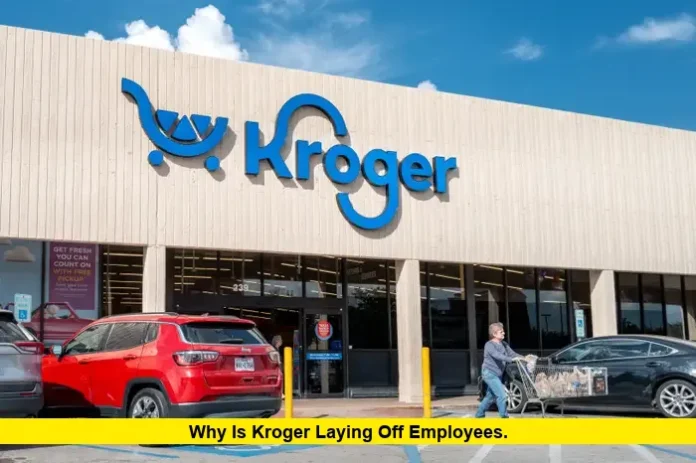

Kroger is planning to eliminate approximately 3,000 corporate positions over the next three years, raising concerns about job security, artificial intelligence, and the future of work at one of America’s largest grocery retailers. The question of why is Kroger laying off employees has become particularly important as the company works to simplify its operations, reduce administrative costs, improve efficiency, and compete more aggressively on grocery prices.
CEO Greg Foran announced the planned reductions in an internal memo to employees on October 12, 2026. The company intends to reduce its corporate workforce across multiple functions, with decisions about affected positions expected to begin in the coming months. Kroger has explained that it wants to eliminate unnecessary organizational layers, reduce duplicated work, and use technology more effectively.
The announcement does not mean that Kroger plans to eliminate 3,000 store jobs or close 3,000 supermarkets. The proposed reductions specifically concern corporate positions. The company has not yet published a complete list of affected departments, job titles, or locations.
Why Is Kroger Laying Off Employees? The Main Reasons
Kroger’s planned layoffs are part of a broader restructuring strategy focused on organizational efficiency, technology, cost management, and customer value. The company believes it can operate with fewer corporate positions while directing more resources toward frontline employees and improving the shopping experience.
Several factors help explain the decision.
1. Reducing Corporate Overhead
One of the main reasons for the Kroger layoffs is the company’s effort to reduce administrative expenses. Large retailers require corporate teams to manage operations, coordinate departments, oversee technology, analyze business performance, and support thousands of employees.
Over time, these organizations can develop overlapping responsibilities and multiple layers of approval. Kroger’s leadership believes its current structure includes more administrative layers, handoffs, and overhead than necessary.
Reducing these layers may help the company make decisions faster and simplify internal processes. However, Kroger has not publicly identified every position that will be eliminated or quantified the expected savings from the latest restructuring.
2. Eliminating Duplicated Work
Kroger also wants to reduce work that is performed by multiple teams or that no longer provides sufficient value to the business.
Duplicated responsibilities can increase operating expenses and slow down projects. For example, when several departments perform similar administrative tasks, management may seek to consolidate those responsibilities into fewer teams or more standardized processes.
The company has indicated that reducing unnecessary work will be an important part of its transformation. The precise departments and functions affected remain unconfirmed.
3. Increasing Efficiency Through Technology
Technology is another significant factor behind Kroger’s workforce changes. The company has been expanding its use of artificial intelligence (AI), data analytics, digital shopping tools, and automated processes.
These technologies can help retailers forecast demand, personalize offers, improve inventory decisions, organize information, and streamline repetitive tasks. As systems become more capable, companies may reassess how work is divided among employees and departments.
Kroger has not confirmed that all 3,000 planned job reductions will result directly from AI replacing employees. The announced plan combines broader organizational simplification with the company’s effort to adapt to technological changes.
4. Redirecting Resources Toward Stores and Customers
Kroger has said that reducing corporate positions will help it invest more resources in frontline employees and customer-focused priorities.
Store employees are responsible for activities that directly influence the shopping experience, including stocking shelves, maintaining product availability, operating checkout lanes, fulfilling online orders, and assisting customers.
By reducing administrative overhead, Kroger aims to give greater priority to the people and operations that serve shoppers directly. Whether the changes produce measurable improvements will depend on how the company implements the restructuring.
5. Competing More Effectively on Grocery Prices
Price competition is another important part of Kroger’s strategy. The company competes with major retailers, including Walmart, Costco, and Aldi, as shoppers compare grocery prices and seek value.
Kroger has been working to lower prices and improve its shopping experience. Reducing corporate expenses may help the company allocate more resources toward these objectives.
However, the announced layoffs do not guarantee a specific reduction in grocery prices. The final effect will depend on the company’s overall costs, supplier agreements, operating performance, and decisions about how savings are used.
Kroger Plans to Eliminate 3,000 Corporate Jobs Over Three Years
Kroger’s announced plan calls for approximately 3,000 corporate positions to be eliminated over a three-year period.
The company has approximately 8,200 corporate employees, according to reporting on the announcement. If both figures remain unchanged, the planned reductions would represent roughly 37% of its corporate workforce.
That is a substantial restructuring, but the timeline is important. Kroger has not announced that all 3,000 positions will disappear immediately. Instead, the company expects to implement the reductions over several years.
CEO Greg Foran communicated the plan in an internal employee memo, explaining that the business needs to become more streamlined, focused, and competitive.
The company has indicated that the changes will affect multiple corporate functions. Nevertheless, there is no complete, publicly confirmed breakdown identifying the departments, positions, and locations that will experience the largest reductions.
Employees should therefore avoid treating unofficial lists of potentially affected jobs as confirmed information.
The three-year schedule also means that the timing may differ across departments. Further announcements are expected to clarify which roles are affected and when individual employment decisions will be communicated.
How Artificial Intelligence Is Connected to Kroger Layoffs
Artificial intelligence has become an increasingly important part of Kroger’s business strategy.
In September 2026, Kroger outlined its AI strategy at GroceryShop 2026, describing how customer insights, operational information, proprietary models, and generative AI capabilities can support business decisions.
The company has been developing AI applications for several purposes, including personalized shopping, meal planning, demand forecasting, operational optimization, and more efficient workflows.
Its AI Shopping Assistant is designed to help customers discover products, plan meals, find recipes, and build shopping carts around their preferences and budgets. Kroger has also discussed tools intended to help frontline employees prioritize tasks and manage operational information.
These initiatives demonstrate that the company is investing in technology to improve both customer experiences and internal processes.
For corporate employees, the potential implications are significant. When technology can automate repetitive work or help smaller teams perform tasks more efficiently, employers may reorganize responsibilities and reconsider staffing requirements.
However, it would be inaccurate to say that AI is the sole reason Kroger is eliminating 3,000 corporate positions. The company has emphasized organizational simplification, duplicated work, overhead reduction, and adapting to technology.
Kroger has not published a role-by-role explanation linking the planned layoffs directly to AI systems.
The distinction is important because technology investments and workforce reductions can occur together without every eliminated position being replaced by automation.
Which Kroger Employees May Lose Their Jobs?
The planned reductions concern Kroger’s corporate workforce across multiple functions. However, the company has not released a comprehensive list of affected employees, departments, job titles, or office locations.
Corporate positions can include responsibilities in areas such as finance, administration, marketing, technology, human resources, merchandising, analytics, and business planning. These are examples of functions found in large retail organizations, not a confirmed list of departments targeted by Kroger.
The absence of a complete breakdown means that employees cannot reliably determine whether a particular team will be affected based on the announcement alone.
Kroger has indicated that decisions about affected roles will begin in the coming months. More information from the company should provide greater clarity about the scope and timing of the changes.
For employees, important considerations include whether their positions will be eliminated, whether alternative roles will be available, and what severance or transition arrangements may apply.
At this stage, Kroger has not publicly confirmed a complete set of severance terms or internal transfer opportunities for everyone affected by the new plan.
Are Kroger Store Employees Also Facing Layoffs?
The announcement specifically concerns corporate jobs, not a confirmed nationwide reduction of 3,000 store employees.
This distinction matters because Kroger employs workers across supermarkets, pharmacies, distribution operations, manufacturing facilities, and corporate offices.
Store-level employees carry out essential daily activities, including customer service, inventory replenishment, checkout operations, pickup orders, and delivery support. Corporate teams provide planning, systems, policies, and administrative support to those operations.
Kroger has said the corporate restructuring is intended to redirect resources toward frontline employees. That suggests the company wants to prioritize its stores and customer experience as it reduces administrative overhead.
However, the announcement does not guarantee that every store-level role will remain unchanged. Nor does it establish that the corporate job cuts will automatically create additional store positions.
Any separate store closures, local staffing changes, or distribution-facility decisions should be evaluated independently rather than treated as part of the 3,000-position announcement without confirmation.
Kroger’s Previous Layoffs and Corporate Restructuring
The latest announcement follows an earlier corporate workforce reduction in 2025.
During the second quarter of 2025, Kroger implemented a plan to reduce its corporate administrative team by nearly 1,000 employees. The company said the restructuring was intended to improve efficiency, lower administrative costs, and free up resources for its retail business.
Kroger also reviewed its e-commerce fulfillment operations during 2025. Following that review, the company decided to close certain automated fulfillment facilities that had not met operational or financial expectations.
Those earlier decisions involved different parts of the business and should not be confused with the newly announced corporate job reductions.
Nevertheless, the developments show that Kroger has been reviewing its cost structure, administrative organization, and digital operations over an extended period.
The latest plan represents another major step in that process. If implemented as announced, it would substantially reduce the company’s corporate workforce compared with its reported current size.
The longer-term question is whether Kroger can maintain effective management, technology support, and coordination across its operations with fewer corporate employees.
How Kroger’s Financial Performance Helps Explain the Restructuring
Kroger’s latest financial results provide additional context for its efforts to simplify operations and strengthen its competitive position.
In September 2026, the company reported second-quarter results for the period ended August 15, 2026. Identical sales excluding fuel increased 0.2% compared with the same period a year earlier.
Kroger also reported that adjusted e-commerce sales grew 20%, reflecting progress in its digital business.
However, the company lowered its full-year 2026 guidance for identical sales growth excluding fuel to a range of 0.2% to 0.8%, compared with its previous forecast of 1% to 2%.
Kroger maintained its adjusted operating-profit and adjusted earnings-per-share guidance. Its results therefore showed a business managing different trends across sales, digital growth, and profitability rather than one facing a uniformly declining performance.
The revised sales outlook helps explain why management is emphasizing efficiency, pricing, and customer experience. Grocery retailers operate in a competitive environment in which customers can switch stores based on price, convenience, and product availability.
Reducing corporate overhead is one way Kroger is attempting to improve its operating model. The financial results do not, however, establish that weaker sales alone caused the announced layoffs.
What Kroger’s Job Cuts Mean for Customers
For shoppers, the most important question is whether the restructuring will lead to better prices and more reliable service.
Kroger has linked its organizational changes to its broader commitment to improve value for customers and strengthen frontline operations. The company wants to use resources more effectively while competing with other major grocery retailers.
If the restructuring removes unnecessary administrative work and improves decision-making, the company may be able to operate more efficiently. Those improvements could support better execution in stores and more investment in customer-focused priorities.
Nevertheless, the benefits are not guaranteed. Grocery prices depend on numerous factors, including supplier costs, transportation, labor expenses, product availability, and competitive conditions.
Kroger has not announced a specific grocery-price reduction tied directly to the 3,000 corporate job cuts.
Customers should therefore distinguish between the company’s stated goals and results that can be measured after the restructuring begins.
Changes in pricing, store service, product availability, and online order fulfillment will help show whether the new operating structure delivers the intended benefits.
Latest Update on Why Kroger Is Laying Off Employees
As of the latest available reporting, Kroger plans to eliminate approximately 3,000 corporate positions over the next three years. CEO Greg Foran announced the plan to employees on October 12, 2026.
The stated reasons include reducing unnecessary management layers, eliminating duplicated work, adapting to technological developments, improving operational efficiency, and directing more resources toward frontline employees and customer priorities.
The reductions are expected to affect multiple corporate functions, but Kroger has not yet publicly identified every affected department or provided a complete schedule for individual job eliminations.
The company is also expected to provide more information about its strategic priorities and longer-term financial targets at its investor update meeting scheduled for October 20, 2026. That event may offer additional context about Kroger’s business strategy, although a detailed breakdown of affected jobs has not been confirmed.
Employees and customers should rely on further official announcements rather than assume that unverified reports about particular departments or locations represent final decisions.
Final Thoughts: Why Is Kroger Laying Off Employees?
Kroger is planning to eliminate approximately 3,000 corporate positions because it wants a simpler organizational structure, lower administrative overhead, less duplicated work, and more efficient use of technology. The company also aims to redirect resources toward frontline employees, competitive grocery prices, and a better customer experience.
Artificial intelligence is part of Kroger’s broader technology strategy, but the available information does not establish that every planned job cut is directly attributable to automation.
The three-year timeline means the restructuring will unfold gradually, with further details about affected positions expected in the coming months. Its ultimate impact will depend on how Kroger redistributes responsibilities, supports employees, and measures improvements in efficiency and customer service.
For corporate employees, the announcement raises legitimate questions about job security and future opportunities. For shoppers, the key issue is whether a leaner corporate organization translates into better value and more reliable service.
Share your thoughts on Kroger’s planned layoffs in the comments, and stay updated for the latest verified developments in the company’s restructuring.