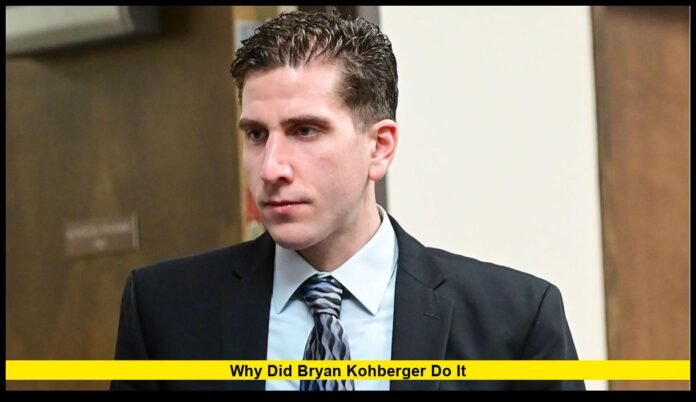

Why did Bryan Kohberger do it remains one of the most searched and emotionally charged questions in American criminal history, even after his guilty plea and life-without-parole sentence. As of January 2026, Kohberger is permanently imprisoned for the November 2022 murders of four University of Idaho students. The courts have confirmed his guilt. Law enforcement has confirmed his actions. Yet no verified motive has ever been established, and no official explanation has been provided by Kohberger himself.
This article presents only confirmed, current facts and explains why the motive question remains unresolved despite years of investigation and a final conviction.
The Crime That Redefined a College Town
In the early morning hours of November 13, 2022, four students were killed inside a rental home near the University of Idaho campus in Moscow, Idaho. The victims were Kaylee Goncalves, Madison Mogen, Xana Kernodle, and Ethan Chapin.
The attack occurred while most of the house was asleep. The victims were stabbed with a large fixed-blade knife. Two roommates survived because they were in separate rooms and did not encounter the attacker.
The nature of the crime shocked the nation. It was rare in scale, personal in method, and seemingly random in victim selection. For weeks, no suspect was named. Fear spread across college campuses nationwide.
Identification and Arrest of Bryan Kohberger
In December 2022, investigators arrested Bryan Christopher Kohberger in Pennsylvania. At the time, he was a doctoral student in criminology at Washington State University, located just a short drive from Moscow, Idaho.
Evidence later presented in court established:
- DNA belonging to Kohberger was found on a knife sheath at the crime scene.
- Cell phone data showed repeated late-night presence near the victims’ residence before the murders.
- Video surveillance placed a vehicle matching his car in the area during the time of the killings.
- Forensic and digital analysis tied his movements to the crime timeline.
These findings established involvement beyond reasonable doubt. They did not establish motive.
Guilty Plea and Life Sentence
In 2025, Kohberger entered a guilty plea to four counts of first-degree murder and one count of burglary. The plea agreement removed the death penalty from consideration. In return, he received:
- Four consecutive life sentences without the possibility of parole
- An additional sentence for burglary
- Permanent placement in a maximum-security facility
The legal process concluded. Accountability was delivered. The victims’ families saw the case resolved in court.
Still, the core psychological question remained unanswered.
No Confirmed Motive in the Official Record
Despite years of investigation, thousands of pages of evidence, and federal-level forensic analysis, prosecutors have never presented a verified motive.
What has been confirmed:
- No romantic relationship existed between Kohberger and any victim.
- No financial, academic, or employment disputes were found.
- No history of personal conflict was documented.
- No sexual assault motive was identified.
- No ideological or political reasoning was established.
- No written confession or explanation has been released.
In court, Kohberger acknowledged responsibility for the killings. He did not explain why he committed them.
Law enforcement officials have stated that motive is unknown and may never be fully determined.
Patterns Without Psychological Conclusions
Investigators were able to document behavior before and after the crime. These patterns describe activity, not intent.
Confirmed elements include:
- Repeated late-night travel near the victims’ residence in the months leading up to the murders.
- A methodical approach to entering and exiting the home.
- Attempts to avoid detection.
- Academic focus on criminal behavior and forensic psychology.
These details establish planning and awareness. They do not establish emotional or personal motivation.
Planning explains how. It does not explain why.
The Impact of a Trial That Never Happened
Because the case ended with a guilty plea, the public never saw a full trial. This has lasting consequences for understanding motive.
A full capital trial typically includes:
- Psychological evaluations
- Expert testimony on behavioral disorders
- Witness accounts of social relationships
- Digital communication analysis
- Personal writings and academic material
Most of this remains sealed or was never introduced in open court. Without cross-examination and public presentation, there is no verified narrative of internal reasoning.
The judicial system achieved its primary goal: permanent incarceration of the offender. It did not obtain a documented explanation.
What the Families Still Do Not Have
For the families of the victims, the lack of motive has been described as a second form of loss. They know who committed the crime. They know he will never be released. They do not know why their children were chosen.
They have been told:
- There is no confirmed personal link.
- There is no proven targeted grievance.
- There is no official psychological diagnosis explaining the act.
- The defendant has not provided a reason.
Closure through sentencing does not always equal closure through understanding.
Why the Question Continues to Dominate Public Search
The question why did Bryan Kohberger do it persists because motive is how the human mind organizes tragedy. People look for patterns to prevent repetition. Parents look for warning signs. Universities look for risk indicators. Communities look for meaning.
In crimes without motive, fear lingers longer. When randomness cannot be ruled out, safety feels fragile.
This is why the case continues to dominate search engines, documentaries, and academic discussions.
What Is Known With Certainty
As of January 2026, the following facts are fully confirmed:
- Bryan Kohberger committed the murders.
- He pleaded guilty in court.
- He is serving life without parole.
- Physical and digital evidence established his presence and actions.
- No official motive has been proven.
- No psychological or ideological explanation has been released.
- No statement from Kohberger has clarified intent.
Every authoritative body involved in the case agrees on one point: motive remains undetermined.
What Cannot Be Claimed as Fact
For accuracy and legal integrity, the following are not established as fact:
- A specific emotional trigger
- A personal vendetta
- A romantic obsession
- A criminal experiment
- A desire for notoriety
- A mental health diagnosis explaining the act
Without verified evidence or sworn testimony, such claims remain unproven and cannot be presented as factual conclusions.
Why Motive May Never Be Officially Known
There are three reasons the full answer may never enter the public record:
- The Defendant’s Silence
Kohberger has not provided an explanation and is not legally required to. - The Absence of a Trial Record
Without a full evidentiary trial, psychological interpretation remains limited. - The Limits of Forensic Science
Behavior can be reconstructed. Internal reasoning often cannot.
The justice system establishes guilt. It does not always uncover inner cause.
The Final Verified Answer
The most accurate and responsible answer to the question why did Bryan Kohberger do it is also the most difficult to accept:
There is no confirmed motive.
There is no officially documented reason.
There is no verified psychological explanation.
There is no proven personal connection.
There is no established ideological cause.
There is only accountability without explanation.
The facts of the case are now settled in court, but the human need to understand motive remains, and that unanswered question continues to shape how the nation remembers this tragedy.