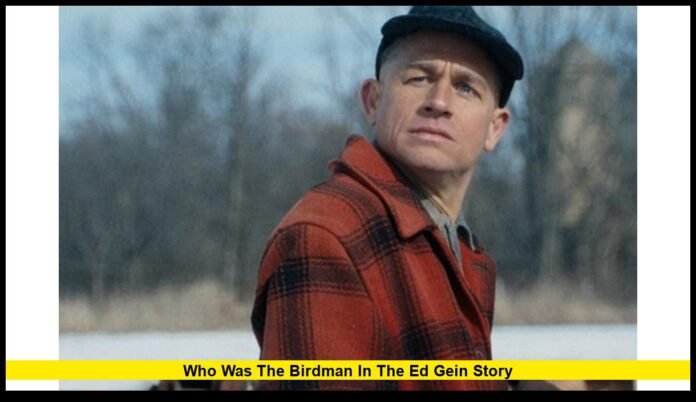

The mystery surrounding who was the Birdman in the Ed Gein story has captivated true crime audiences across the United States, especially following the recent release of Monster: The Ed Gein Story on Netflix. The series introduced viewers to a sinister, almost mythical figure — “the Birdman” — who appeared to correspond with Ed Gein from behind prison bars. But while the show’s portrayal is chilling and memorable, the real story behind this character is even darker, rooted in one of America’s most horrifying mass murders.
The Birdman is not a fictional villain. He was a real person: Richard Speck, a mass murderer whose crimes and disturbing behavior in prison earned him the infamous nickname “Birdman.” This article dives deep into Speck’s life, the origins of the Birdman label, his connection (and non-connection) to Ed Gein, and how this figure became embedded in American true crime mythology.
Richard Speck: A Criminal History That Shocked the Nation
To understand the Birdman’s role in Ed Gein’s story, it’s important to first explore the life and crimes of Richard Speck. Born on December 6, 1941, in Kirkwood, Illinois, Speck grew up in a troubled home environment. His early years were marked by instability, alcohol abuse within the family, and poor academic performance. By his teenage years, he had already started drinking heavily and engaging in petty crime.
After leaving school, Speck worked a series of menial jobs but struggled to stay out of trouble. He was arrested multiple times for misdemeanors such as forgery, burglary, and assault. Over time, his crimes escalated, and his violent tendencies became more apparent.
The Night of the Massacre — July 13, 1966
Richard Speck became infamous on a summer night that would haunt Chicago forever. On July 13, 1966, he broke into a townhouse at 2319 East 100th Street, which housed several young student nurses. Over the course of the night, he methodically bound, terrorized, and murdered eight women, one by one.
The victims, all nurses or nursing students, had bright futures ahead of them. Speck’s brutality was shocking not only because of the number of victims but also because of the cold, controlled manner in which he carried out the murders. One woman, Corazon Amurao, managed to survive by hiding under a bed until he left. Her testimony would become instrumental in identifying and capturing Speck.
Arrest and Sentencing
After a massive manhunt, Speck was arrested just days later. His trial was a national media sensation, drawing unprecedented attention from the public and the press. Initially sentenced to death, his penalty was later commuted to life imprisonment when the U.S. Supreme Court declared the death penalty unconstitutional in 1972.
He ultimately received a sentence of 400 to 1,200 years in prison — effectively ensuring he would never walk free again. Speck remained behind bars until his death from a heart attack in 1991, the day before his 50th birthday.
Why Richard Speck Was Called the “Birdman”
The moniker “Birdman” didn’t come from his crimes but from a haunting episode that occurred during his incarceration. While serving his sentence at Stateville Correctional Center in Illinois, Speck found an injured sparrow that had flown into his cell. For a short period, he cared for the bird, feeding it and keeping it as a pet.
However, when prison guards demanded that he surrender the bird, Speck responded in a way that horrified even seasoned correctional officers. He grabbed the sparrow and threw it into a rotating fan, killing it instantly. Then he reportedly said, “If I can’t have it, no one can.”
This single act became symbolic of Speck’s cruelty and earned him the nickname “Birdman,” a dark twist on the famous “Birdman of Alcatraz,” Robert Stroud, who raised and cared for birds during his imprisonment. Unlike Stroud, Speck’s story was not one of redemption or care — it was one of control, dominance, and destruction.
The “Birdman” name stuck and became one of the most memorable aspects of his prison years. It was used by fellow inmates, guards, journalists, and eventually television writers, solidifying his disturbing legacy.
Birdman’s Appearance in the Ed Gein Story
The recent Netflix series Monster: The Ed Gein Story brought the Birdman back into public discussion by including Richard Speck as a side character. In the show, Speck is portrayed as corresponding with Ed Gein from prison, expressing admiration and attempting to connect with the infamous killer.
However, it’s crucial to separate fact from dramatization. There is no historical evidence that Richard Speck and Ed Gein ever communicated through letters or had any form of relationship. They lived during overlapping periods, but their crimes occurred in different regions, and their prison sentences did not overlap in a way that facilitated such communication.
The inclusion of Birdman in the Ed Gein story is a creative decision by the show’s producers, intended to draw thematic connections between notorious criminals of the mid-20th century. By having Speck appear as Birdman, the series explores how criminals often idolize or are mythologized alongside each other in popular culture.
This fictionalized connection has, however, led many viewers to research the real Birdman — uncovering the dark truth behind Speck’s nickname and crimes.
Richard Speck’s Life in Prison: A Chilling Legacy
Speck’s life behind bars was as notorious as his life before. Far from being a subdued prisoner, he became infamous for his behavior inside Stateville. Reports describe a man who showed no remorse for his crimes and adapted to prison life in disturbing ways.
In 1996, several years after his death, leaked prison videotapes from the 1980s surfaced and shocked the American public. The tapes showed Speck using drugs, engaging in sexual activity, and speaking casually about his murders. One of the most chilling moments on the tape was when he was asked why he killed the nurses. He smiled and said, “It just wasn’t their night.”
This lack of remorse and the casual way he talked about one of the most brutal crimes in U.S. history reinforced his place as one of America’s most disturbing criminals.
Birdman in Pop Culture and American Crime Lore
The nickname “Birdman” has outlived Richard Speck himself. It has appeared in books, documentaries, and television shows, often used as shorthand for his cruelty and lack of empathy.
While Ed Gein is often remembered for his gruesome crimes and influence on horror films like Psycho and The Texas Chainsaw Massacre, Richard Speck represents a different kind of terror — calculated mass murder followed by decades of chilling behavior in prison.
Their stories are separate but have become intertwined in popular media due to their shared era and the mythologizing tendency of true crime narratives. The Netflix portrayal is a prime example of how modern storytelling weaves together real figures to build larger narratives about evil, fear, and fascination.
Separating Truth from Fiction in the Birdman-Gein Narrative
- Fact: Richard Speck was a real mass murderer, responsible for killing eight nurses in 1966.
- Fact: He earned the nickname “Birdman” after the incident with the sparrow in prison.
- Fact: He lived during the same era as Ed Gein, but there is no evidence they ever interacted.
- Fiction: The Netflix portrayal of Birdman writing letters to Gein is a dramatized invention.
- Fiction: Any notion of a criminal alliance or shared schemes between them is entirely fabricated.
This distinction matters because while dramatizations can make for compelling television, understanding the real history helps preserve the integrity of the victims’ stories and the reality of these crimes.
Conclusion: The Real Birdman Behind the Ed Gein Story
The Birdman in the Ed Gein story refers to Richard Speck, a real-life American mass murderer whose cruelty behind bars earned him one of the most infamous nicknames in criminal history. Though Netflix’s portrayal adds fictional layers, the real Speck’s story is chilling enough on its own.
His horrific crimes, cold demeanor, and disturbing behavior in prison made him a figure of fear and fascination — and his “Birdman” nickname became a lasting symbol of his cruelty. While Ed Gein and Richard Speck never truly crossed paths, their stories now intersect in popular culture, reminding audiences of the dark realities behind these infamous names.
What are your thoughts on the real story behind Birdman and his connection to the Ed Gein narrative? Share your opinion below and join the conversation on America’s most haunting criminal histories.