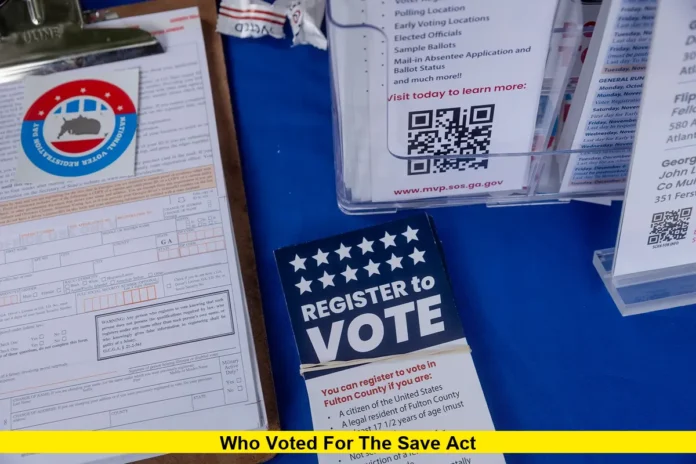

In a narrow and highly contentious vote this week, who voted for the SAVE Act was brought into sharp focus as the U.S. House of Representatives passed the Trump-backed SAVE America Act — a bill imposing new voting requirements — by a 218-213 margin, with only one Democrat breaking from party lines to support the measure. This vote has ignited fierce debate nationwide over election integrity and voter access as the bill heads to the Senate.
Take action now – read how lawmakers’ decisions could affect voting rights.
What the SAVE America Act Is and What It Does
The SAVE America Act — often discussed alongside its legislative cousin, the Safeguard American Voter Eligibility (SAVE) Act — is a Republican-driven election law proposal aimed at tightening voter registration and ballot access rules. The most recent version requires documentary proof of U.S. citizenship at registration and photo identification at polling places. Proponents argue these measures are necessary to protect election integrity, while opponents say they could create new barriers for eligible voters, particularly low-income citizens and people who lack ready access to the required documents.
Unlike existing federal law, which already bars noncitizens from voting, this legislation would codify stringent documentation requirements that go beyond what most states currently demand. Critics also warn that the bill’s enforcement mechanisms — including potential criminal penalties for officials who fail to verify citizenship — could have far-reaching impacts on election administration.
The House Vote Breakdown
On February 11, 2026, the House of Representatives passed the bill by a vote of 218 in favor and 213 against. Most Republicans voted for the SAVE America Act, holding to party lines in support of its stricter voting standards. Democrats largely opposed the bill, arguing it would disenfranchise voters, particularly those without easy access to passports, certified birth certificates, or other forms of citizenship documentation.
Notably, the vote included one Democratic lawmaker crossing party lines to support the measure — Representative Henry Cuellar of Texas — making him the only Democrat voting with Republicans in favor of the bill this session.
Republicans Who Voted for the SAVE Act
The Republican majority in the House broadly supported the bill. Though roll call lists are extensive, members who publicly advocated for stronger voter ID and proof-of-citizenship requirements included:
- Rep. Chip Roy (R-TX) – Lead sponsor and vocal defender of the bill’s goals.
- Rep. Jack Bergman (R-MI) – Supporter of the SAVE Act’s approach to election integrity.
- Numerous other Republican representatives aligned with the effort, backing the bill as a key legislative priority in the GOP’s election-policy agenda.
House Republicans framed their votes as necessary to reinforce public confidence in U.S. elections, a talking point amplified by former President Donald Trump and other party leaders even as widespread noncitizen voting remains statistically rare.
Democratic Opposition and the Lone Democratic ‘Yes’
Democrats overwhelmingly opposed the SAVE America Act, contending the stringent documentation requirements would disproportionately affect citizens who may lack easy access to passports or certified birth certificates, such as low-income voters, naturalized citizens, and elderly Americans. They also warn the timing — close to upcoming primaries — could disrupt state election operations.
The lone Democrat voting for the bill, Rep. Henry Cuellar, broke with his party’s majority stance, citing reasons tied to election confidence and integrity. While individual statements outlining Cuellar’s rationale were not widely publicized at the time of the vote, this crossover vote highlights the intense bipartisan pressure surrounding election-related legislation.
Why This Vote Matters Right Now
This vote on who voted for the SAVE Act matters both politically and practically. The legislation now moves to the Senate, where it faces procedural hurdles, including the need for 60 votes to overcome a filibuster. Senate dynamics — including some Republican dissent over federalizing election rules — could determine the bill’s fate.
Critics argue that by requiring documentary proof of citizenship and photo ID, the law could effectively reduce participation among millions of registered voters who do not immediately have those documents in hand. Advocates counter that these requirements will shore up public trust and prevent even rare cases of noncitizen voter registration or voting.
Policy analysts also note that while federal elections already prohibit noncitizen voting, the proposed requirements could alter how states validate eligibility and maintain voter rolls, possibly increasing administrative burdens.
Responses From Across the Political Spectrum
Reactions to the SAVE America Act vote underscore the deep partisan divide over election policy:
- Republicans: Many expressed support for the vote, framing it as essential to safeguard the democratic process and secure election systems.
- Democrats: Most criticized the vote as an attempt to suppress voter participation under the guise of election integrity.
- Voting Rights Organizations: Civil liberties advocates warn that the act could disenfranchise eligible voters and complicate voter outreach efforts.
- Some Republican Lawmakers: A few, including Senator Lisa Murkowski, have expressed concern about federal overreach in election regulations, signaling potential resistance in the Senate.
What Happens Next?
With the House’s passage of the SAVE America Act, the spotlight now turns to the Senate. Lawmakers must decide whether to take up the bill, modify its provisions, or allow it to stall. Given the current political composition, overcoming a filibuster will be challenging without bipartisan backing.
The broader debate over election law reforms — including voter ID requirements, proof of citizenship, and voter registration procedures — is expected to remain a key political flashpoint heading into the 2026 midterm elections.
Closing Thoughts
As voters watch how who voted for the SAVE Act unfolds in Congress, this vote represents a defining moment in the ongoing national conversation on election integrity and voter access. Understanding which lawmakers backed the legislation and why helps illuminate the broader legislative landscape shaping U.S. democracy today.
Join the conversation in the comments below and stay informed on how this unfolding story could impact voters nationwide.