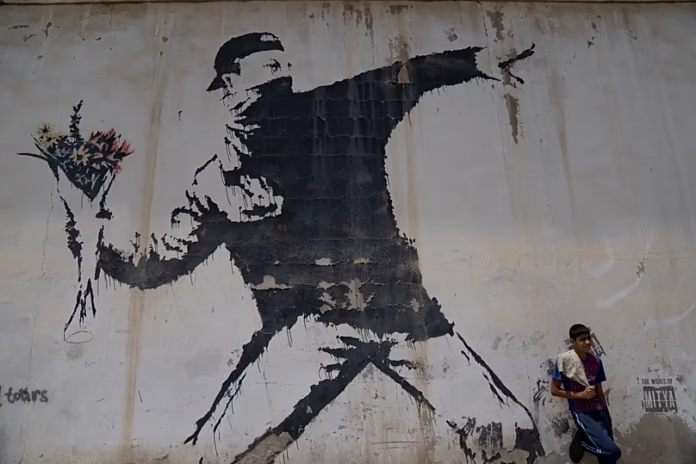

For nearly three decades, the question “who is Banksy?” has captivated art lovers, journalists, and curious minds around the world. Now, a sweeping investigative report published this week has reignited that question with more force than ever — and this time, reporters say they have the evidence to answer it.
A months-long investigation by journalists claims to have finally unmasked the celebrated Bristol-based graffiti artist and activist. The story has rocketed to the top of global news feeds, sparking passionate debate about identity, privacy, art, and the public’s right to know.
This story is developing rapidly — keep following for the latest updates as more details emerge.
A Legend Built on Anonymity
Banksy rose to global prominence through stenciled street art appearing on walls across the United Kingdom, marked by sharp satirical wit and unmistakably anti-establishment themes. Over the decades, those works evolved into a worldwide cultural phenomenon — appearing in Gaza, New York City, New Orleans, and most recently, war-torn Ukraine.
The artist’s pieces have sold at auction for millions of dollars. His company, Pest Control, serves as the official authentication body for his work. One of the most famous moments in contemporary art history came when Banksy’s piece “Girl with Balloon” partially shredded itself seconds after selling at a Sotheby’s auction in 2018 — a stunt that stunned the art world and cemented his legend.
What made Banksy truly unique was not just the art — it was the anonymity. The mystery became as famous as the murals.
What Triggered the Current Discussion
A lengthy investigative report published in March 2026 identified Banksy as Robin Gunningham, a Bristol-born man who reportedly changed his name to David Jones around 2008. The name Gunningham had actually surfaced as early as that same year in a British newspaper investigation, but the public largely chose to look the other way — preferring, as one critic put it, the romance of mystery over a straightforward answer.
The latest investigation compiled a sweeping body of evidence. Journalists traced travel records, witness accounts, and a decades-old police report from New York, where a man matching Gunningham’s description was arrested for defacing a billboard. At the Carlton Arms Hotel — a haven for artists in residency — the man reportedly painted walls in lieu of paying rent, signing early work as “Robin Banks,” a name that allegedly evolved into the now-iconic alias.
Reporters also traveled to Ukraine, where a series of Banksy murals appeared in late 2022, and confirmed that a man matching Jones’s identification had been present in the country at the same time.
Public Reaction
The internet erupted almost immediately. Social media users, art critics, and long-time Banksy followers divided sharply into two camps: those who viewed the unmasking as legitimate public interest journalism, and those who condemned it as a dangerous invasion of privacy.
Many pointed out the cultural contradiction at the heart of the story — Gunningham’s name had been available for nearly two decades, and the public had collectively chosen to ignore it. Banksy’s entire career was built on speaking truth to power from the shadows. For many fans, exposing that shadow felt like destroying the art itself.
Others took a more pragmatic view. Some art market analysts suggested the unmasking could actually increase the long-term value of Banksy’s work, arguing that a confirmed identity provides greater confidence for collectors and investors. The more that is known about an artist’s life, the argument goes, the stronger the foundation for a lasting market.
What Banksy’s Team Has Said
The artist has not personally responded, but his representatives have spoken clearly and firmly.
Banksy’s company, Pest Control, stated the artist “has decided to say nothing” about the discovery. His legal representative, however, was more pointed in his pushback. The lawyer stated that his client does not accept many of the details in the investigation as accurate, and added that publishing the story would violate the artist’s privacy, interfere with his work, and place him in physical danger.
The lawyer elaborated that working anonymously or under a pseudonym “serves vital societal interests,” protecting freedom of expression by allowing creators to speak truth to power without fear of retaliation, censorship, or persecution. He also disclosed, without going into specifics, that Banksy has been subjected to fixated, threatening, and extremist behavior over the years — making clear that the anonymity was never merely a marketing device.
Why This Topic Matters
The Banksy story transcends art world gossip. At its core, it raises profound questions about the rights of anonymous creators in the digital age — and the boundaries of investigative journalism.
Journalists behind the report argued that the public has a deep interest in understanding the identity of a figure with such profound and enduring influence on culture, the art industry, and international political discourse. That framing reflects a genuine and unresolved tension: does the public’s right to know outweigh an individual’s right to remain anonymous, especially when that anonymity is itself part of the artistic statement?
Banksy’s work has long punched upward at governments, corporations, and institutions. The irony is not lost on observers that exposing the person behind those works could, in theory, silence the very voice they represent. If Banksy’s identity becomes fully public and legally settled, what the artist can safely say — and where — changes fundamentally.
What Comes Next
The story is far from over. Banksy’s legal team appears prepared to contest the narrative, and Pest Control has offered no confirmation of any details. Whether further legal action, new artwork, or additional investigative findings surface in the coming weeks remains to be seen.
What is certain is that the cultural conversation around who is Banksy — about anonymity, artistic freedom, and the nature of public figures — will intensify before it fades. Banksy has always used mystery as a medium. The world is now watching to see what that medium looks like without it.
Do you think Banksy’s identity should remain protected? Drop your thoughts in the comments and follow this story for the latest developments.