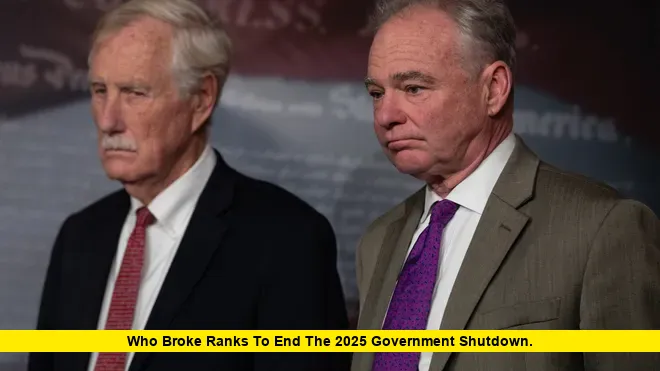

The question of who broke ranks to end the 2025 government shutdown has dominated political discussion across the United States this November. After more than a month of gridlock, frustration, and mounting national costs, a handful of senators stepped away from strict party lines to bring the government back to life. Their move — bold, controversial, and historic — reshaped the narrative of congressional politics in 2025.
The Longest Shutdown in U.S. History
The 2025 government shutdown began at 12:01 a.m. on October 1, 2025, after Congress failed to pass a spending bill for the new fiscal year. Disagreements over healthcare funding, tax credits, and overall spending priorities triggered the stalemate.
For 40 days, federal operations slowed to a crawl. More than a million government employees went unpaid, air travel delays worsened, and vital programs such as food assistance, veterans’ services, and tax processing were disrupted. Economists warned of lasting consequences if the shutdown continued much longer.
By early November, the public’s patience had worn thin. Pressure grew from every corner — federal workers, local economies, and business leaders — urging lawmakers to act. It was in this tense environment that eight senators made a decision that would define the end of the crisis.
Who Broke Ranks to End the 2025 Government Shutdown
On November 9, 2025, the U.S. Senate took a decisive step toward reopening the federal government. In a 60–40 vote, the chamber advanced a short-term funding bill that would extend operations through January 30, 2026.
To reach that critical 60-vote threshold, eight members from the Democratic caucus joined Republicans, effectively breaking ranks with party leadership and changing the course of history.
Those who crossed party lines were:
- Dick Durbin (D–Illinois)
- Tim Kaine (D–Virginia)
- Catherine Cortez Masto (D–Nevada)
- John Fetterman (D–Pennsylvania)
- Maggie Hassan (D–New Hampshire)
- Jacky Rosen (D–Nevada)
- Jeanne Shaheen (D–New Hampshire)
- Angus King (I–Maine), an Independent who caucuses with Democrats
These eight senators defied political pressure and broke with party strategy to support the funding deal, providing the decisive votes that reopened the U.S. government. Their move not only ended the shutdown but also demonstrated that bipartisan cooperation, though rare, is still possible in today’s polarized Congress.
Why They Broke Ranks
Breaking ranks in Washington is never a small act. Each of the eight senators faced intense scrutiny — from colleagues, constituents, and political observers. Yet, the reasons behind their votes were clear and deeply rooted in both principle and practicality.
1. The Human and Economic Toll
The shutdown’s impact was being felt across the nation:
- Federal employees missed multiple paychecks.
- Veterans’ benefits faced delays.
- National parks and museums remained closed, affecting tourism and local economies.
- Contract workers, many of whom would not receive back pay, were losing income permanently.
For senators representing states with high numbers of federal workers, such as Virginia, New Hampshire, and Nevada, the situation had become untenable. Breaking ranks became not just a political decision — but a moral one.
2. Constituent Pressure
Public opinion had shifted sharply. Polls showed a majority of Americans blaming both parties for the impasse, and calls for compromise grew louder. Federal unions, state governors, and business leaders urged Congress to act, even if it meant crossing party lines.
3. Pragmatic Politics
Several of these senators have reputations as moderates or dealmakers. Their political identities are tied to solving problems rather than deepening divisions. Supporting the funding deal aligned with their commitment to keep government functioning, even if it meant upsetting their party’s base.
4. A Promise of Future Debate
The funding bill that ended the shutdown did not include every policy goal Democrats had sought, particularly on healthcare and tax credits. However, the deal included a commitment to revisit those issues later. For the breakaway senators, ending the shutdown now was the first step toward a larger legislative solution.
Inside the Deal That Reopened the Government
The short-term funding bill that passed the Senate and was later signed into law by the President carried several key provisions designed to stabilize federal operations:
- Funding Extension: Government agencies are funded through January 30, 2026, giving lawmakers additional time to negotiate full-year appropriations.
- Back Pay for Workers: All furloughed federal employees are guaranteed full back pay for the period of the shutdown.
- Operational Safeguards: The bill includes temporary measures to ensure that critical programs such as food assistance, veterans’ benefits, and air traffic control remain fully funded.
- Commitment to Future Votes: Congressional leaders agreed to revisit health-related funding provisions, including premium tax credits, before the end of the year.
While far from a complete solution, the legislation restored normal operations across the country and ended weeks of uncertainty.
Reaction Across Washington
The decision by these eight senators to break ranks created ripple effects throughout Washington.
Democratic Leadership Reaction
Party leaders expressed frustration over the defections, arguing that unity was essential to negotiating long-term healthcare funding. However, even critics within the party acknowledged the public’s exhaustion with the shutdown and the necessity of action.
Republican Praise for Bipartisanship
Republicans, including Senate leadership, welcomed the crossover votes as a demonstration of pragmatic leadership. They emphasized that government should never be held hostage to partisan disputes and applauded the eight senators for “putting country first.”
White House Response
The President swiftly signed the bill into law, praising the Senate for “restoring government function and showing that cooperation is still possible.”
Public Sentiment
Across the country, relief replaced frustration. Federal employees received assurances of back pay, airports resumed normal operations, and public facilities began reopening. The end of the shutdown brought an immediate sense of normalcy after more than a month of chaos.
The Political Fallout
Breaking ranks always carries political risks. For some of these senators, the decision could reshape their political futures.
- Moderates Strengthened: The eight senators positioned themselves as problem-solvers willing to defy gridlock. This could appeal to independent voters in future elections.
- Progressive Backlash: Progressive activists criticized the move as a “premature surrender,” arguing that more could have been gained if Democrats had held firm.
- Party Dynamics: The event deepened the internal divide between the moderate and progressive wings of the Democratic Party. Leadership may face challenges in maintaining unity during upcoming budget negotiations.
Despite the risks, the senators stood by their decision, emphasizing that ending the shutdown was the responsible course of action.
Economic and Social Relief Following the Reopening
The immediate aftermath of reopening the government brought measurable relief:
- Federal employees began receiving back pay within days.
- National parks, museums, and monuments reopened to the public.
- Food assistance and veterans’ programs resumed full operation.
- Government contracts, research grants, and infrastructure projects were reactivated.
Economists predicted that the end of the shutdown would help the U.S. economy recover the billions lost during the 40-day freeze. However, they also warned that repeated shutdowns could erode public trust and investor confidence if Congress fails to create more stable budgeting mechanisms.
Lessons and What Comes Next
The 2025 shutdown has left behind both relief and reflection. Lawmakers now face a new deadline in January 2026 to finalize a full-year funding package — a process that could reignite the same debates if no consensus emerges.
Key issues that will shape the next round of negotiations include:
- Long-term healthcare funding and ACA subsidies.
- Adjustments to defense and domestic spending limits.
- Reforms to prevent future shutdowns through automatic funding mechanisms.
For now, the federal government is open, workers are paid, and essential services are restored. Yet, the path ahead remains uncertain — especially as political divisions deepen heading into the 2026 midterm elections.
The Legacy of the Eight Senators Who Broke Ranks
The decision by these eight lawmakers will likely be studied for years as a case of principle versus party loyalty. Their votes ended a crisis that was affecting millions of Americans, demonstrating that individual courage can still break through partisan walls.
In an era when politics often rewards division, these senators showed that compromise — though imperfect — can deliver real relief to real people. Their action serves as a reminder that leadership sometimes means standing apart from the crowd.
The answer to who broke ranks to end the 2025 government shutdown is clear: eight senators who chose governance over gridlock, people over politics, and progress over partisanship. Their decision reopened the doors of the U.S. government — and perhaps, just maybe, reopened the possibility of genuine cooperation in Washington.
Do you think these senators made the right choice in breaking party lines to end the shutdown? Share your thoughts below and stay informed about how this decision shapes future congressional negotiations.