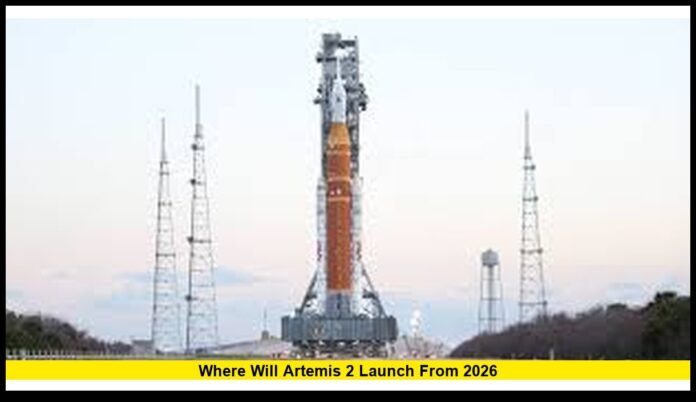

The question where will artemis 2 launch from continues to gain momentum as NASA moves closer to launching its first crewed lunar mission in over five decades. Artemis II is scheduled to lift off from Launch Complex 39B at Kennedy Space Center in Florida, a site deeply rooted in the history of American space exploration and now central to its future.
This mission is more than just another rocket launch. It represents a return to deep space for human astronauts and marks a critical step toward establishing a sustained presence on and around the Moon. With preparations advancing and public interest growing, understanding the exact launch location and its significance offers a clearer picture of what lies ahead.
If you’re following NASA’s Artemis program or planning to watch this historic event unfold, this detailed guide covers everything from the launch site to mission goals and what it means for the United States.
Kennedy Space Center: The Launch Point for Artemis II
Artemis II will launch from Launch Complex 39B at NASA’s Kennedy Space Center, located on Florida’s east coast near Cape Canaveral. This facility has long served as the backbone of the nation’s most ambitious space missions.
Launch Complex 39B was originally developed during the Apollo era and later adapted for the Space Shuttle program. Today, it has been upgraded to support the powerful Space Launch System rocket, making it one of the most advanced launch sites in the world.
The location offers several strategic advantages:
- Direct access to open ocean launch trajectories
- Proximity to the equator, which improves fuel efficiency
- Established infrastructure for assembling and launching large rockets
- Decades of operational experience with human spaceflight
These factors make Kennedy Space Center the ideal location for launching a mission as complex and high-stakes as Artemis II.
A Modern Launch Pad Built on Historic Ground
Launch Complex 39B carries decades of history, but it has been transformed to meet the demands of modern space exploration.
The launch pad has undergone extensive upgrades, including:
- Reinforced flame trenches to handle increased rocket thrust
- Advanced lightning protection systems
- New fueling systems capable of supporting cryogenic propellants
- Enhanced safety and monitoring technologies
These upgrades ensure that the site can support the Space Launch System, which generates more power than any rocket NASA has used before.
Despite these modernizations, the pad still reflects its historic legacy, connecting today’s Artemis missions with the achievements of the Apollo era.
The Space Launch System: Powering the Mission
Artemis II will rely on the Space Launch System (SLS), NASA’s most powerful rocket to date. This heavy-lift vehicle is designed specifically for deep-space missions and plays a central role in the Artemis program.
The SLS stands over 300 feet tall and produces millions of pounds of thrust at liftoff. Its design includes:
- A core stage powered by four RS-25 engines
- Two solid rocket boosters that provide the majority of initial thrust
- An upper stage that propels the Orion spacecraft beyond Earth orbit
The rocket will lift off from Launch Complex 39B, carrying the Orion spacecraft and its crew into space before beginning the journey toward the Moon.
Orion Spacecraft: Designed for Deep Space Travel
Sitting atop the SLS rocket is the Orion spacecraft, built to carry astronauts farther than any modern crewed vehicle.
Orion is equipped with systems that support long-duration missions, including:
- Life-support technology for extended space travel
- Navigation systems capable of deep-space operations
- Communication systems that maintain contact with Earth
- A heat shield designed to withstand extreme reentry temperatures
After launch, Orion will separate from the rocket and continue its journey independently, eventually looping around the Moon before returning to Earth.
Mission Objectives: What Artemis II Will Accomplish
Artemis II is a test mission, but its goals are critical for the success of future lunar landings.
The mission will last approximately 10 days and will include:
- A launch from Kennedy Space Center
- A series of system checks in Earth orbit
- A trajectory that carries the spacecraft around the Moon
- A return journey ending with a splashdown in the Pacific Ocean
This flight will test every major system involved in human deep-space travel, from propulsion and navigation to life support and reentry.
By completing these objectives, Artemis II will pave the way for Artemis III, which aims to land astronauts on the lunar surface.
Meet the Crew Heading to the Moon
Artemis II will carry four astronauts, representing both the United States and Canada.
The crew includes:
- Reid Wiseman, serving as commander
- Victor Glover, serving as pilot
- Christina Koch, serving as mission specialist
- Jeremy Hansen, representing the Canadian Space Agency
This mission marks several historic milestones, including the first time a woman and a Canadian astronaut will travel on a lunar mission.
The crew will play a vital role in testing spacecraft systems and ensuring that all components function as expected during the journey.
Launch Preparations and Timeline
NASA has been working through a detailed series of milestones leading up to the Artemis II launch.
These preparations include:
- Assembling the Space Launch System rocket inside the Vehicle Assembly Building
- Integrating the Orion spacecraft with the rocket
- Transporting the fully assembled vehicle to Launch Complex 39B using a crawler-transporter
- Conducting fueling tests and countdown rehearsals
- Completing final safety and readiness reviews
The targeted launch window is set for early April 2026, though final timing will depend on technical readiness and weather conditions.
Why the Launch Site Matters for the Mission
Understanding where will artemis 2 launch from is more than a logistical detail—it is central to the mission’s success.
Kennedy Space Center provides:
- The infrastructure needed to support a rocket of this scale
- A proven track record in launching human spaceflight missions
- Geographic advantages that improve efficiency and safety
The launch site also serves as a symbol of continuity, linking past achievements in space exploration with future ambitions.
Economic and National Impact
The Artemis II launch carries significant importance beyond the space industry.
In the United States, the mission supports thousands of jobs across engineering, manufacturing, and research. It also drives investment in new technologies that can have applications beyond space exploration.
The launch from Florida is expected to draw attention from across the country, boosting tourism and highlighting the role of the U.S. as a leader in space exploration.
Additionally, the mission strengthens partnerships with international space agencies, reinforcing collaboration on a global scale.
What Comes After Artemis II
Artemis II is a stepping stone toward more ambitious goals.
Future missions in the Artemis program include:
- Artemis III, which aims to land astronauts on the Moon
- Artemis IV, focused on building infrastructure in lunar orbit
- Long-term plans to establish a sustained human presence on the Moon
These missions are part of a broader effort to prepare for eventual human exploration of Mars.
Each step builds on the previous one, making Artemis II a critical milestone in NASA’s long-term vision.
How Americans Can Watch the Launch
The Artemis II launch is expected to capture national and global attention.
Viewers across the United States will be able to watch the launch through live broadcasts, with coverage beginning well before liftoff. For those near Florida’s Space Coast, designated viewing areas will provide opportunities to see the launch in person.
The event is likely to become one of the most watched space launches in recent history, reflecting renewed public interest in human space exploration.
Key Takeaways
- Artemis II will launch from Launch Complex 39B at Kennedy Space Center
- The mission marks the first crewed journey toward the Moon since the Apollo era
- The Space Launch System rocket will carry the Orion spacecraft and its crew
- The mission will test systems needed for future lunar landings
- The launch site plays a crucial role in ensuring mission success
Following missions like Artemis II offers a glimpse into the future of space exploration and the evolving role of the United States in deep space travel.
Are you planning to watch Artemis II launch from Florida? Share your thoughts and stay tuned for more updates on this historic mission.