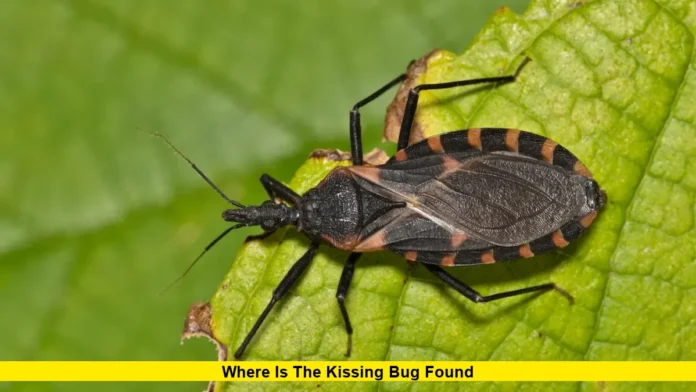

The question many Americans are asking is where is the kissing bug found, and the answer is increasingly concerning for public health. Once believed to be limited to rural regions of Central and South America, this blood-sucking insect has spread widely across the United States, raising alarms due to its link with Chagas disease, a potentially life-threatening illness.
The Expanding Range of the Kissing Bug
Over the last two decades, researchers and health agencies have tracked the steady spread of kissing bugs across the U.S. Today, the insects have been identified in at least 32 states, with the highest concentrations in the southern and southwestern regions.
These include:
- Texas, Arizona, and New Mexico, which report the most frequent sightings.
- Louisiana, Mississippi, Arkansas, and Missouri, where both insects and confirmed animal infections have been recorded.
- California, where recent detections in Los Angeles and San Diego counties have highlighted an urban spread.
Even states further east, such as Florida, Georgia, South Carolina, North Carolina, Virginia, and Maryland, have reported infected insects or animal hosts, showing that the range is not limited to the desert Southwest.
Human Cases of Chagas Disease in the U.S.
While the insect itself is unsettling, the real risk lies in its ability to transmit Trypanosoma cruzi, the parasite that causes Chagas disease. In the United States, locally transmitted human infections have been confirmed in at least eight states. These include Texas, Arizona, Louisiana, California, Arkansas, Missouri, Mississippi, and Tennessee.
Experts warn that most cases go undetected because symptoms can be mild or delayed for years. When left untreated, the infection can lead to heart failure, digestive complications, or sudden cardiac arrest. This hidden nature makes the kissing bug a silent but serious public health issue.
Animal Infections: A Warning Sign
Dogs and wildlife act as important “reservoirs” for the parasite, often becoming infected after exposure to kissing bugs. In several states, veterinarians have reported infection rates as high as 30% among dogs in kennels.
Animal infections have been confirmed across large portions of the South and Midwest, including Oklahoma, Nebraska, Kentucky, Alabama, and Georgia. Because dogs often live in close contact with humans, their infection rates are a red flag for possible community spread.
Why the Spread Is Growing
There are several reasons kissing bugs are thriving in the U.S.:
- Climate shifts: Warmer temperatures allow the insects to survive in areas where they once could not.
- Urban sprawl: Human expansion into rural and semi-rural areas increases contact with wildlife and bugs.
- Pet exposure: Dogs housed outdoors or in rural kennels are especially vulnerable, creating a link between wildlife and households.
- Low awareness: Many Americans do not recognize kissing bugs, and infections often go undiagnosed for years.
Identifying the Kissing Bug
Kissing bugs are often mistaken for harmless insects, but they have distinct features. They are about an inch long, with a dark brown or black body and orange or red markings along the edges. Their pointed head and long legs make them easy to distinguish once you know what to look for.
They are nicknamed “kissing bugs” because they typically bite around the mouth and eyes at night, attracted by carbon dioxide from human breath.
How Transmission Happens
Unlike mosquitoes, kissing bugs do not spread the parasite directly through their bite. Instead, they feed on blood and then defecate near the bite wound. If the parasite-laden feces enters the body through broken skin or mucous membranes, infection can occur.
This unusual mode of transmission makes prevention tricky, but not impossible.
States With the Highest Risk
A simplified overview of where kissing bugs are most concerning today:
| Region | Risk Level | Notable Concerns |
|---|---|---|
| Texas, Arizona, NM | High | Multiple local human cases, high dog infection rates |
| California | Medium | Growing detections in Los Angeles and San Diego |
| Gulf Coast states | Medium | Insect presence plus confirmed human infections |
| Southeast & Mid-Atlantic | Emerging | Animal infections and insect detections reported |
Prevention and Safety Tips
Public health officials recommend several steps to limit exposure:
- Seal entry points: Close gaps in walls, roofs, and foundations where bugs may enter.
- Install window screens: Keep insects from flying indoors.
- Manage outdoor lighting: Bright lights can attract kissing bugs at night.
- Protect pets: Keep dogs indoors at night when possible, and clean outdoor shelters frequently.
- Handle sightings carefully: Avoid direct contact with the insect; if captured, report it to local health officials.
Current Outlook
The latest health updates suggest that the U.S. should now be considered hypoendemic for Chagas disease—meaning there is consistent but low-level transmission within the country. This classification underscores that the risk is real, even if large outbreaks are not yet occurring.
In cities like Los Angeles and Houston, medical experts estimate thousands of people may already be living with undiagnosed Chagas disease. Fewer than two percent of those infected are aware of their status, leaving a large gap in prevention and treatment.
Closing Thoughts
So, where is the kissing bug found today? The answer is: across more than half the country, with the highest risks in the southern and southwestern United States. The insect is no longer a foreign concern—it is firmly established here, and its ability to silently spread Chagas disease makes it a challenge for both doctors and communities.
Staying alert, recognizing the insect, and protecting households and pets are the most effective tools we have right now. As awareness grows, so does the opportunity to prevent more infections.
What do you think—have you seen these insects in your area? Share your experience in the comments and help others stay safe.