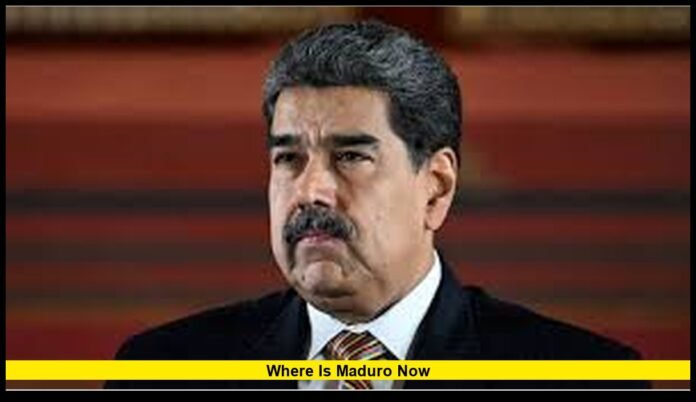

Where is Maduro now is no longer a routine political question. It has become a defining issue shaping diplomatic relations, regional stability, and international legal debate across the Western Hemisphere. As of today, Nicolás Maduro is outside Venezuela and under U.S. federal authority, marking a decisive shift in both Venezuelan governance and global political dynamics.
For years, Maduro’s physical presence in Caracas symbolized continuity of power. That certainty no longer exists. His removal from Venezuela has altered the country’s political trajectory and raised urgent questions about what comes next for the nation and the region.
Where Is Maduro Now as of Today
As of the most recent confirmed updates, Nicolás Maduro is in U.S. custody and no longer on Venezuelan soil. He is being held under federal legal authority, following a U.S. military operation conducted in Caracas on January 3, 2026.
Maduro’s exact detention location has not been publicly disclosed. U.S. officials have stated that this decision is based on security and legal considerations. What has been confirmed is that Maduro is within U.S. jurisdiction, unable to exercise political authority, and subject to the American judicial system.
This status represents a fundamental break from his years as Venezuela’s central power figure.
How Maduro’s Status Changed Overnight
The events that reshaped Maduro’s status unfolded rapidly. In the early hours of January 3, coordinated military action took place in Caracas, targeting key government-controlled locations. Within hours, Maduro and his wife were detained and removed from the country.
By the end of the same day, U.S. officials publicly confirmed that Maduro was no longer in Venezuela and would face federal legal proceedings. The speed and finality of the operation left little ambiguity about his removal from power.
For Venezuelans and international observers alike, the shift was immediate and irreversible.
Loss of Power Inside Venezuela
Maduro’s absence has effectively ended his ability to govern Venezuela.
He no longer:
- Issues executive orders
- Commands military or security forces
- Represents Venezuela in international forums
- Controls state institutions or economic policy
Without his physical presence or communication authority, the political structure that revolved around Maduro for more than a decade has fractured. Senior officials remain in place, but governance has entered an uncertain phase.
This sudden vacuum has reshaped Venezuela’s internal power balance.
Legal Status Under U.S. Authority
Maduro is now classified as a federal detainee under U.S. law. Long-standing criminal cases tied to narcotics trafficking and organized crime are expected to proceed through the American judicial system.
U.S. officials have confirmed that the matter has shifted from military action to legal process. Preparations for court proceedings are underway, and Maduro’s case will move forward within the framework of U.S. federal courts.
No announcements have been made regarding release, transfer, or diplomatic negotiation.
Why the Exact Location Is Not Public
Many continue asking where Maduro is now in a physical sense. Authorities have chosen not to disclose specific detention details.
This approach reflects:
- Security risks associated with high-profile detainees
- Ongoing legal preparation
- Diplomatic sensitivities
What remains confirmed is that Maduro is outside Venezuela, under U.S. control, and without public access or political authority.
Immediate Effects Inside Venezuela
Maduro’s removal triggered rapid responses inside the country.
Key developments include:
- Emergency meetings among government officials
- Heightened security in major cities
- Public condemnation of foreign intervention
Despite strong rhetoric, no credible evidence has emerged disputing Maduro’s removal from Venezuela. His absence is acknowledged even by those contesting the legality of the operation.
Venezuela now faces a transitional period without its long-standing leader.
Confirmed Timeline of Events
- Early January 3, 2026: Military action begins in Caracas
- Same morning: Nicolás Maduro and his wife are detained
- Hours later: Maduro is flown out of Venezuela
- Later that day: U.S. officials confirm federal legal proceedings will follow
This timeline provides a clear and factual answer to where is Maduro now: he is in U.S. custody, outside Venezuela.
Why the Question “Where Is Maduro Now” Matters
The importance of knowing where Maduro is now extends far beyond Venezuela.
This moment affects:
- Regional stability in Latin America
- Migration patterns across neighboring countries
- Global energy markets linked to Venezuelan oil
- Future U.S. foreign policy in the Western Hemisphere
For years, Maduro’s location was predictable and symbolic of his grip on power. His absence changes political calculations across borders and institutions.
Regional Stability and Political Shifts
Maduro’s removal has introduced uncertainty across Latin America. Neighboring governments are monitoring Venezuela closely for signs of unrest, institutional breakdown, or political realignment.
Venezuela’s internal decisions now carry heightened regional implications, particularly regarding border security, humanitarian concerns, and diplomatic relations.
Impact on Migration Trends
Venezuela has experienced one of the largest population movements in modern regional history. Maduro’s absence may influence migration decisions, either by encouraging cautious optimism or by increasing short-term uncertainty.
Neighboring nations are preparing for potential changes in migration flow, depending on how Venezuela’s political situation evolves.
Energy Markets and Economic Signals
Venezuela holds some of the world’s largest proven oil reserves. Political instability has long constrained production and exports.
Maduro’s removal has prompted renewed attention to:
- Oil production policy
- Infrastructure rehabilitation
- International market access
Even without immediate policy changes, perception alone influences market behavior and long-term investment planning.
Implications for U.S. Foreign Policy
Maduro’s current status represents a significant and defining moment in U.S. engagement within the Western Hemisphere. His removal from power and placement under U.S. federal authority reflects a recalibration of how the United States approaches long-standing political crises tied to criminal allegations, governance breakdowns, and regional instability.
This development signals a willingness to enforce legal accountability beyond borders when U.S. authorities determine that criminal conduct has international consequences. It underscores an approach that prioritizes judicial process and enforcement mechanisms over prolonged diplomatic stalemates, particularly in cases involving allegations of organized crime and transnational activity.
It also reflects a shift in how political leadership is addressed when linked to criminal activity. The distinction between head-of-state status and legal responsibility has been sharply redefined, sending a clear message that political office does not guarantee immunity when serious charges are involved. This shift may influence how future cases involving foreign leaders are handled under U.S. law.
Finally, Maduro’s status establishes a precedent that will influence future diplomatic strategy across the region. Governments throughout Latin America are reassessing assumptions about sovereignty, intervention, and accountability. U.S. policymakers are likely to weigh this moment heavily as they shape responses to future political crises involving corruption, instability, or cross-border crime.
Taken together, this development will shape U.S. relations across Latin America for years to come, affecting diplomatic engagement, security cooperation, and the broader balance between enforcement and diplomacy in the Western Hemisphere.
What Happens Next
While many operational and legal details remain classified, several outcomes are already clear and continue to shape developments surrounding Nicolás Maduro’s status and Venezuela’s future.
Maduro no longer holds power within Venezuela. His removal from the country has effectively ended his ability to govern, direct state institutions, or influence military and security operations. Decision-making authority now rests with remaining political and institutional figures inside Venezuela, creating a new and uncertain balance of power.
U.S. legal proceedings are moving forward. Maduro remains under U.S. federal authority, and preparations for judicial action are underway. His status has shifted fully from political leadership to legal accountability, signaling that the matter will proceed through the American legal system rather than diplomatic negotiation.
Venezuela faces a complex political transition. With its long-standing leader absent, the country is entering a period marked by uncertainty, internal recalibration, and competing claims of authority. How governance evolves, how institutions respond, and how stability is maintained will define the next phase of Venezuela’s political landscape.
International diplomatic pressure continues. Governments across the Americas and beyond remain actively engaged, issuing statements, holding emergency discussions, and reassessing regional strategies. The situation has intensified global debate over sovereignty, intervention, and accountability in international affairs.
At present, no verified information suggests Maduro will return to Venezuela in the near future. U.S. officials have given no indication of release or transfer, and Maduro remains outside the country under federal jurisdiction, marking a decisive break from his years in power.
A Defining Moment in Modern Venezuelan History
Maduro’s confirmed status outside Venezuela marks the conclusion of an era defined by centralized authority, prolonged political confrontation, and deep institutional control. His absence has disrupted a system that shaped governance, economic policy, and regional relationships for more than a decade. While the structure that follows has yet to fully take shape, the shift itself is unmistakable and irreversible.
The question where is Maduro now has a clear and factual answer, but its broader consequences are still unfolding across political, legal, and economic spheres. Venezuela now stands at a crossroads, facing internal uncertainty alongside heightened international scrutiny. How power is redistributed, how institutions adapt, and how global actors respond will define the next chapter of the country’s modern history.
Final Perspective
Nicolás Maduro is no longer a governing presence inside Venezuela. His detention under U.S. federal authority has brought a definitive end to his direct control over the country’s political institutions, military command, and international representation. For the first time in years, Venezuela’s future is no longer shaped by a single centralized figure, forcing domestic leaders, regional governments, and global powers to reassess long-standing assumptions about authority and continuity in the country.
This moment will be analyzed for years, not only for how it closed a prolonged chapter in Venezuelan leadership, but for how it reshaped the balance between power, accountability, and international influence in the Americas. Maduro’s removal has altered diplomatic norms, challenged traditional concepts of sovereignty, and underscored the growing role of legal enforcement in global politics. While the long-term outcome remains uncertain, the shift itself is unmistakable—and its impact will extend far beyond Venezuela’s borders.