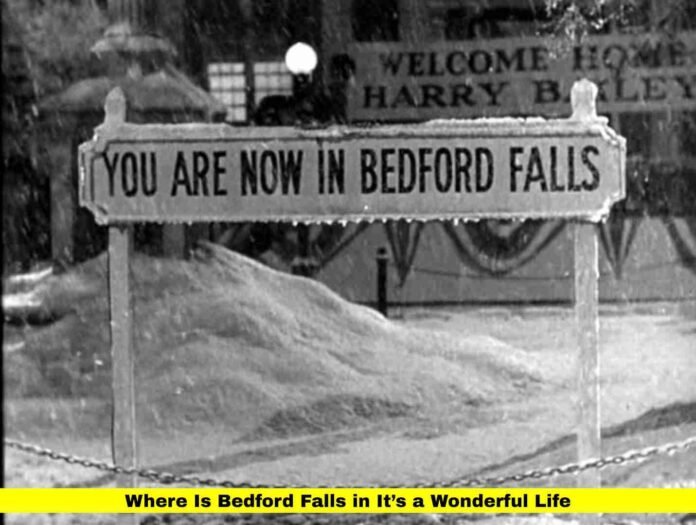

Bedford Falls is a fictional town created for the movie, not a real place on any map.
Where is Bedford Falls in It’s a Wonderful Life remains one of the most searched questions tied to the classic American film, especially as interest continues to grow across digital platforms and seasonal broadcasts. The answer, confirmed and unchanged today, is clear: Bedford Falls is a fictional town created for the movie, not a real place on any map.
Even so, the setting feels authentic, familiar, and deeply American. That realism has fueled decades of curiosity, travel interest, and cultural discussion. This article explains exactly where Bedford Falls exists, how it was created, and why it continues to feel so real to audiences in the United States.
Bedford Falls Exists Only on Screen
Bedford Falls does not exist as a physical town. It was created exclusively for the 1946 film It’s a Wonderful Life and functions entirely as a fictional setting crafted to serve the story’s emotional core. There are no official town records, municipal boundaries, maps, or geographic coordinates tied to Bedford Falls. Its existence begins and ends within the world of the film.
Despite its fictional status, Bedford Falls feels remarkably real because it was designed to mirror the structure and spirit of early twentieth-century American towns. The streets, homes, businesses, and social spaces reflect a familiar small-town rhythm that audiences instantly recognize. This intentional realism allows viewers to connect deeply with the setting, even though it has no physical counterpart.
Within the film, Bedford Falls acts as more than a backdrop—it is the narrative’s heartbeat. Every major turning point unfolds within its neighborhoods, from family moments inside modest homes to pivotal scenes in public gathering places. The town’s consistency and emotional continuity make it feel lived-in and authentic, reinforcing the film’s themes of community, sacrifice, and belonging.
How the Town Was Created for the Film
Bedford Falls was brought to life through an ambitious full-scale movie set designed specifically for It’s a Wonderful Life. The filmmakers constructed the town on a soundstage and backlot in California, creating an entire community from the ground up. This controlled environment allowed them to design every street, storefront, bridge, and home with precision, while also managing lighting, weather effects, and camera movement without real-world limitations.
Building the town on a studio lot gave the production exceptional flexibility. Seasonal changes, especially the film’s iconic winter scenes, could be created on demand. Snow-covered sidewalks, frosted bridges, glowing shop windows, and residential streets were carefully crafted to look natural and worn, not polished or artificial. The set design emphasized realism, making the town feel inhabited and emotionally warm rather than overtly theatrical.
The result was a setting that felt authentic and enduring, even though it existed only within the confines of the studio. Bedford Falls became a believable small town with its own visual identity, supporting the film’s themes and drawing audiences into its world in a way that few fictional locations have achieved since.
Why the Setting Feels So Real
The realism of Bedford Falls comes from deliberate and thoughtful design choices that closely reflect everyday life in small-town America during the early twentieth century. Rather than creating an idealized or exaggerated setting, the filmmakers modeled the town on places audiences already knew, drawing from common layouts and social structures found across the country at the time.
At the heart of the town is a central downtown area filled with local businesses, gathering spots, and offices that serve as daily meeting points for residents. Surrounding this core are residential neighborhoods located within easy walking distance, reinforcing the close-knit nature of the community. A recognizable bridge and river provide a physical landmark and a symbolic focal point, anchoring the town both visually and emotionally.
Equally important is the strong sense of community interaction woven into the setting. Neighbors know one another, businesses feel personal, and public spaces are shared and familiar. These elements closely mirror towns throughout the Northeast and Midwest, which is why so many viewers feel an immediate personal connection to Bedford Falls, even knowing it is fictional.
The Role of Bedford Falls in the Story
Bedford Falls is far more than a backdrop for the film’s events; it functions as a character in its own right. The town actively shapes the protagonist’s choices, relationships, and emotional conflicts, influencing the direction of his life at every stage. His sense of duty, frustration, sacrifice, and fulfillment is inseparable from the place he calls home.
Each location within Bedford Falls carries narrative weight. The bridge represents moments of crisis and transformation, the family home reflects stability and love built over time, and the downtown streets embody both opportunity and limitation. These spaces are not interchangeable settings but emotional touchstones that mark the character’s internal journey.
Through Bedford Falls, the film explores enduring themes of belonging, responsibility, and shared humanity. The town mirrors the interconnected lives of its residents, showing how individual actions ripple outward to affect the entire community. Without Bedford Falls anchoring the story, the film would lose much of its emotional depth, coherence, and lasting impact.
Why People Search for Its Real Location
Many viewers assume Bedford Falls must be based on a real town, largely because of how naturally it fits into the fabric of American life. The layout, social dynamics, and everyday routines shown on screen feel authentic rather than stylized, making it easy to believe the town exists somewhere beyond the film.
Over time, this realism has fueled ongoing curiosity. Search trends consistently show interest in identifying a real-world counterpart to Bedford Falls. Film fans, travelers, and history enthusiasts often hope to visit a place that captures the same atmosphere, believing it might offer a tangible connection to the story and its enduring themes.
Despite this widespread interest, Bedford Falls itself remains entirely fictional. While it reflects the look and spirit of many real American towns, it was never meant to represent a single location. Its power lies in its universality, allowing viewers from different regions to see their own hometown reflected on screen.
Real-World Inspirations Behind the Fiction
Although Bedford Falls itself is not a real town, its design was influenced by real American communities familiar to audiences of the time. Rather than modeling the setting after a single location, the filmmakers blended common small-town characteristics from across the country. This approach allowed the town to feel recognizable without being traceable to one specific place.
These influences are visible in the town’s architecture, street layout, and social interactions. Modest homes sit near a walkable downtown, local businesses serve as community hubs, and neighbors maintain close personal ties. The social dynamics reflect shared values, routines, and challenges common to many American towns during the early twentieth century.
By choosing a composite rather than a specific model, the filmmakers created a setting that felt universal. This creative decision helped the story resonate with audiences nationwide, allowing viewers from different regions to see elements of their own hometowns reflected in Bedford Falls.
The Famous Bridge and Its Meaning
One of the most recognizable and emotionally charged features of Bedford Falls is the bridge. It appears at pivotal moments in the story, marking turning points that shape the direction of the narrative. Each time the bridge is shown, it signals a moment of reflection, crisis, or change, making it far more than a simple piece of scenery.
Symbolically, the bridge represents transition, connection, and the space between despair and hope. It serves as a threshold where characters confront their deepest fears and reconsider their paths forward. Its straightforward design, resembling the modest bridges found in many American towns near rivers or canals, reinforces the film’s grounded realism and relatability.
Because of its importance, many viewers search for the bridge in real life, hoping to stand where such powerful scenes unfolded. However, like Bedford Falls itself, the bridge exists only within the carefully constructed set created for the film, living on as a lasting symbol rather than a physical landmark.
Bedford Falls Versus Pottersville
The contrast between Bedford Falls and its alternate version, Pottersville, reinforces just how central the town is to the story. Both versions occupy the same physical space, yet they reflect entirely different values, shaped by the presence or absence of compassion, responsibility, and personal sacrifice.
Bedford Falls is depicted as warm, cooperative, and human-scaled. Its streets feel familiar, businesses are personal, and relationships are rooted in mutual care. By contrast, Pottersville appears crowded, impersonal, and chaotic. Neon lights replace welcoming storefronts, community ties dissolve, and the environment feels harsh and transactional. The shift is immediate and unsettling.
This stark transformation highlights how individual actions can shape an entire community. Because the town is fictional, the film can present this change with clarity and emotional force, using the same setting to show two vastly different outcomes. The contrast underscores the story’s central message: places are defined not just by buildings, but by the values of the people who inhabit them.
Why the Town Feels Timeless
Although Bedford Falls is set within a specific historical period, it avoids heavy reliance on trends, slang, or cultural references that would firmly anchor it to one moment in time. This restraint gives the town a timeless quality, allowing it to feel familiar to audiences long after the era it depicts has passed.
Rather than emphasizing fleeting fashions or contemporary details, the town reflects enduring values such as community, responsibility, generosity, and shared purpose. These themes transcend generations, making Bedford Falls relatable to viewers regardless of when they first encounter the film. The setting feels lived-in and authentic without being dated.
Because of this timelessness, interest in Bedford Falls continues decades later. Viewers still search for its location not because it represents a specific place, but because it captures a sense of belonging that feels universal and enduring.
How Modern Audiences Engage With Bedford Falls
Today, Bedford Falls continues to attract attention through television broadcasts, streaming platforms, and ongoing social media discussions. Each new viewing introduces the town to fresh audiences, while longtime fans revisit it as part of seasonal traditions. As a result, interest in the setting remains active rather than fading with time.
Many viewers pause mid-watch to search for details about the town, curious about whether it exists beyond the screen. Online discussions frequently revolve around questions of location, inspiration, and real-world counterparts, with fans sharing theories and personal connections to towns that remind them of Bedford Falls.
This steady engagement keeps the question alive year after year. The fact that Bedford Falls is fictional ultimately adds to its appeal, allowing it to remain open to interpretation while continuing to feel personal, familiar, and emotionally resonant for audiences across generations.
Why It Was Not Based on One Specific Town
The filmmakers avoided naming a real town to prevent limiting the story’s reach. A fictional setting allowed audiences nationwide to imagine Bedford Falls as their own hometown.
This decision proved effective. Viewers from different regions feel equally connected to the town, regardless of geography.
The absence of a real location strengthens the film’s universal message.
How the Setting Reflects American Identity
Bedford Falls represents an idealized version of American community life. It emphasizes cooperation, mutual support, and shared responsibility.
These values align with cultural ideals that continue to shape American storytelling. The town’s fictional nature allows these themes to stand front and center.
That alignment explains why the setting remains memorable.
Clarifying Common Misconceptions
Despite frequent claims, Bedford Falls is not officially located in any U.S. state. No map, sign, or historical record places it in New York, California, or anywhere else.
Any real-world associations come from visual similarities or personal interpretation. These connections do not change the town’s fictional status.
Understanding this distinction helps separate fact from assumption.
Why the Question Still Matters Today
The question of where Bedford Falls is speaks to the power of storytelling. When a fictional place feels real, people naturally want to locate it.
This curiosity reflects emotional investment rather than confusion. Viewers search for the town because it feels meaningful.
That response confirms the success of the film’s world-building.
The Legacy of a Fictional Town
Bedford Falls stands among the most recognizable fictional towns in American cinema. Its influence extends beyond the film into holiday traditions and cultural memory.
Few fictional places inspire such consistent curiosity. The town’s impact proves that physical existence is not required for lasting relevance.
Its legacy remains strong today.
Understanding the Answer Clearly
To state the answer plainly, Bedford Falls does not exist as a real place. It exists only within the story of It’s a Wonderful Life.
That fact has not changed and remains fully verified. What continues to evolve is the town’s place in popular culture.
The fictional setting remains one of cinema’s most enduring creations.
Why Bedford Falls Feels Like Home
Even without a physical address, Bedford Falls feels familiar. It reflects shared experiences, community ties, and everyday struggles.
That emotional familiarity explains why people keep searching for it. The town lives on through memory rather than geography.
Its sense of place is internal rather than mapped.
A Town That Exists Beyond Maps
Bedford Falls exists in conversations, traditions, and annual viewings. It occupies a mental and emotional space rather than a physical one.
This kind of existence may be more powerful than bricks and roads. It allows each viewer to imagine the town in personal terms.
That flexibility keeps it alive across generations.
Final Perspective on Its Location
Understanding where Bedford Falls is requires shifting perspective. It is not found on a highway or riverbank, but within the story itself.
That realization does not diminish its importance. Instead, it highlights how fiction can create places that feel just as real as any town on a map.
Do you picture Bedford Falls as your hometown, or somewhere you wish existed? Share your thoughts and stay informed as its legacy continues to spark curiosity.