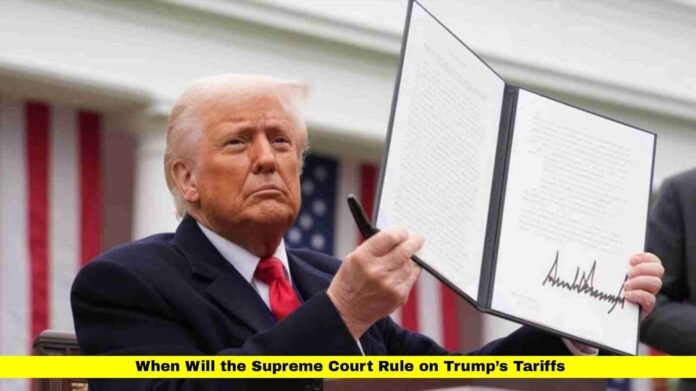

When will the Supreme Court rule on Trump’s tariffs? After hearing oral arguments in early November 2025, the nation now awaits one of the most consequential trade law decisions in years. Legal analysts expect the ruling by July 2026, marking the conclusion of the current Supreme Court term.
Current Status of the Case
The case focuses on tariffs imposed during Donald Trump’s presidency under the International Emergency Economic Powers Act (IEEPA). These tariffs, initiated in April 2025, were justified as an emergency measure to protect American industries. However, several trade groups and importers challenged their legality, arguing that the law does not grant the president unlimited power to alter trade duties without congressional approval.
On November 5, 2025, the Supreme Court heard oral arguments. Justices from both conservative and liberal wings questioned the extent of executive power under IEEPA, signaling skepticism about the administration’s sweeping interpretation. Legal experts believe this ruling could redefine how future presidents use emergency powers in trade and foreign policy.
Timeline of Events
The timeline of the case demonstrates how quickly it advanced through the federal court system after the controversial tariffs were imposed.
In April 2025, Donald Trump announced new tariffs on select imports, citing national security threats. Within a month, several business coalitions and trade organizations filed lawsuits challenging the move. By May 28, 2025, the U.S. Court of International Trade ruled that Trump exceeded his presidential authority. However, enforcement of the ruling was delayed pending appeal.
In August 2025, the U.S. Court of Appeals for the Federal Circuit upheld that finding in a close 7–4 decision. The Trump administration then urgently petitioned the Supreme Court in September 2025, arguing that the tariffs were critical to national security. The Supreme Court agreed to hear the case on an expedited basis, leading to the November oral arguments.
Given this timeline, a final ruling is expected by July 2026, aligning with the court’s regular term schedule.
Why July 2026 Is the Most Likely Ruling Date
The Supreme Court traditionally releases major decisions at the end of its term, which concludes in late June or early July each year. Because the Trump tariffs case involves intricate constitutional and economic questions, justices will require months to deliberate, draft opinions, and address dissenting views.
Legal analysts note that the complexity of this case—touching on the separation of powers, international trade policy, and emergency authority—makes a quick ruling unlikely. Additionally, Chief Justice John Roberts tends to time high-profile decisions near the end of term to allow maximum internal discussion and to maintain the appearance of judicial restraint.
Therefore, the July 2026 timeframe represents both tradition and practicality: it gives justices sufficient time for thorough review while meeting the court’s usual schedule for releasing major rulings.
What Factors Could Affect the Timing
While July 2026 is widely anticipated, certain developments could speed up or delay the decision. If the justices reach a strong majority opinion early, they could release a per curiam decision—a shorter, unified judgment—before the summer. However, if opinions are deeply divided or if the court opts to remand the case back to a lower court, the timeline could extend slightly.
Another potential factor is the economic and political sensitivity of the issue. The tariffs have direct implications for importers, manufacturers, and consumers. As the U.S. approaches another election season, the court may consider the broader impact of its timing, although historically, the judiciary strives to remain independent of electoral influence.
The Legal Question at the Heart of the Case
At its core, the Supreme Court must decide whether the International Emergency Economic Powers Act gives the president unilateral authority to impose tariffs in non-wartime conditions. Trump’s legal team argues that national economic threats qualify as emergencies under IEEPA, giving him full discretion to act. Opponents counter that tariff power lies exclusively with Congress, and the law was never meant to authorize large-scale trade actions.
This legal confrontation may become one of the most significant rulings on executive authority in decades. If the Court upholds the tariffs, future presidents could invoke emergency powers to reshape economic policy. Conversely, if the Court limits the scope of IEEPA, it could rein in presidential discretion and strengthen Congress’s control over trade.
Impact on U.S. Businesses and Global Trade
The outcome of the Supreme Court’s ruling will reverberate across global markets. Many American importers have already been paying higher duties since 2025, and a ruling invalidating the tariffs could lead to billions in refund claims. On the other hand, if the tariffs are upheld, industries that depend on imported materials may face continued cost pressures.
For global trade partners, the decision will signal whether the United States intends to preserve stability in trade law or expand executive power. Countries like China, Mexico, and Canada, all of which are affected by the tariffs, are closely monitoring the case. The decision could shape future trade negotiations and influence global economic alliances.
Political Reactions and Public Response
The debate over Trump’s tariffs has reignited political divisions in Washington. Supporters claim that the tariffs protect American manufacturing and strengthen the economy, while critics warn that they undermine congressional authority and inflate consumer prices.
Lawmakers from both parties have filed amicus briefs urging the Court to clarify limits on presidential power. Meanwhile, trade associations, importers, and economists have issued public statements stressing the urgency of a clear and timely decision.
Public opinion remains split—some voters view the tariffs as necessary protection, while others see them as a destabilizing force in international trade.
Possible Outcomes and Their Implications
The Supreme Court could rule in several ways:
- Uphold the Tariffs in Full: This would grant presidents broader emergency powers in trade, setting a new precedent for executive authority.
- Strike Down the Tariffs Entirely: This would reaffirm Congress’s exclusive control over tariff policy and could trigger significant financial adjustments.
- Issue a Limited Ruling: The Court may uphold tariffs under narrow conditions but require future actions to meet stricter standards.
Each outcome carries profound implications for future administrations, business operations, and the balance of power between government branches.
What Businesses Should Do Until the Ruling
Companies affected by the tariffs are advised to maintain legal compliance while preparing for both outcomes. Many importers have set aside financial reserves in case refunds become available. Others are diversifying supply chains or renegotiating contracts to mitigate ongoing tariff exposure.
Trade lawyers recommend monitoring court dockets and preparing documentation for potential refund claims should the tariffs be invalidated. Meanwhile, exporters and logistics firms are revising 2026 projections in anticipation of market shifts once the ruling arrives.
Final Thoughts
So, when will the Supreme Court rule on Trump’s tariffs? All signs point to July 2026 as the decisive moment. Until then, the case remains one of the most watched in the nation, shaping conversations on economic power, presidential authority, and global commerce.
The outcome will define not only Trump’s trade legacy but also the boundaries of presidential power for years to come. As businesses and policymakers await the decision, one thing is certain—the ruling will leave a lasting imprint on American law and the world economy.
Stay tuned for updates, and share your thoughts in the comments about how this case could affect the future of trade and governance.