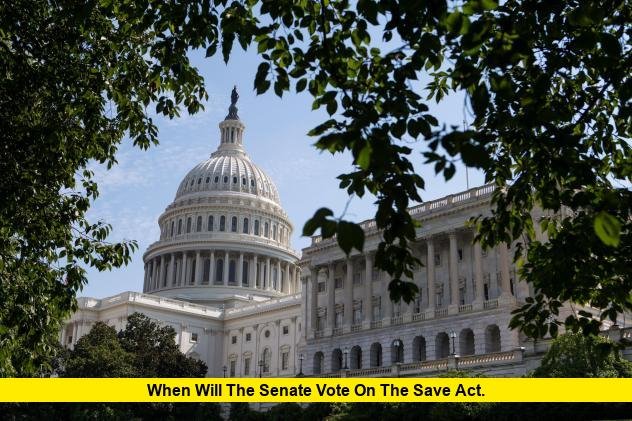

The U.S. Capitol is facing a major legislative showdown as lawmakers move toward deciding when will the Senate vote on the SAVE Act and its revised version, the SAVE America Act, after a narrow House passage. The issue has become one of the most contentious election policy debates in Washington this year, placing the future of federal voting rules at the center of national attention.
Breaking down what’s happening now
This year’s legislative session has seen renewed energy around what was originally known as the Safeguard American Voter Eligibility Act, or SAVE Act. The bill, aimed at imposing new election-related requirements, passed the U.S. House of Representatives amid sharp partisan divisions and now sits with the Senate as lawmakers weigh next steps. The Senate has not yet set a firm timeline for a vote on the measure, leaving advocates, opponents, and political analysts watching closely.
Stay tuned as developments unfold and the Senate prepares for one of the biggest debates on election policy in recent years.
What the SAVE Act and SAVE America Act Are
The SAVE Act, short for the Safeguard American Voter Eligibility Act, was introduced in the 119th Congress as legislation that would require documentary proof of U.S. citizenship to register to vote in federal elections. Although U.S. voter registration already requires affirmations of citizenship, the bill would impose specific documentation rules, such as valid passports or birth certificates, to qualify. In its original form, the House passed the SAVE Act in April 2025, but it stalled and did not receive action in the Senate at that time.
In early 2026, House Republican and Senate sponsors introduced a revised version called the SAVE America Act. This newer bill builds on the original proposals and adds further voter verification and identification requirements. It also includes nationwide photo ID rules, restrictions on mail-in voting procedures, and directives for frequent voter roll maintenance. This revised measure passed the House on February 11, 2026, with a 218–213 vote split primarily along party lines.
Why the Senate Vote Timing Matters
After the House approved this sweeping election rule overhaul, all attention turned to the U.S. Senate, which must consider whether and when to take up the legislation.
Unlike the House, the Senate operates under rules that allow extended debate and require 60 votes to overcome a filibuster and move most legislation to a final vote. Republicans hold a narrow majority in the Senate, but falling short of 60 votes means they would need bipartisan support to advance the bill. Current Senate leadership has not announced a specific date for bringing the SAVE Act or SAVE America Act to the floor, and procedural barriers make a vote uncertain at best.
Senate Majority Leader and committee chairs play key roles in deciding when legislation reaches the floor. As of now, they have not committed to a vote schedule, and Senate aides suggest the decision may hinge on whether there is enough support to advance the bill beyond procedural hurdles. Observers note that without significant Democratic backing, the legislation may languish in committee or be subject to prolonged debate that prevents a floor vote.
What the House Passed and What the Senate Faces
● The House’s Narrow Passage
On February 11, 2026, the U.S. House of Representatives passed the SAVE America Act following a politically charged debate. The bill passed 218–213, largely along party lines, with one Democrat supporting the measure. The legislation mandates documentary proof of citizenship to register to vote, expands photo ID requirements, and includes other election rule changes.
House Republicans argued the bill protects election integrity, while Democrats countered that it could suppress voter turnout and impose unnecessary barriers on eligible voters. Critics say the provisions could disproportionately affect communities with limited access to documentation or transportation.
● Senate’s Uncertain Path
Once legislation is sent to the Senate, it typically goes to committee for hearings and markup before any floor action. While the Senate has the authority to bring the bill up for debate, there is no official schedule for a vote. Senate leaders often balance competing priorities, and high-stakes measures like this can take weeks or months before they reach a final vote—if at all.
Some senators have indicated skepticism about whether the bill can secure the 60-vote threshold needed to proceed. Without bipartisan support, the Senate may stall the bill or modify its text before action. There have been discussions about potential amendments to soften certain requirements or address concerns about voter access, but no formal action has yet occurred.
Political Stakes Around the SAVE Act Vote
Partisan Divide and Public Reaction
The SAVE Act and SAVE America Act have sharply divided lawmakers and the public. Republicans view strengthened voter documentation and ID rules as necessary to bolster public confidence in election outcomes. Democrats and voting rights advocates argue that these changes would restrict access to the polls and create new bureaucratic hurdles for eligible voters, particularly in low-income or rural communities.
Voting rights groups have mobilized opposition, framing the legislation as unnecessary and harmful. They point out that current federal laws already bar non-citizens from registering and voting, and adding documentary proof requirements could complicate existing processes without clear evidence of widespread fraud.
What Comes Next in the Senate
At this stage, there are several potential outcomes:
- Senate sets a timeline for debate and a procedural vote on whether to advance the bill.
- Senate committees hold hearings to examine provisions and allow expert testimony.
- Senators offer amendments that could change the bill’s language or scope before consideration.
- The bill fails to overcome a filibuster, meaning it doesn’t reach a final vote.
Senate leaders must gauge support from their own caucus and possibly some opposition lawmakers to secure the votes needed for procedural advancement. If sufficient support does not materialize, the bill may stall indefinitely.
Impacts of a Senate Vote Delay
A delayed vote impacts not only legislative strategy but also public perception. Stakes are high as midterm elections are approaching, and changes to federal voter registration and voting rules could alter how millions of Americans participate in elections. Lawmakers in both parties are keenly aware that how they handle the SAVE Act may resonate with voters nationwide.
Despite the uncertainty around a Senate vote date, members of Congress continue to engage in discussions, negotiations, and public messaging about the bill’s implications. All eyes now shift to the Senate floor and leadership decisions on when, or whether, the chamber will put the measure up for a vote.
Let us know how you think the Senate should handle this legislation and what timing makes sense in the comments below.