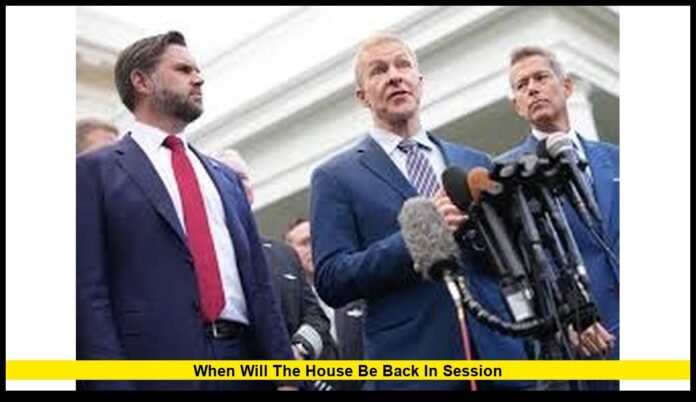

The question on many Americans’ minds right now is simple but pressing: when will the House be back in session? As the United States House of Representatives remains adjourned amid a prolonged federal funding standoff, the uncertainty has fueled growing frustration in Washington and across the country.
The chamber has been out of session for several weeks, with lawmakers still waiting for official word from leadership on when they’ll be called back to Washington, D.C. The decision largely hinges on progress—or lack thereof—in negotiations over the ongoing government shutdown.
Where Things Stand Now
As of November 2025, the House has no active floor sessions scheduled. Speaker Mike Johnson has yet to set a firm return date, emphasizing that the chamber will reconvene only after the Senate takes concrete action on government funding.
The House recessed before the start of the new fiscal year, and since then, members have been away from the Capitol while the federal government remains in partial shutdown. Normally, the House would hold multiple legislative days each week, but its floor calendar has remained empty since early October.
This extended pause has raised concern not just among lawmakers but also among citizens who depend on federal services now hindered by the funding lapse.
Why the House Hasn’t Returned Yet
The question of when will the House be back in session is directly tied to political strategy and negotiations between the two chambers of Congress.
1. The Ongoing Government Shutdown
The federal government entered a shutdown at the start of October after Congress failed to approve new spending bills or a short-term funding extension. With appropriations bills stalled, federal agencies began limiting operations and furloughing employees.
2. House vs. Senate Disagreement
The House passed its version of a temporary spending measure, but the Senate declined to advance it. The two chambers remain divided on funding priorities, including budget levels, health care subsidies, and domestic spending cuts.
3. Political Calculations by Leadership
Speaker Mike Johnson has made clear that the House will not return until the Senate takes action. This strategy is meant to apply pressure on the upper chamber, but it has also kept the House inactive for weeks.
4. Internal Party Divisions
Even within the House, members are split. Some Republicans support Johnson’s decision to hold out, while others have voiced frustration over the extended absence and the public perception that the House is “not working.” Democrats, meanwhile, have pushed for an immediate return to session to vote on a bipartisan solution.
The Official Calendar Situation
The official 2025 House calendar originally showed multiple working sessions for November and December, with only a short recess scheduled around Thanksgiving. However, those plans were disrupted once the government shutdown began.
At this point, no updated schedule has been released. The most recent notice from leadership indicates that members remain “on standby” and could be called back to Washington with as little as 24 hours’ notice if a funding deal emerges in the Senate.
This approach allows flexibility but also leaves staff, committees, and constituents in limbo. Most committee work has been suspended, and legislative aides have limited capacity to plan hearings or markups without a clear session date.
Possible Scenarios for the House’s Return
While no official announcement has been made, several possible scenarios could determine when the House will be back in session:
- Immediate Return After Senate Action
If the Senate passes a bipartisan funding measure in the coming days, the House could be called back within 48 hours for a vote. - Return After Thanksgiving
If negotiations stretch further, the next likely window would be after the Thanksgiving recess—potentially the final week of November. - December Return
If talks stall completely, the House might delay reconvening until December, when year-end deadlines force lawmakers to act on a short-term or long-term funding bill.
Each scenario carries its own political and logistical implications. A sooner return would allow faster resolution of the shutdown, while further delays would deepen its impact on federal operations.
Consequences of Staying Out of Session
The absence of the House from Washington affects not only political optics but also everyday life for millions of Americans.
Government Services at Risk
With no new funding bills passed, federal agencies are operating under limited budgets. Many workers remain furloughed, and essential services are stretched thin.
Stalled Legislation
Key bills on defense spending, healthcare funding, and disaster relief are all waiting for House consideration. The longer the chamber stays out, the larger the backlog grows.
Constituent Representation
Lawmakers who were recently elected but not yet sworn in cannot assume their roles until the House is back in session. This means some districts temporarily lack active representation in Congress.
Political Fallout
Public perception of an inactive Congress can have real consequences. Many Americans view the continued adjournment as a failure of leadership and cooperation, adding to voter frustration ahead of future elections.
How the Senate Influences the Timeline
The Senate’s actions—or inaction—are the main determining factor for when the House will be back in session. The upper chamber is currently working on its own spending package. If it passes and leadership signals bipartisan agreement, the House will be compelled to return quickly to approve or amend the measure.
However, if the Senate remains gridlocked, the House leadership may continue its holdout strategy, keeping members away until a clear path forward emerges.
This dynamic underscores how deeply intertwined the two chambers are when it comes to fiscal legislation. Neither can operate effectively without the other, yet political divisions have pushed both into a state of stalemate.
Reactions from Lawmakers and the Public
Across party lines, frustration is mounting. Some members of Congress have voiced concern that staying out of session during a shutdown damages public trust. They argue that the House should reconvene—even symbolically—to show commitment to resolving the crisis.
Public sentiment mirrors this frustration. Polls suggest that Americans overwhelmingly want both chambers to return to Washington and work together to reopen the government.
Local communities are also feeling the impact. Federal programs that support infrastructure, education, and food assistance are under strain, and uncertainty about future funding makes planning difficult for states and municipalities.
What to Expect in the Coming Days
Here’s what could happen next regarding when the House will be back in session:
- If the Senate reaches a deal, expect Speaker Johnson to announce a swift return date, possibly within two days.
- If negotiations continue past mid-November, the earliest realistic return could be late in the month.
- If talks collapse, the chamber may remain recessed into December, increasing the risk of deeper economic and administrative disruptions.
Even when lawmakers do return, significant challenges await. They will need to pass a continuing resolution or a full-year appropriations package, resolve disputes over domestic and defense spending, and restore confidence among the American public.
Looking Ahead
The ongoing uncertainty around when the House will be back in session highlights the growing challenges of governance in an era of divided politics. While the official answer remains unknown, the consequences of inaction are increasingly clear.
If leadership acts swiftly and both chambers cooperate, the House could be back within weeks. If not, the delay may extend into the holiday season—further complicating the government’s ability to function smoothly.
Either way, the situation is being closely watched not just by political observers but by citizens whose livelihoods depend on timely legislative decisions.
In summary, the question “when will the House be back in session” remains unresolved—but momentum may soon shift. The House stands ready to return once the Senate finalizes a path forward. Until then, Americans wait for Congress to do what they were elected to do: work.
Stay informed, share your views below, and follow developments as the House’s return date takes shape in the days ahead.