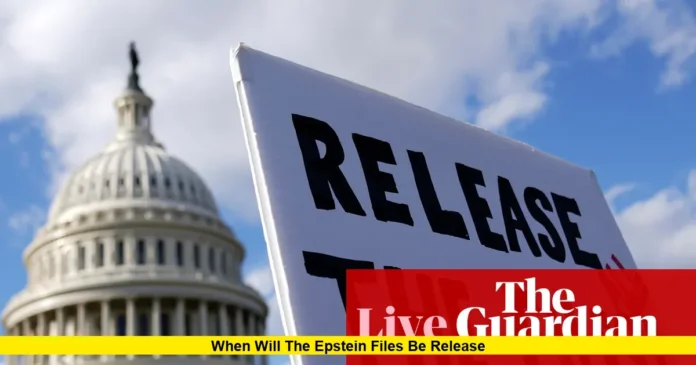

The question when will the Epstein files be released has gained renewed national attention after Congress advanced legislation mandating public disclosure of Justice Department records connected to Jeffrey Epstein. The timeline is now clearer than at any point in recent years, and the legal pathway for release is firmly in motion. This article examines the exact current status, what remains pending, and what Americans should expect once the release window officially begins.
A Clearer Timeline Emerges
After years of intense public pressure, Congress approved a bill requiring the release of Epstein-related records held by the Department of Justice. Both chambers passed the legislation on the same day in November 2025, marking a sharp shift in transparency efforts. The measure now sits on the president’s desk, where a signature would trigger the release window.
Once the bill becomes law, the Justice Department will have a fixed, legally mandated period—approximately 30 days—to make the records publicly accessible. This timeframe represents the first definitive answer to long-standing questions about disclosure. Until the presidential signature occurs, however, the countdown has not formally begun.
Americans following the process closely now have a clear understanding of what must happen next, and each step in the timeline is a matter of public record.
What Exactly Will Be Released?
The legislation requires the release of federal investigative materials related to Epstein. These records include documents, communications, and other materials tied to various phases of the federal investigations.
The files will be released in a structured, searchable format, ensuring accessibility for both experts and everyday readers. While the public will gain significant visibility into the case, some redactions are authorized. These include:
- Information that reveals the identity of victims
- Sensitive details tied to active investigations
- National-security-related content
- Other protected categories defined under federal law
The intention is to strike a balance between transparency and privacy, especially for individuals who were harmed by Epstein and continue to seek anonymity.
Why the Release Timeline Matters
For years, the case has been surrounded by speculation, confusion, and frustration. Calls for disclosure have come from across the political spectrum, from survivors, and from a wide range of advocacy groups who argue that transparency is essential.
A confirmed release timeline matters for several reasons:
1. Public Trust in Institutions
A predictable, legally enforced timeline ensures that federal agencies follow a clear path toward disclosure, strengthening public confidence.
2. Accountability
The release will allow journalists, researchers, and legal experts to analyze previously unseen information and evaluate how the investigation was handled.
3. Closure for Survivors
Many survivors have called for a full accounting of the facts. While the files cannot erase trauma, access to the truth provides validation and helps prevent future institutional failures.
4. Historical Record
The case is one of the most widely discussed federal investigations of the century. Public access ensures the historical narrative is grounded in documented evidence, not speculation.
Current Stage of the Release Process
The current status is straightforward:
Congress has passed the legislation, and the president is expected to sign it. Once the signature is recorded, the 30-day release period formally begins.
The steps that have already occurred include:
- The bill passed the House with overwhelming bipartisan support.
- Hours later, the Senate approved the same version of the bill without amendment.
- The legislation was delivered to the White House for final approval.
This rapid sequence marked a major turning point in the longstanding debate over whether the files would ever be fully released.
What Happens Immediately After the Signature
Once the president signs the bill, the Department of Justice must begin preparing the files for public release. This includes:
- Organizing and formatting documents
- Applying legally required redactions
- Preparing a public-facing digital archive
- Ensuring accessibility for broad readership
- Confirming that no protected or active-investigation content is improperly disclosed
The process will be strictly time-bound, meaning the agency cannot delay beyond the statutory window. A large portion of the work has already been underway for months through internal reviews, which may speed up the process once the law takes effect.
Why the Timeline Has Shifted Now
Several factors created momentum for the bill’s passage:
Growing Bipartisan Agreement
Members of both parties voiced support, citing the need for openness and clarity.
Public Pressure
Demand for transparency surged in recent years, driven by new public statements from survivors and attention in national media.
Institutional Readiness
Federal agencies have already cataloged and reviewed large portions of the relevant documents, making release administratively feasible.
Leadership Signals
Key leaders in Congress pushed the bill forward quickly, emphasizing public interest and the need to restore trust in investigative institutions.
These forces converged to finally overcome the legislative inertia that had blocked earlier efforts.
How Much Will the Public Actually See?
While the release will be substantial, some parts of the files will remain shielded. The public should expect a mix of fully open documents and others that contain carefully placed redactions. The overall volume of material will still be large, likely spanning thousands of pages.
What remains redacted will fall under legal exceptions, but the majority of the records will be accessible. Names may be withheld when linked to uncharged misconduct or protected status, but structural information about the investigations will be available.
In short, the public will receive a comprehensive window into the case, though not every detail will be visible.
Understanding the Importance of Format and Accessibility
One notable requirement is that the files must be provided in an easily navigable format. This ensures readers are not left sifting through poorly organized scans or technical obstacles.
The final archive will likely include:
- Organized document sets
- Searchable text
- Indexing for major categories
- Clear grouping based on investigative stages
This format allows researchers and journalists to conduct efficient analysis and gives everyday readers the chance to explore the material without technical barriers.
What Americans Should Expect Over the Next Several Weeks
While the exact date of the presidential signature has not been publicly finalized, the timeline is straightforward once it occurs. The coming weeks will include:
- Announcement of the bill’s signing
- Start of the mandatory release period
- Departmental preparation of files for publication
- Launch of the public archive
When the archive goes live, there will likely be widespread national coverage and high public traffic as readers examine the newly released material.
The question when will the Epstein files be released now has a structured legal answer rather than an open-ended one. That marks a major shift from the uncertainty that has defined this issue for years.
Implications of the Upcoming Release
The release will likely spark renewed discussion about the broader scope of the case. Public attention may shift toward:
- Examination of investigative decisions
- Analysis of individual communications
- Review of institutional responses
- Calls for further accountability
The disclosure does not necessarily imply future criminal charges, but it does provide the groundwork for deeper public evaluation.
In Summary
A major turning point has arrived. Once the president signs the bill, the release timeline begins, and the Department of Justice must provide a public archive within about 30 days. The coming release will offer clarity to an issue steeped in speculation and will give Americans access to information that has remained behind closed doors for far too long.
As the final step approaches, this is the moment to stay tuned, watch the timeline closely, and share your thoughts as the release date draws near.