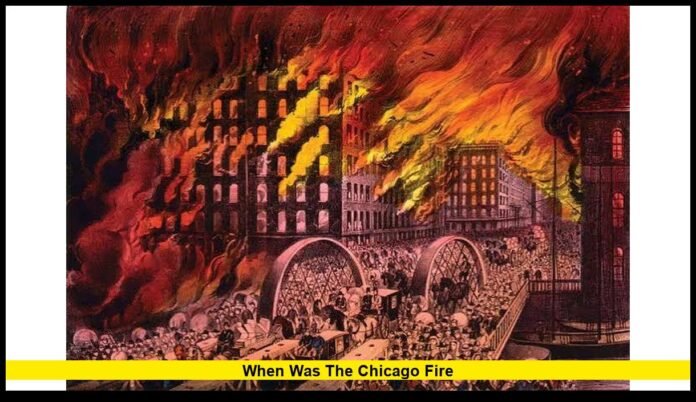

For readers asking when was the Chicago fire, the historic disaster began on the night of October 8, 1871, and continued until the early hours of October 10. What started as a fire on Chicago’s West Side developed into one of the most destructive urban disasters in 19th-century America, consuming thousands of buildings and forcing a huge portion of the city’s population from their homes.
More than 150 years later, the Great Chicago Fire remains a defining chapter in the city’s history. Its destruction was extraordinary, but so was Chicago’s recovery. The rebuilding that followed helped reshape the city’s architecture, business districts and approach to urban development.
A City on the Brink
Chicago in 1871 was a rapidly expanding American city with a population approaching 300,000. Railroads, shipping and commerce had helped turn it into an important economic center, attracting workers, families and businesses from across the country and overseas.
Rapid growth came with serious vulnerabilities.
Much of the city contained wooden houses, businesses, sidewalks and other structures. Dry weather had left combustible materials dangerously vulnerable, while strong winds could carry flames and burning debris over considerable distances.
Fire protection technology was also limited compared with today’s standards.
That combination created the conditions for a catastrophe when flames appeared on October 8.
The Night the Fire Began
The blaze was reported in the vicinity of the O’Leary family’s property on DeKoven Street at approximately 8:30 p.m.
Firefighters moved toward the area, but the fire quickly became difficult to contain. The flames were strengthened by wind and surrounded by structures capable of burning rapidly.
As the fire intensified, it moved northeast toward the heart of Chicago.
The direction of the wind proved critical. Instead of remaining confined to one neighborhood, the fire advanced through increasingly populated sections of the city.
By the following day, large portions of Chicago were engulfed.
Why the Flames Became So Destructive
The scale of the disaster cannot be explained by the initial fire alone.
Chicago’s physical environment effectively provided fuel for the advancing flames. Wooden buildings stood close together, while wooden streets, sidewalks and fences added to the amount of combustible material.
The city’s prolonged dry spell made conditions even more dangerous.
Strong winds then pushed the fire toward the central sections of Chicago. Burning embers could travel ahead of the main flames and ignite structures that appeared to be separated from the fire.
The result was a rapidly expanding wall of destruction.
The Famous O’Leary Cow Story
Few stories associated with an American disaster are as recognizable as the tale of the O’Leary family’s cow.
According to the legend, the animal knocked over a lantern in a barn, starting the blaze. The story spread quickly and Catherine O’Leary became associated with the disaster.
There is no conclusive evidence that a cow caused the fire.
The exact origin of the blaze remains uncertain. The enduring story became part of popular culture, but historians have never established it as a fact.
The O’Leary family consequently carried an enormous amount of public blame for an event whose precise cause was never proven.
Chicago Burns for More Than a Day
The disaster continued through October 9.
The flames moved through residential neighborhoods and commercial areas, destroying homes, businesses, hotels and public buildings. Some of Chicago’s most important structures were lost.
Residents rushed away from advancing flames. Many headed toward Lake Michigan or areas that appeared less threatened.
By the time the fire began losing its strength, an enormous portion of the city had been devastated.
Rain and changing weather conditions helped firefighters gain control during the early hours of October 10.
The Great Chicago Fire had lasted roughly 36 hours.
The Human Cost
The physical destruction was staggering, but the effect on residents was even more significant.
At least 300 people are estimated to have died. The exact total remains uncertain because records from the disaster were incomplete.
Around 100,000 people were left homeless.
For thousands of families, the fire meant losing homes, possessions, workplaces and sources of income within a matter of hours.
Emergency assistance became an immediate priority. Food, clothing, shelter and other supplies were needed as Chicago began dealing with the enormous number of displaced residents.
Thousands of Buildings Disappear
The fire destroyed approximately 17,500 to more than 18,000 structures, depending on the historical estimate used.
The burned district covered more than three square miles and included large sections of the city’s business and residential areas.
The damage extended across neighborhoods on the South Side, West Side and North Side.
Chicago’s skyline and streetscape were transformed almost overnight.
Yet the city’s transportation infrastructure and surrounding areas provided a foundation from which economic activity could resume.
Chicago Chooses to Rebuild
The most remarkable chapter began after the flames disappeared.
Chicago did not remain a city of ruins. Reconstruction started rapidly, supported by financial assistance, donations and investment.
Businesses reopened. Temporary structures appeared. New buildings began rising across the damaged districts.
The rebuilding effort also created an opportunity to reconsider how Chicago should be constructed.
Fire-resistant materials received greater attention, while architects and engineers explored new methods of designing large urban buildings.
The disaster therefore became a turning point rather than the end of Chicago’s growth.
The Road Toward the Modern Skyline
Chicago’s rebuilding helped establish an environment in which architectural experimentation could flourish.
During the decades that followed, architects increasingly used steel and other innovative construction techniques. Taller buildings became possible, eventually producing the skyscraper form that would become closely associated with Chicago.
The Home Insurance Building, completed in 1885, is widely regarded as an important milestone in the development of modern skyscraper construction.
Chicago’s architectural transformation was not caused by the fire alone, but the destruction created a unique opportunity to rebuild large sections of the city with new ideas and technologies.
A Disaster That Changed Urban Planning
The Great Chicago Fire also demonstrated the consequences of inadequate fire protection in a rapidly growing city.
Building practices became an important part of the discussion surrounding reconstruction. Fire-resistant construction became increasingly desirable, particularly in areas where dense development created serious risks.
The disaster helped reinforce the importance of stronger infrastructure, improved firefighting capabilities and better approaches to urban planning.
For American cities experiencing rapid population growth, Chicago became an important example of how devastating urban fires could be—and how rebuilding could be used to create safer environments.
The Fire’s Place in American History
The Chicago disaster occurred during a period when several major fires struck parts of the Midwest. On the same date, the devastating Peshtigo Fire swept through Wisconsin and killed far more people.
Yet Chicago’s fire received enormous national attention because of the city’s growing importance and the extraordinary scale of its destruction.
The event became a major subject of newspaper coverage, illustrations and public discussion.
Its legacy eventually extended beyond the immediate disaster, influencing the way people thought about construction, insurance, municipal services and the future of American cities.
Why the Great Chicago Fire Still Matters
The answer to when was the Chicago fire is simple—October 8 to October 10, 1871—but understanding its significance requires looking beyond those dates.
The fire destroyed a huge portion of a young and rapidly growing city. Hundreds died, approximately 100,000 people lost their homes and thousands of buildings disappeared.
Yet Chicago emerged from the disaster with renewed momentum.
Reconstruction attracted investment and encouraged architectural innovation. Over time, the city became one of America’s most important commercial and architectural centers.
The Great Chicago Fire therefore stands as both a story of destruction and a story of transformation. Its flames reshaped Chicago physically, while the rebuilding effort helped establish the foundations of the modern city.
More than a century and a half later, the event remains a powerful reminder that major disasters can permanently alter the direction of a city—and that recovery can become part of its identity.