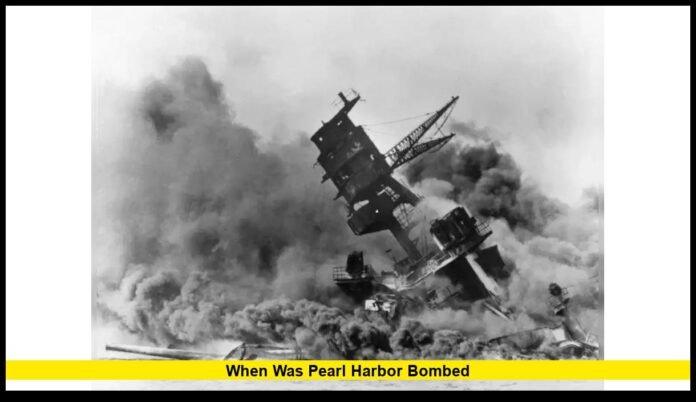

When was Pearl Harbor bombed? The devastating attack occurred on December 7, 1941, when Japan launched a surprise military strike against the United States naval base at Pearl Harbor, Hawaii. That Sunday morning forever changed the course of American history, marking the country’s entry into World War II.
As the nation observes the 84th anniversary in 2025, Pearl Harbor remains a symbol of sacrifice, resilience, and unity — a day that continues to be remembered across generations.
The Date That Lives in Infamy
On December 7, 1941, at approximately 7:55 a.m. local time, waves of Japanese aircraft attacked the U.S. Pacific Fleet anchored at Pearl Harbor. Within less than two hours, the surprise strike caused massive destruction, sinking or damaging nearly 20 American naval vessels and destroying more than 180 aircraft.
The attack killed 2,403 Americans, including sailors, soldiers, and civilians. Another 1,178 were wounded. The losses were staggering, both in human lives and in military power.
The following day, President Franklin D. Roosevelt addressed the nation, calling December 7 “a date which will live in infamy.” His speech marked the beginning of America’s full-scale involvement in World War II, as Congress declared war on Japan within 24 hours.
Why Japan Bombed Pearl Harbor
The attack was part of Japan’s broader plan to expand its control across the Pacific. At the time, tensions between the U.S. and Japan had escalated due to Japan’s military aggression in Asia and the Pacific.
By late 1941, the U.S. had imposed economic sanctions and trade restrictions on Japan, including an embargo on oil exports — a crucial resource for Japan’s war efforts. In response, Japanese leaders decided to strike preemptively, hoping to cripple the U.S. Pacific Fleet and delay American intervention as they expanded across Southeast Asia.
The attack on Pearl Harbor was meant to be a decisive blow. Instead, it unified the United States and galvanized the nation for war.
Details of the Attack
The assault on Pearl Harbor unfolded in two waves:
- First Wave (7:55 a.m.) – Japanese bombers and torpedo planes targeted battleships moored along “Battleship Row.” The USS Arizona, USS Oklahoma, and USS West Virginia were among the hardest hit. The Arizona exploded after a bomb ignited its ammunition magazine, killing more than 1,100 crew members instantly.
- Second Wave (8:45 a.m.) – A second group of planes attacked airfields and remaining ships. Despite intense anti-aircraft fire, the attackers inflicted significant damage before retreating.
In total, eight U.S. battleships were hit, with four sunk and the others heavily damaged. While several ships were later repaired and returned to service, the destruction initially appeared catastrophic.
However, key U.S. assets — including aircraft carriers — were not in port that day, allowing the Navy to recover faster than Japan expected.
Immediate Aftermath
In the hours after the bombing, confusion and chaos swept through Hawaii. Medical teams rushed to treat thousands of wounded personnel, and emergency crews worked to contain fires and rescue survivors trapped below decks.
Across the mainland, the news spread rapidly by radio. Americans reacted with shock, anger, and a renewed sense of unity. Recruitment centers saw long lines of young men volunteering for service, determined to defend their country.
By December 8, 1941, the United States had officially entered World War II. Within days, Germany and Italy declared war on America, expanding the global conflict.
Key Facts About the Pearl Harbor Attack
| Detail | Information |
|---|---|
| Date of Attack | December 7, 1941 |
| Time | Began at 7:55 a.m. (Hawaii Standard Time) |
| Location | Pearl Harbor, near Honolulu, Hawaii |
| Casualties | 2,403 Americans killed, 1,178 wounded |
| Ships Damaged or Sunk | 21 naval vessels (including 8 battleships) |
| Aircraft Destroyed | 188 |
| Japanese Aircraft Used | 353 planes launched from 6 aircraft carriers |
| Duration | Approximately 1 hour and 15 minutes |
The USS Arizona: A Symbol of Sacrifice
The USS Arizona remains the most enduring symbol of the attack. The explosion that sank the ship claimed the lives of 1,177 crew members — more than half of all Americans killed that day.
Today, the USS Arizona Memorial stands above the sunken ship in Pearl Harbor as a solemn tribute. Visitors can still see oil droplets — often called “the black tears of the Arizona” — slowly rising to the surface from the wreckage below.
Every year, thousands of people visit the memorial to pay their respects to those who lost their lives.
Pearl Harbor’s Role in World War II
The bombing of Pearl Harbor transformed the United States from a neutral nation into a global power actively engaged in the war. In the months following the attack:
- The U.S. mobilized its industrial capacity to build ships, aircraft, and weapons on an unprecedented scale.
- Millions of Americans joined the armed forces, including many who served in the Pacific Theater.
- The country united behind a common purpose — defeating the Axis powers and securing peace.
By 1945, the U.S. Navy had rebuilt its Pacific fleet and played a decisive role in ending the war with Japan, culminating in Japan’s surrender after the atomic bombings of Hiroshima and Nagasaki.
Commemorating Pearl Harbor Today
Eighty-four years later, December 7 remains a day of reflection and remembrance. Each year, the National Park Service and the U.S. Navy hold memorial ceremonies at the Pearl Harbor National Memorial in Hawaii.
Survivors, veterans, and families gather to honor those who served and sacrificed. The ceremony typically includes a moment of silence at 7:55 a.m., marking the exact moment the attack began.
In 2025, special commemorations include educational programs for younger generations, ensuring that the lessons of Pearl Harbor continue to be shared. Digital exhibits and interactive tours now allow Americans across the country to experience the history virtually.
Lessons From Pearl Harbor
Pearl Harbor remains a defining event in American history. It taught the nation the value of vigilance, preparedness, and unity in the face of adversity.
For many, the anniversary is not only a reminder of loss but also a testament to resilience. The U.S. emerged from the tragedy stronger, more united, and determined to protect freedom around the world.
The attack also marked the beginning of America’s transformation into a global leader — both militarily and economically — shaping the world we know today.
Conclusion
So, when was Pearl Harbor bombed? The attack took place on December 7, 1941, a Sunday morning that forever changed the course of history. Eighty-four years later, the nation continues to honor the heroes who served, the lives lost, and the enduring spirit of those who rebuilt a nation from tragedy.
How do you honor the memory of Pearl Harbor today? Share your thoughts in the comments below.