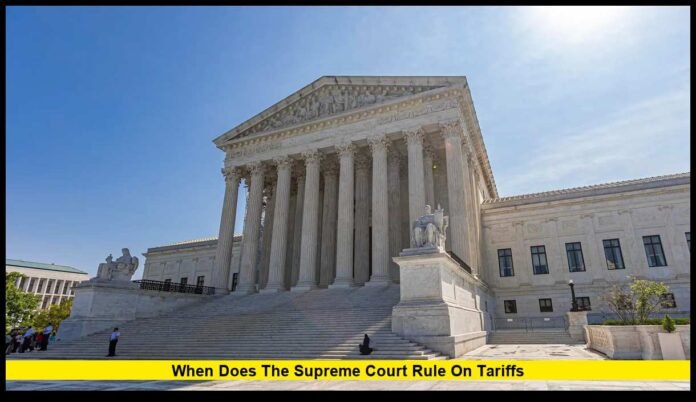

Decisions are expected by June 2026
If you’re asking when does the Supreme Court rule on tariffs, you’re not alone. As trade tensions continue to affect global markets, the U.S. Supreme Court is reviewing several major tariff-related cases that could redefine presidential power and reshape U.S. trade policy. These cases, scheduled for decision during the 2025–2026 term, have broad implications for industries, consumers, and America’s relationships with its trading partners.
As of November 2025, the Court has heard oral arguments but has not yet issued rulings. Final decisions are expected by June 2026, which aligns with the Court’s traditional schedule for releasing opinions before its summer recess.
Here’s a detailed look at the current status of these cases, the laws being challenged, and what could happen when the Supreme Court rules on tariffs in the months ahead.
Why the Supreme Court Is Reviewing Tariffs in 2025
To understand the current debate, it’s important to know why the Supreme Court of the United States is addressing tariffs again in 2025. The issue centers on the president’s power to impose trade restrictions without explicit congressional approval, particularly under two key laws:
Section 232 of the Trade Expansion Act of 1962 allows the president to impose tariffs if imports are determined to threaten national security. This authority was used extensively during the administration of Donald Trump, particularly on steel and aluminum imports, and later adjusted or maintained under Joe Biden.
Section 301 of the Trade Act of 1974 permits the president to impose tariffs or other trade measures to counteract unfair foreign trade practices. This provision became central to the U.S.–China trade dispute and remains an active tool of trade enforcement.
In addition, recent litigation has focused on tariffs imposed under the International Emergency Economic Powers Act (IEEPA), a statute that grants the president authority to regulate economic transactions during declared national emergencies. In 2025, the Court agreed to hear cases including Learning Resources v. Trump, which question whether IEEPA actually authorizes broad tariff powers and whether such delegation violates constitutional limits.
These authorities have been relied upon not only by Presidents Trump and Biden, but also by Kamala Harris in continuing executive trade enforcement strategies. Critics argue that the cumulative use of these statutes has shifted too much tariff-setting power to the executive branch, potentially bypassing Congress’s constitutional role under Article I to regulate commerce and levy duties.
The Supreme Court’s review is therefore not simply about trade policy — it is about constitutional structure. The justices are examining whether Congress has provided an “intelligible principle” when delegating tariff authority and whether expansive interpretations of these statutes violate the nondelegation doctrine or separation-of-powers principles.
A ruling in 2026 could significantly redefine the limits of presidential trade authority and clarify how far future administrations can go in imposing tariffs without new legislation from Congress.
Key Cases Before the Supreme Court in 2025–Early 2026 (Updated Overview)
Several major cases concerning tariffs and executive trade powers have shaped the legal landscape heading into 2026. While not all earlier challenges were granted full Supreme Court review, ongoing litigation has continued to raise constitutional questions about presidential authority over trade.
1. American Institute for International Steel v. United States
- Originally challenged the legality of Section 232 steel tariffs imposed in 2018.
- Plaintiffs argued that Congress delegated excessive authority to the president without clear limits, violating the Constitution’s separation of powers.
- The Supreme Court of the United States declined to hear the case in 2020.
- As of February 2026, the Court has not overturned Section 232, but renewed legal debates in lower courts — combined with broader challenges to executive emergency powers — have revived constitutional scrutiny over how much discretion the president may exercise under national security justifications.
2. National Foreign Trade Council v. United States (Section 301 Litigation Context)
Although no Supreme Court ruling under this exact caption has redefined Section 301 authority as of early 2026, multiple lawsuits have challenged tariffs imposed under Section 301 of the Trade Act of 1974, particularly those targeting Chinese imports.
Key legal arguments include:
- Whether the U.S. Trade Representative exceeded statutory authority.
- Whether procedural requirements under the Administrative Procedure Act were properly followed.
- Whether tariff extensions were lawfully justified.
As of February 2026, Section 301 tariffs remain in effect, and courts have generally upheld broad executive discretion, though procedural compliance remains an active area of litigation.
3. Exemption and Exclusion Process Challenges (Section 232 Administration)
Various business groups and importers have brought cases challenging how exemptions under Section 232 of the Trade Expansion Act of 1962 were administered.
Claims have included:
- Inconsistent approval standards.
- Lack of transparency in exclusion decisions.
- Allegations that smaller manufacturers were disproportionately harmed.
While these disputes have generated significant lower-court activity, no sweeping Supreme Court decision as of February 2026 has invalidated the Section 232 framework itself. Instead, courts have focused more narrowly on administrative fairness and procedural consistency.
The Broader 2025–2026 Turning Point: IEEPA Litigation
The most consequential tariff-related case currently before the Supreme Court involves emergency powers under the International Emergency Economic Powers Act (IEEPA), including Learning Resources v. Trump.
Unlike earlier Section 232 and Section 301 challenges, this case directly questions whether IEEPA authorizes the president to impose broad tariffs at all — and whether such authority violates constitutional limits on delegated power.
As of February 2026:
- The Court has heard arguments.
- A decision is pending.
- The ruling could significantly clarify or limit presidential authority in trade emergencies.
Across all of these cases, the same fundamental issue remains: how much authority Congress can delegate to the president in shaping trade policy without violating the Constitution’s separation of powers.
When Will the Supreme Court Rule on Tariffs?
The U.S. Supreme Court’s 2025–2026 term began on October 7, 2025, and will continue through June 2026. Based on the Court’s historical schedule, decisions on tariff-related cases are expected between April and June 2026.
Here’s a projected timeline of events:
| Date | Event |
|---|---|
| October 2025 | Oral arguments begin for tariff-related cases. |
| December 2025 | Amicus briefs and rebuttals submitted. |
| January–March 2026 | Justices deliberate and circulate draft opinions. |
| April–May 2026 | Tentative internal votes and opinion drafting. |
| June 2026 | Final decisions released before summer recess. |
While the Court has not announced specific decision dates, trade experts predict that the rulings will likely arrive in late June 2026, among the final opinions of the term due to their complexity and broad economic implications.
Background: Decades of Legal Debate Over Tariffs
Tariffs have long been a politically charged issue in the United States. The Constitution grants Congress authority over taxes and trade, but over time, lawmakers have delegated certain powers to the executive branch to handle fast-moving international economic issues.
Historical milestones:
- 1934 Reciprocal Trade Agreements Act: Gave the president power to negotiate tariffs.
- 1962 Trade Expansion Act (Section 232): Allowed tariffs to protect national security.
- 1974 Trade Act (Section 301): Expanded executive tools to counter unfair trade practices.
In 1976, the Supreme Court upheld Section 232’s constitutionality in Federal Energy Administration v. Algonquin SNG, Inc., arguing that it included “intelligible principles” guiding the president’s discretion.
However, critics now argue that modern interpretations go far beyond the intent of that ruling, especially since recent presidents have used these powers to enact broad and long-lasting trade restrictions.
Economic Stakes of the Tariff Rulings
When the Supreme Court rules on tariffs, the decisions will affect more than legal precedent—they will directly influence consumer prices, business costs, and global trade flows.
If the Court upholds current laws:
- The president will retain broad authority to impose tariffs.
- Current tariffs on Chinese goods, steel, and aluminum will likely remain in place.
- Domestic producers may benefit from continued trade protection, but import-reliant industries could face higher costs.
If the Court limits or overturns presidential powers:
- Congress would regain greater control over tariff decisions.
- Many existing tariffs could be reviewed, reduced, or repealed.
- Prices for imported goods could drop, helping consumers but potentially hurting U.S. manufacturers.
Economists estimate that lifting or reducing tariffs could lower consumer inflation by up to 0.3% over the next year. However, they also warn that it could weaken domestic industry competitiveness in the short term.
Political and Business Reactions
The upcoming Supreme Court tariff rulings have drawn widespread attention from both political parties and major industries.
Democratic perspective:
Democrats largely support greater congressional oversight, arguing that unchecked executive power threatens balance in government and undermines trade stability. Several Democratic lawmakers have proposed legislation that would require congressional approval for new tariffs imposed under Section 232.
Republican perspective:
Many Republicans argue that the president should retain flexibility in responding quickly to foreign trade threats. They view tariff powers as an essential tool for protecting national interests and countering unfair trade practices by China and other nations.
Business community response:
Organizations like the U.S. Chamber of Commerce and National Foreign Trade Council have filed briefs urging the Supreme Court to limit executive power, citing unpredictability and long-term harm to global supply chains.
Meanwhile, domestic steel and aluminum producers support maintaining current tariffs, saying they protect American jobs and prevent market dumping by foreign competitors.
Recent Developments Leading to the 2025 Review
The road to the Supreme Court’s 2025 review of tariffs began nearly a decade ago.
Timeline Overview:
| Year | Event |
|---|---|
| 2018 | Trump administration imposes tariffs on steel, aluminum, and Chinese imports. |
| 2019–2020 | Businesses file lawsuits challenging constitutionality of Section 232 and Section 301 actions. |
| 2021 | Lower courts uphold most tariffs but question procedural fairness. |
| 2023 | Appeals courts issue conflicting opinions, prompting Supreme Court interest. |
| 2025 | Supreme Court consolidates multiple cases for review. |
| 2026 (Expected) | Court issues landmark ruling defining scope of presidential trade powers. |
These developments highlight how the intersection of trade law and executive authority has become one of the defining constitutional questions of the decade.
Possible Scenarios After the Rulings
Once the Supreme Court issues its decisions, several possible outcomes could unfold:
- Status Quo Maintained:
- The Court upholds current trade laws, affirming the president’s authority under Section 232 and 301.
- The White House continues using tariffs as a foreign policy tool.
- Partial Limitations:
- The Court narrows the interpretation of “national security” or “unfair practices,” requiring more oversight or justification.
- This would preserve executive power but add procedural guardrails.
- Major Constitutional Shift:
- The Court rules that these laws violate the nondelegation doctrine, forcing Congress to rewrite trade legislation.
- This could cause temporary uncertainty in markets but reestablish congressional control over trade policy.
Global Reactions to the Pending Decisions
Internationally, trading partners are watching closely.
- China hopes for a ruling that curtails U.S. tariff powers, which could lead to tariff rollbacks.
- European Union officials have expressed interest in renewed negotiations once U.S. trade law is clarified.
- Canada and Mexico, key U.S. partners under the USMCA, are monitoring potential effects on North American trade stability.
Global markets are likely to react strongly to the eventual ruling, with potential impacts on currency exchange rates, commodity prices, and manufacturing supply chains.
What Businesses Should Do Now
While awaiting the Supreme Court’s decision, businesses involved in international trade should:
- Review supply chains for tariff exposure and alternative sourcing options.
- Stay updated on pending legislation that could alter tariff laws after the Court’s decision.
- Plan financial contingencies for possible import cost changes or market volatility.
- Engage trade counsel to assess potential refund opportunities if tariffs are overturned.
Preparation and flexibility will be key in navigating the post-ruling environment, whatever the outcome.
The Bottom Line
For anyone asking when does the Supreme Court rule on tariffs, the answer is clear: decisions are expected by June 2026. These rulings will shape the balance of power between Congress and the president, redefine U.S. trade authority, and influence global markets for years to come.
Do you believe the Supreme Court should limit presidential powers over tariffs, or maintain flexibility in trade policy? Share your opinion in the comments below and stay informed as this historic ruling approaches.