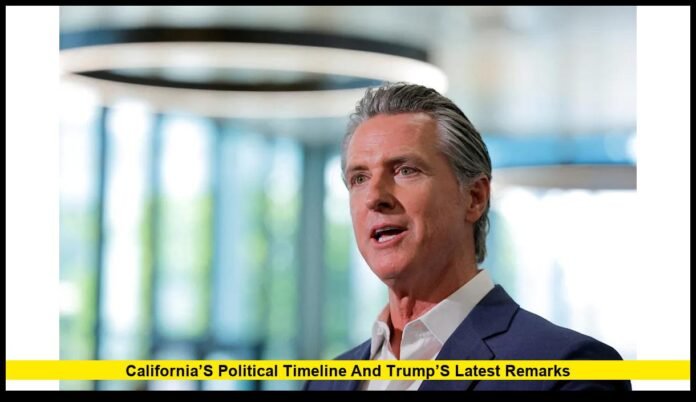

Many Americans are now asking, “When does Gavin Newsom term end?”
The answer is simple. Governor Gavin Newsom’s second term ends on January 4, 2027.
Until then, California’s politics will continue to shape national discussions and influence the future of both major parties.
However, while Newsom manages state challenges, a new controversy involving Donald Trump and Microsoft has added more heat to the political scene.
Trump recently demanded that Microsoft fire Lisa Monaco, the company’s President of Global Affairs, claiming political bias.
This unexpected comment again connects business, technology, and politics in America’s already tense climate.
Newsom’s Term Timeline and Role
Gavin Newsom began his first term as California governor in January 2019.
He won re-election in November 2022, starting his second term on January 2, 2023.
Therefore, under California’s constitution, his term will end in January 2027.
He is serving the maximum two consecutive terms allowed.
After that, California will elect a new leader, marking a fresh chapter for the state.
Until then, Newsom continues to focus on economic stability, housing, and environmental policies.
Moreover, he remains one of the most visible Democratic leaders in the nation.
Many analysts believe his decisions during this period could shape his political future beyond California.
Newsom’s Leadership: Achievements and Challenges
Governor Newsom often emphasizes innovation, equality, and sustainability.
He has championed clean energy, education funding, and homelessness prevention.
Furthermore, his government has invested billions to tackle climate change and expand renewable energy.
However, his leadership faces challenges.
California still struggles with high housing costs, homelessness, and urban crime rates.
Critics argue that the governor’s policies are not solving these issues quickly enough.
Even so, his supporters praise his bold vision.
They believe California remains a global model for progressive policy and climate leadership.
In addition, the governor continues to push for fair wages and expanded healthcare access.
According to a Public Policy Institute of California (PPIC) poll in October 2025,
53% of Californians approve of his job performance, while 42% disapprove.
These numbers show stable support, even amid political pressure.
Trump’s Remark About Microsoft and Lisa Monaco
Meanwhile, on the national stage, Donald Trump once again dominated headlines.
At a recent Florida rally, Trump urged Microsoft to fire Lisa Monaco, calling her “politically biased.”
Monaco, a former U.S. Deputy Attorney General, joined Microsoft earlier this year.
She now oversees global policy, cybersecurity, and regulatory relations.
Trump said her ties to the Department of Justice made her unfit for a corporate role.
However, Microsoft defended her appointment and praised her experience.
The company stated that Monaco’s leadership strengthens Microsoft’s international strategy.
This controversy reflects deeper political tensions.
In addition, it highlights how corporate leadership and political loyalty often clash in today’s America.
Newsom, who supports stronger regulation of tech companies, has not commented publicly on the issue.
Still, California’s tech-driven economy could feel ripple effects from the ongoing debate.
California’s Political Climate Before 2027
As 2027 approaches, California’s political stage is already shifting.
Several Democratic leaders are preparing for potential campaigns to replace Newsom.
Possible contenders include Attorney General Rob Bonta, Los Angeles Mayor Karen Bass, and Lt. Gov. Eleni Kounalakis.
On the Republican side, former San Diego Mayor Kevin Faulconer and policy expert Lanhee Chen are possible candidates.
However, Democrats still dominate statewide offices, giving them a clear advantage.
Therefore, California’s next election will likely focus more on policy differences within the Democratic Party itself.
Voters are expected to evaluate each candidate’s stance on housing, public safety, and environmental policy.
In addition, economic recovery remains a top priority.
California’s budget faces pressure due to slowing tech growth and reduced tax revenue.
Newsom’s fiscal choices in the next year could influence his legacy once his term ends.
The Bigger Question: What Happens After Newsom’s Term Ends?
Many wonder what Newsom will do after January 2027.
Some predict that he may run for the presidency in 2028.
However, he has publicly denied such ambitions and insists he will complete his current duties.
Still, his growing national visibility keeps speculation alive.
He frequently appears on national media, defends Democratic policies, and debates conservative governors.
Therefore, his name often appears alongside major national figures like Kamala Harris and Gretchen Whitmer.
If Newsom ends his term with visible progress on housing, climate, and the economy,
he could emerge as a strong candidate for future national leadership.
Otherwise, persistent issues might limit his reach beyond California.
California’s Key Policy Fronts in 2025–2027
1. Housing and Homelessness
Housing remains California’s most urgent issue.
Newsom’s administration has streamlined approval processes for affordable housing.
However, construction delays and local opposition still slow progress.
In addition, homelessness continues to rise in major cities like Los Angeles and San Francisco.
2. Climate and Energy
California’s goal is to reach 100% clean electricity by 2045.
The state leads in electric vehicle adoption and renewable energy investments.
Moreover, new projects in solar and offshore wind are underway.
Yet, critics say the timeline remains ambitious and costly.
3. Public Safety and Education
Education and safety remain voter concerns.
Newsom increased teacher salaries and launched new school funding programs.
Meanwhile, crime prevention strategies focus on police training and community partnerships.
4. Economic Growth
California remains the world’s fifth-largest economy.
However, the slowing tech industry has caused some job losses.
Therefore, the state is diversifying into biotechnology, green manufacturing, and clean energy jobs.
Trump’s Comments Reflect a Larger Divide
Trump’s criticism of Microsoft and Lisa Monaco highlights America’s ongoing political divide.
His message appeals to voters skeptical of big corporations and federal agencies.
Meanwhile, Democrats see his remarks as an attack on private enterprise and women leaders.
In contrast, Gavin Newsom represents a different vision of leadership.
He emphasizes inclusion, innovation, and global cooperation.
Therefore, the contrast between the two leaders symbolizes two distinct paths for America’s future.
Although Trump’s statement was unrelated to California, it still affects national sentiment.
Big Tech, largely based in Newsom’s state, often finds itself in the middle of partisan debates.
Consequently, the state’s economy and reputation remain closely tied to these national conversations.
How Newsom’s Remaining Term Could Shape His Legacy
With just over a year left, Newsom faces several defining tests.
First, he must demonstrate measurable results in reducing homelessness.
Second, he must maintain economic stability amid rising costs.
Finally, he must continue positioning California as a leader in clean energy and innovation.
If he succeeds, his record will likely boost his standing across the Democratic Party.
However, failure to deliver progress may overshadow his earlier achievements.
Therefore, every policy choice he makes between now and 2027 matters greatly.
Public Sentiment in 2025
Voters remain cautiously optimistic.
Many appreciate Newsom’s steady approach and clear communication.
However, others feel disconnected from Sacramento’s decisions.
Economic inequality and affordability remain everyday concerns.
In addition, young voters expect stronger climate action and better housing opportunities.
Older voters, meanwhile, prioritize cost-of-living relief and healthcare security.
Therefore, Newsom must balance these competing expectations until his term ends.
What Comes Next for California
When Gavin Newsom’s term ends in January 2027, California will face a transition moment.
The next governor will inherit both the state’s strengths and its deep challenges.
Moreover, national attention will likely follow, since California often sets policy trends for the country.
Between now and then, residents will watch how Newsom handles final-term decisions.
His leadership could influence not only the state’s direction but also the future of progressive politics nationwide.
Final Thoughts
So, when does Gavin Newsom term end?
It ends on January 4, 2027.
But the story does not stop there.
His decisions in the next year will shape California’s economy, climate policy, and national influence for years to come.
Meanwhile, Donald Trump’s remarks about Microsoft and Lisa Monaco remind us how politics now reaches every part of American life.
From Sacramento to Silicon Valley, every headline carries weight.
Therefore, both leaders—Newsom and Trump—remain central to the country’s evolving political narrative.
What are your thoughts on Newsom’s performance and Trump’s latest comment?
Share your views below and join the discussion.